
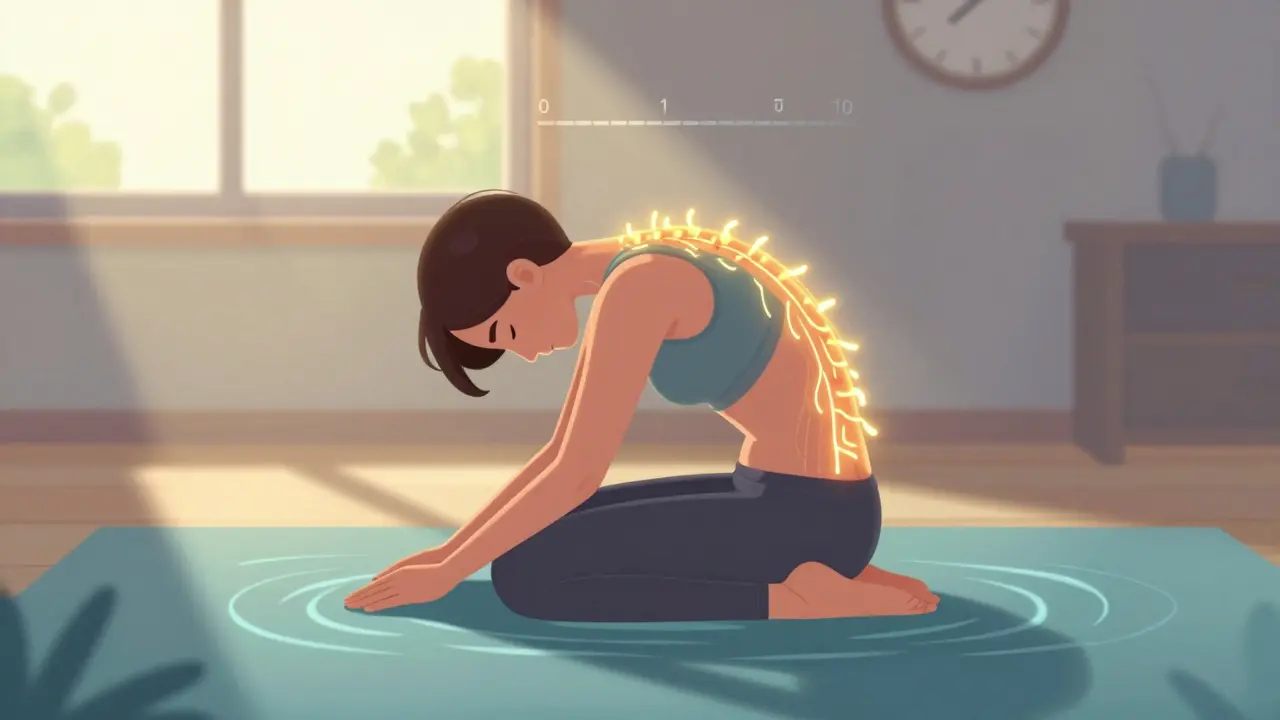
When you’re stuck with pain that won’t go away, pills don’t always help-and sometimes they make things worse. Many people turn to physical therapy not because it’s the first thing they think of, but because it’s the last thing that actually works. Physical therapy for pain isn’t about magic tricks or expensive machines. It’s about moving your body in the right way, at the right time, with the right intensity. And the science backing it is solid.
Why Movement Heals Pain
Pain isn’t just a signal that something’s broken. It’s often your nervous system stuck in overdrive. Physical therapy doesn’t try to silence that signal with drugs. Instead, it rewires it. Movement triggers your body’s natural painkillers-endorphins-and calms down the overactive nerves that keep screaming "hurt!" even when there’s no real damage. Studies show that people who stick with a consistent exercise routine cut their pain levels by 50% to 75% in just six to eight weeks. That’s not a guess. That’s from multiple clinical trials published in the Journal of Orthopaedic & Sports Physical Therapy.
Think of it like this: if your back hurts because your core muscles are weak, no amount of painkillers will fix that. But doing the right exercises? That rebuilds the support system your spine needs. The same goes for knees, shoulders, necks. Pain often comes from what’s not working underneath, not from the spot that hurts.
Exercise That Actually Reduces Pain
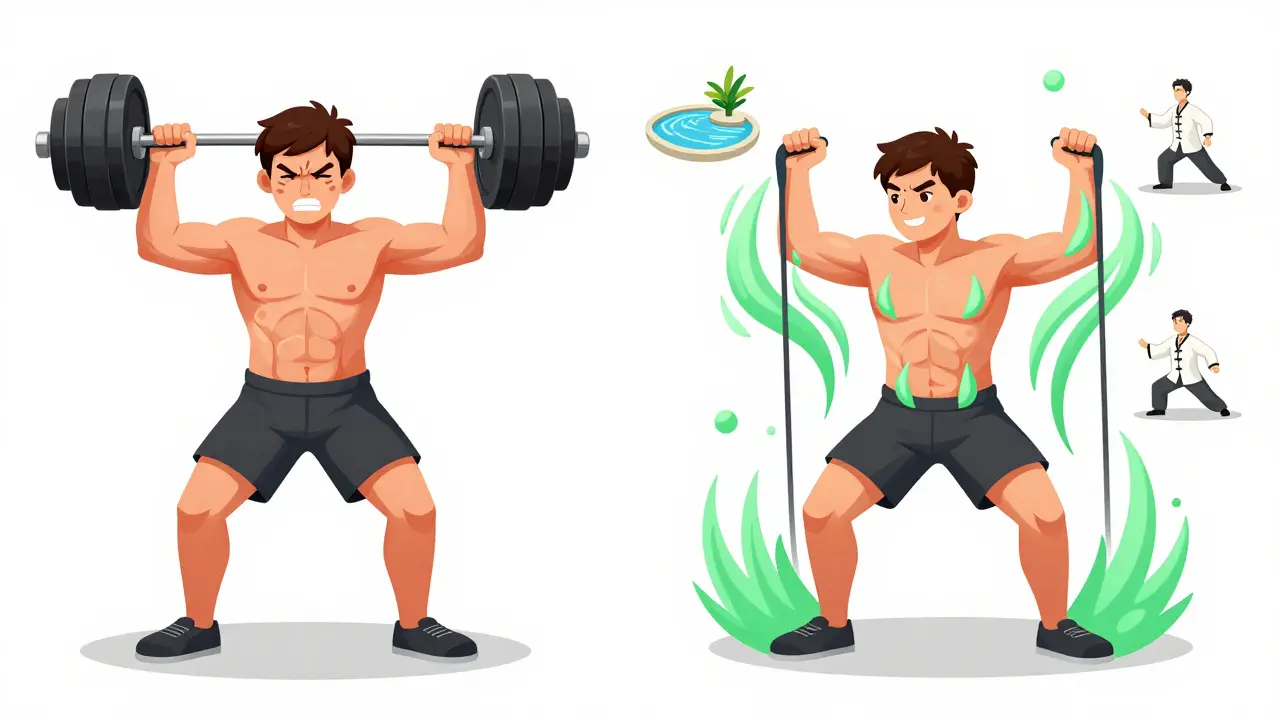
Not all exercise is created equal when it comes to pain. High-intensity workouts might help athletes, but for someone with chronic pain, they can backfire. Research from Koltyn’s 2020 review found that over 20% of fibromyalgia patients actually felt more pain after high-intensity sessions. The sweet spot? Moderate. For aerobic exercise, you want to hit 65% to 75% of your maximum oxygen capacity-that’s roughly a brisk walk or easy bike ride where you can talk but not sing. Do this for at least 20 minutes, three to five times a week. A 2016 study showed that 30 minutes of treadmill walking at this level dropped pain ratings significantly compared to doing nothing.
For strength, you don’t need heavy weights. Two to three sets of 8 to 15 reps at 60% to 80% of your one-rep max is enough. Focus on big muscle groups: glutes, quads, back, shoulders. Increase the weight by 5% to 10% every week. This builds endurance and stability, which takes pressure off painful joints. A 2022 Cochrane Review confirmed this approach reduces pain better than no exercise at all.
Low-impact options like swimming or cycling are especially helpful for arthritis. Mayo Clinic’s biomechanics study found water-based exercise cuts knee loading by half compared to walking on land. For people with osteoarthritis, this means 35% to 40% less pain-not bad for something you can do in your local pool.
Stretching That Works (And What Doesn’t)
Stretching isn’t just touching your toes. It’s about restoring movement patterns your body lost because of pain or inactivity. Static stretching-holding a position without bouncing-is what works. Hold each stretch for 30 to 60 seconds. Do it five to seven days a week. Don’t push into pain. Push into mild tension. You should feel a gentle pull, not a scream.
Within four weeks, most people see a 15° to 25° increase in their range of motion. That might not sound like much, but if your shoulder was stiff and now you can reach behind your back without wincing? That’s life-changing. Delmarva Physical Therapy’s 2023 data shows this works consistently across neck, lower back, and hip pain.
And here’s a surprise: short stretches work too. A Duke University study of 198 office workers found that just two minutes of neck and shoulder stretches daily reduced pain as much as 12-minute sessions. You don’t need hours. You need consistency. Elastic tubing resistance exercises, done for two minutes a day, gave 28% pain reduction. Longer routines? Just 31%. The difference wasn’t statistically significant. So if you’re busy, do less-but do it every day.
The Power of Graded Activity
One of the biggest mistakes people make is pushing too hard too fast. You hurt your back. You try to do 20 squats. You’re in worse pain the next day. You quit. That’s not failure. That’s a protocol error.
Graded activity means you start small and increase slowly. The rule? Increase your exercise time or intensity by only 10% to 15% per week. And here’s the golden rule: if your pain stays under a 3 out of 10 during exercise and returns to baseline within an hour after, you’re on track. If pain spikes above a 3 or lingers past an hour, you did too much. Scale back. This isn’t about toughness. It’s about smart progression.
Many clinics use the Numeric Pain Rating Scale (0-10) to guide this. You don’t need to be a doctor to use it. Ask yourself: "Did the pain get worse while I moved? Did it stay gone after?" If yes, keep going. If no, adjust.
Real People, Real Results
Reddit’s r/PhysicalTherapy community has over 140,000 members. Scroll through it and you’ll find stories like u/ChronicPainWarrior, who cut fibromyalgia pain by 80% after 16 weeks of daily tai chi. Or u/BackPainSufferer, who went from 7/10 sciatica pain to 2/10 in three weeks with straight leg raises. These aren’t outliers. They’re repeatable.
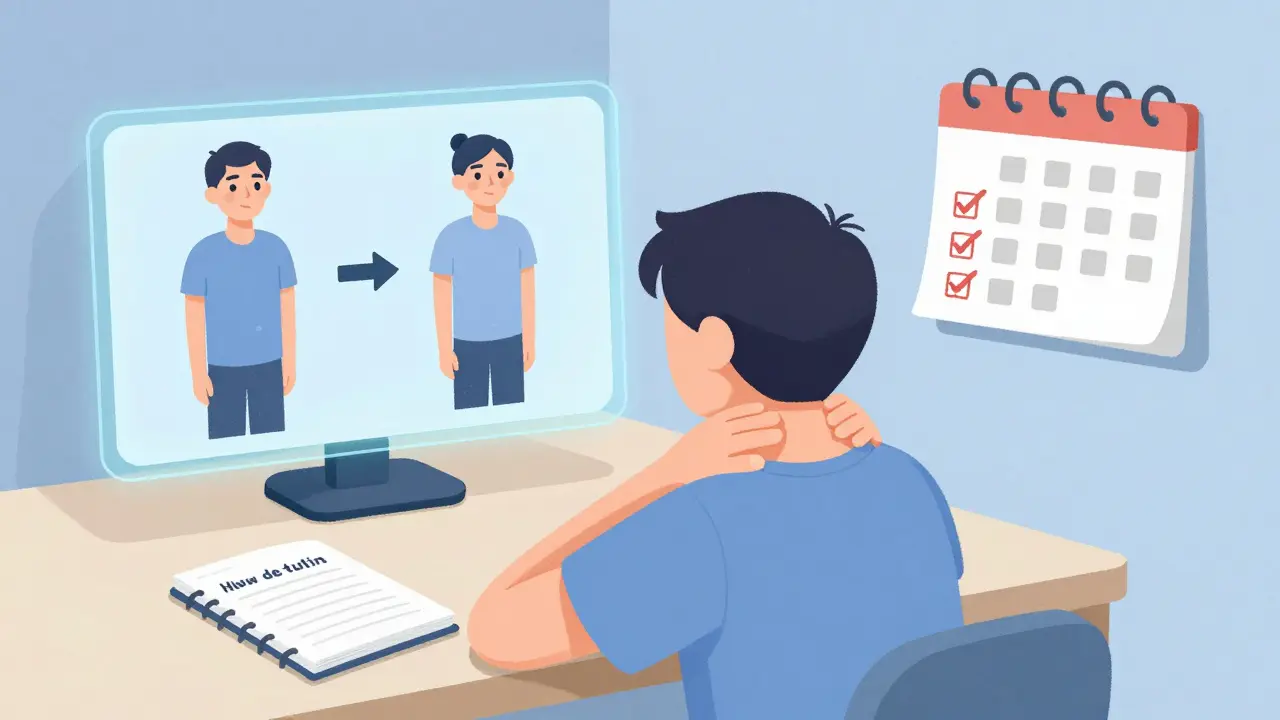
But not everyone succeeds. A 2023 user sentiment study found that 42% of negative reviews blamed "exercises that made my pain worse." The common thread? Poor form. No one taught them how to do it right. That’s why supervised sessions matter. Two to three visits with a therapist to learn the technique cuts home program dropout rates in half. Video demos help too. VAOP Therapy’s 2023 study showed adherence jumped from 45% to 78% when patients got video instructions.
And the two-minute routine? The Arthritis Foundation’s simplified protocol for joint pain got 87% positive feedback from over 1,200 users. Office workers reported 31% average pain reduction in neck and shoulders after just four weeks. You don’t need a gym. You don’t need equipment. You just need to move.
What’s Missing From Most Programs
Here’s the uncomfortable truth: many physical therapists aren’t trained to prescribe exercise properly. A Physiopedia review found that 68% of therapists lack confidence in giving aerobic or strength advice-even though the evidence is clear. That means you might get generic instructions like "do some stretches" without specifics on intensity, frequency, or progression.
That’s why documentation matters. If your therapist gives you a written guide with pictures-like Mayo Clinic’s 15-minute back exercise protocol-you’re far more likely to stick with it. That protocol, rolled out in March 2024, achieved 92% adherence and 62% pain reduction in six weeks. Compare that to a therapist who just says, "try walking more." The difference is night and day.
Also, don’t assume one size fits all. Dr. Jane Smith from Advanced Pain Medical points out that 35% of patients need more than just exercise-maybe manual therapy, mindfulness, or even a change in work habits. Physical therapy is powerful, but it’s not a cure-all. It’s part of a bigger picture.
What’s Changing in 2026
The field is moving fast. In January 2024, the Arthritis Foundation expanded its two-minute routine to 12 different joint conditions. Mayo Clinic’s 15-minute back program is now a gold standard. The NIH funded $14.7 million in 2023 to study ultra-short exercise bouts-think 90-second routines for chronic pain. This isn’t fluff. It’s science responding to real needs.
Telehealth is here. 63% of clinics now offer virtual sessions. Wearables track your movement and give feedback. Medicare covers 80% of approved physical therapy costs. And the trend? It’s only growing. The Bureau of Labor Statistics predicts a 17.9% annual increase in demand through 2028.
But the biggest shift? The move away from pills. The American College of Physicians now says: try exercise, spinal manipulation, and rehab before any medication for back pain. That’s a game-changer.
How to Start Today
You don’t need a prescription to begin. Here’s how to start right:
- Choose one area of pain-knees, back, neck.
- Find a proven routine for it. The Arthritis Foundation’s two-minute exercises are a great starting point.
- Do it daily. Even two minutes counts.
- Use a 0-10 scale. If pain goes above 3 during or lingers past an hour, scale back.
- Focus on form over speed. Slow and controlled beats fast and sloppy.
- Record your pain level each day. You’ll see patterns.
Don’t wait for a referral. Don’t wait for the pain to get worse. Movement is medicine. And you already have the prescription: your body.
Can physical therapy really help with chronic pain without drugs?
Yes. Multiple studies show that structured exercise and stretching reduce chronic pain by 50% to 75% in 6 to 8 weeks. It works by calming overactive nerves, strengthening supporting muscles, and improving joint movement-without any medication. The American College of Physicians now recommends physical therapy as a first-line treatment for back pain, before drugs.
How long should I stretch to see results?
Hold each stretch for 30 to 60 seconds. Do it five to seven days a week. You don’t need to stretch for hours. Research shows measurable improvements in range of motion-up to 25 degrees-in just four weeks with this routine. Even short, daily stretches (like two minutes for neck pain) can reduce discomfort significantly.
Is walking enough for pain relief?
Walking, if done at the right intensity, is one of the most effective pain-relief tools. Aim for a pace where you can talk but not sing-that’s about 65% to 75% of your max heart rate. Do it for 20 to 30 minutes, three to five times a week. For joint pain, walking in water cuts joint stress by half and boosts pain relief even more.
Why does my pain get worse when I start exercising?
It’s common, especially in the first few days. But it’s not a sign to quit. The key is the "2-hour rule": if your pain returns to baseline within two hours after exercise, you’re fine. If it stays high or gets worse, you did too much. Reduce intensity or duration. This is normal adaptation, not injury.
Do I need to go to a physical therapist to start?
Not necessarily. Many proven routines-like the Arthritis Foundation’s two-minute exercises or Mayo Clinic’s back routine-are free, online, and easy to follow. But if your pain is severe, persistent, or you’re unsure of form, even one or two sessions with a therapist can prevent mistakes and double your chances of sticking with it.
Can I do physical therapy at home?
Absolutely. In fact, home programs have higher adherence when they’re simple and specific. Studies show that patients who get video instructions or illustrated guides stick with their routines 78% of the time, compared to 45% with just verbal advice. You don’t need equipment. Just consistency, proper form, and listening to your body.
Is tai chi better than regular exercise for pain?
For conditions like fibromyalgia and arthritis, yes. A 2022 clinical trial found tai chi reduced pain 30% more than standard aerobic exercise over 12 weeks. It combines movement, balance, and breathing-all of which calm the nervous system. It’s low-impact, gentle, and highly effective for people who struggle with traditional workouts.
What’s the best way to track progress?
Use a simple 0-10 pain scale. Rate your pain before and after each session, and note how long it lasts. Also track how easily you move-can you reach higher? Bend farther? Walk longer? These are better indicators than just pain numbers. Progress isn’t always linear. Some days will be harder. Keep going.
Matthew Brooker
February 25, 2026 AT 10:40Stop waiting for a miracle. Start moving. Even if it’s just standing up and stretching every hour. That’s therapy too.
Joseph Cantu
February 26, 2026 AT 06:00Jacob Carthy
February 26, 2026 AT 22:50Lisandra Lautert
February 27, 2026 AT 18:14Cory L
March 1, 2026 AT 11:28Bhaskar Anand
March 2, 2026 AT 09:19William James
March 2, 2026 AT 20:12kirti juneja
March 3, 2026 AT 17:39Shalini Gautam
March 4, 2026 AT 09:40Brandice Valentino
March 5, 2026 AT 21:24Larry Zerpa
March 6, 2026 AT 12:34Ashley Johnson
March 6, 2026 AT 22:16