
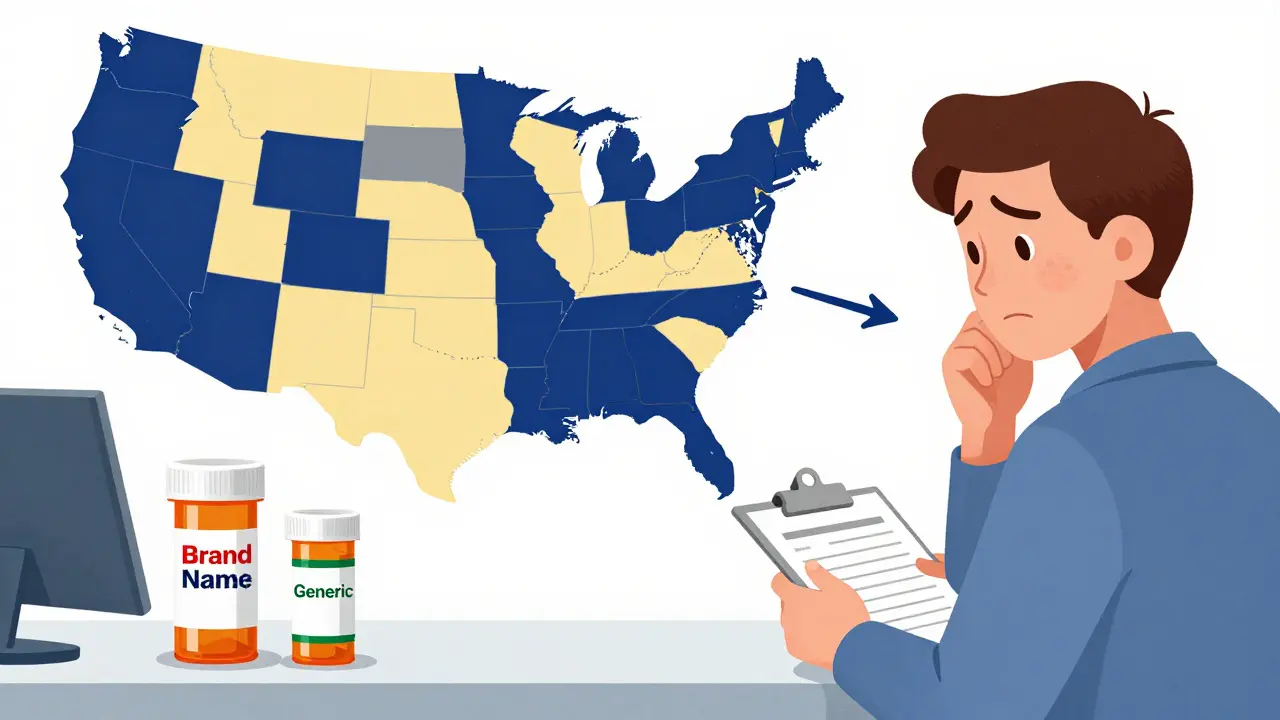
When you pick up a prescription, do you know whether your pharmacist swapped your brand-name drug for a cheaper generic? In some states, they have to. In others, they can, but only if you say yes. This isn’t just a pharmacy quirk-it’s a patchwork of state laws that directly affects how much you pay, whether you take your medicine, and even how well it works.
At its core, substitution law answers one simple question: Can a pharmacist give you a generic version of a drug instead of the brand-name version your doctor prescribed? The answer isn’t the same across the U.S. Some states force pharmacists to substitute generics whenever possible. Others let pharmacists decide, but only if the patient agrees. These differences aren’t minor. They change how millions of people get their meds-and how much the system spends doing it.
What’s the Difference Between Mandatory and Permissive Substitution?
Mandatory substitution means the pharmacist must switch to a generic drug if it’s available and approved by the FDA. The only way to stop it is if the doctor writes "Dispense as Written" or "Brand Medically Necessary" on the prescription. No exceptions. No asking the patient. Just swap it.
Permissive substitution is the opposite. The pharmacist can swap, but they don’t have to. And in many cases, they can’t even do it without your explicit consent. You might get asked: "Do you want the generic?" If you say no, they have to give you the brand name-even if it costs three times as much.
This isn’t just about preference. It’s about control. In mandatory states, the system pushes toward cheaper drugs by default. In permissive states, the default is the more expensive brand name unless someone actively changes it.
Which States Require Substitution? Which Allow It?
As of 2020, 19 states and Washington, D.C., have mandatory substitution laws. That includes Alabama, Alaska, Arizona, Arkansas, Colorado, Connecticut, Delaware, Idaho, Indiana, Kentucky, Louisiana, Maine, Maryland, Massachusetts, Mississippi, Montana, New Hampshire, North Dakota, and West Virginia.
The rest? They’re permissive. But even among permissive states, rules vary. Some require the pharmacist to ask you before switching. Others require written consent. A few don’t require any notice at all.
Why does this matter? Look at the numbers. A study in JAMA Internal Medicine found that in states with mandatory substitution, 48.7% of prescriptions for simvastatin (a cholesterol drug) were filled with the generic version within six months of its release. In permissive states? Only 30%. That’s nearly a 20-point gap.
And it gets sharper. States that required patient consent had just 32.1% generic use. States that didn’t require consent? 98.1%. One simple rule change-asking for permission-drove generic use down by two-thirds.
How Do Pharmacists Know What to Do?
Most states rely on the FDA’s Orange Book, which lists drugs that are therapeutically equivalent. If a generic is in the Orange Book, it’s considered safe to swap. But some states go further. A few use positive formularies-lists of drugs that must be substituted. Others use negative formularies-drugs that can’t be swapped, like certain seizure or thyroid meds.
Prescription format matters too. In some states, doctors use two-line prescription pads: one line for the brand name, another for the generic. If the doctor signs the generic line, substitution is automatic. In states without this system, doctors have to write phrases like "Do Not Substitute" or "Brand Medically Necessary" to block the swap.
Pharmacists in mandatory states don’t have time to ask questions. They’re trained to assume substitution is the rule, not the exception. In permissive states, they’re trained to pause, ask, and document consent. That adds time-and cost-to every prescription.
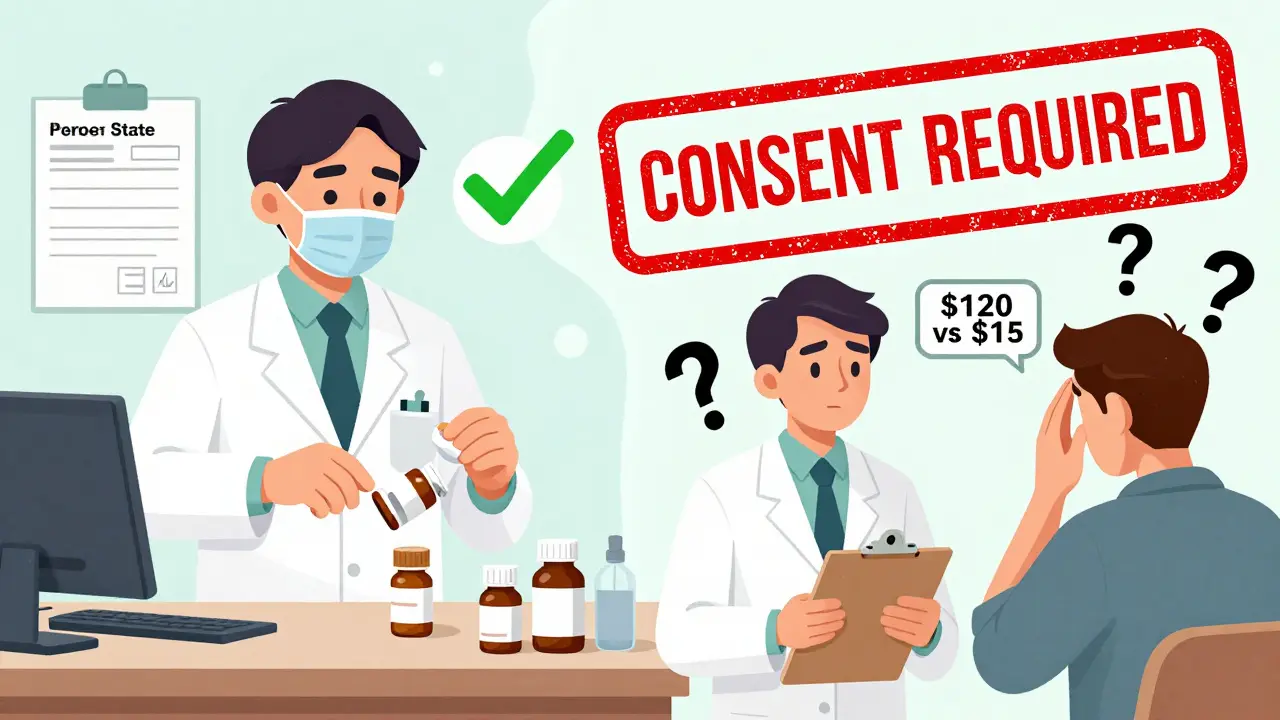
Why Do Patient Consent Rules Matter So Much?
It’s counterintuitive. You’d think asking patients if they want a cheaper drug would help. But the data says otherwise.
When pharmacists have to ask for consent, many patients say no-not because they don’t understand generics, but because they’re confused. They think the generic is weaker. Or they remember a bad experience years ago. Or they just don’t want to think about it.
One study found pharmacists in mandatory states with consent rules were nearly twice as likely to avoid substituting for drugs with a narrow therapeutic index-like warfarin or levothyroxine-than pharmacists in mandatory states without consent rules. Why? Because they feared liability. If a patient had a bad reaction, they’d be blamed for not asking.
That’s the hidden cost of consent: it doesn’t empower patients. It paralyzes pharmacists.
What About Biosimilars? It’s Even Worse
Biosimilars-generic versions of complex biologic drugs like Humira or Enbrel-are the next frontier. But the rules are even stricter.
Forty-five states have tougher rules for biosimilars than for regular generics. Most require the doctor to be notified before substitution. Some require written consent. A few ban substitution entirely unless the drug is labeled as "interchangeable" by the FDA.
That’s a problem. Biologics cost tens of thousands of dollars a year. Biosimilars can cut that cost by 15-30%. But if pharmacists can’t swap them without jumping through hoops, patients won’t get the savings. And insurers won’t push for them.
Only nine states and D.C. treat biosimilars the same way they treat regular generics. That means in most places, patients are stuck paying brand prices-even when cheaper, equally safe alternatives exist.
Who Pays the Price?
The financial impact is huge. Generic drugs cost 80-85% less than brand names. A 1% increase in generic use saves Medicare Part D $160 million a year. Multiply that by Medicaid and private insurers, and you’re talking billions.
States with mandatory substitution save more. But they also see better adherence. When patients pay less, they’re more likely to keep taking their meds. A 2011 study showed patients in mandatory substitution states filled 18% more prescriptions for chronic conditions than those in permissive states.
Meanwhile, brand-name drug companies spend millions lobbying in permissive states to keep consent rules strong. They know: if patients don’t have to say yes, they won’t get the brand.
What’s Changing? What’s Next?
The number of mandatory substitution states has grown-from 14 in 2014 to 19 in 2020. That trend is likely to continue. More states are realizing: if you want to cut costs and improve care, you need to make generics the default.
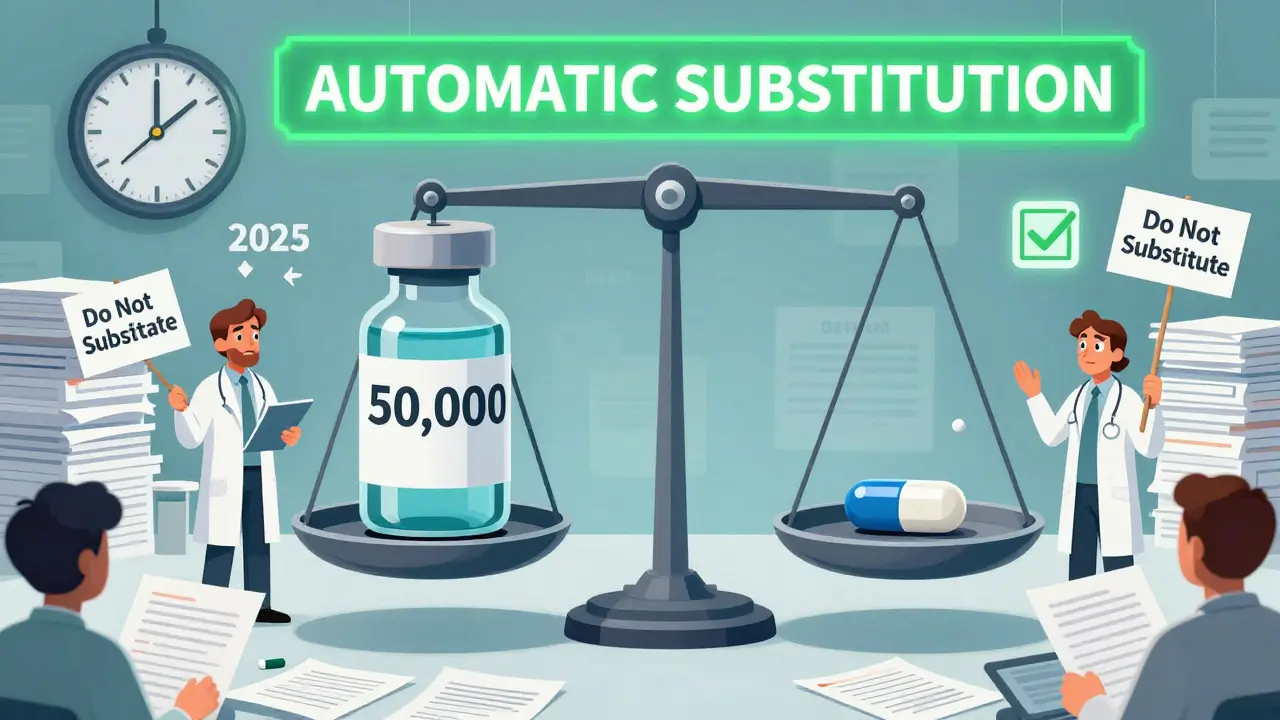
But the rise of biosimilars is forcing a rethink. Can we apply the same rules to a $50,000 biologic as we do to a $10 cholesterol pill? Maybe not. But the current patchwork of rules isn’t working. Pharmacists are confused. Doctors are frustrated. Patients are paying more than they should.
The future? More states will likely adopt mandatory substitution for small-molecule generics-without consent. For biosimilars, we may see a middle ground: automatic substitution with a one-time patient education session, not a signature.
One thing’s clear: the system isn’t broken. It’s just outdated. And it’s costing Americans billions.
Can my pharmacist substitute my prescription without telling me?
In mandatory substitution states, yes-unless your doctor wrote "Dispense as Written." In permissive states, it depends. Some states require the pharmacist to notify you, others require your consent, and a few allow substitution with no notice at all. Check your state’s pharmacy board rules to know for sure.
Why do some drugs have "Do Not Substitute" on the prescription?
Doctors add this for drugs with a narrow therapeutic index-like warfarin, levothyroxine, or seizure medications-where even small changes in dosage can cause serious side effects. While generics are usually safe, some doctors prefer to avoid any risk. In mandatory states, this notation overrides the substitution law.
Are generic drugs really as good as brand-name drugs?
Yes. The FDA requires generics to have the same active ingredient, strength, dosage form, and route of administration as the brand. They must also prove they’re absorbed in the body at the same rate and to the same extent. The only differences are inactive ingredients like fillers or dyes-which rarely affect how the drug works.
Can I refuse a generic substitution if I want the brand name?
Yes, in every state. Even in mandatory substitution states, if you ask for the brand, the pharmacist must give it to you. You may have to pay the full price out of pocket, though, if your insurance doesn’t cover the brand when a generic is available.
Do these laws apply to online pharmacies too?
Yes. Online pharmacies must follow the laws of the state where the prescription is filled, not where you live. So if you order from a pharmacy in a mandatory substitution state, they’ll swap your drug even if your home state is permissive. Always check where your pharmacy is licensed.
Why do some states require two-line prescription pads?
It’s a visual shortcut. One line is for the brand name, the other for the generic. If the doctor signs the generic line, substitution is automatic. It’s designed to make substitution easier in mandatory states and reduce confusion. States without this system rely on written phrases like "Do Not Substitute," which can be misinterpreted or missed.
tynece roberts
March 15, 2026 AT 01:39so like… i just found out my pharmacist swaps my meds without telling me and i didnt even know that was a thing?? 🤯
im in cali (permissive state) and they always ask me now, but i just assumed it was standard everywhere. turns out nope. some states just flip the switch and go for it. kinda wild how much this affects my bill and whether i actually refill.
also, why do i feel like i’m being ‘managed’ by the system? like, am i supposed to be a passive participant in my own healthcare? i mean, i get cost savings, but… i also just want to know what’s in my body. not a game of russian roulette with pills.
Hugh Breen
March 16, 2026 AT 13:23OH MY GOD THIS IS A GAME CHANGER 🙌
im from the UK and we’ve had generic substitution for DECADES. it’s just… normal. like, we don’t even talk about it. it’s not a ‘debate’ - it’s public health. why are we making people CHOOSE between their wallet and their health??
and biosimilars?? bro, if we can make a $50k drug $35k, why are we still playing 2003-era consent games??
pharmacists should be empowered, not terrified. patients should be informed, not interrogated.
STOP THE MADNESS. 🇬🇧❤️🇺🇸
Byron Boror
March 18, 2026 AT 11:26mandatory substitution is the only way. period. end of story.
these permissive states are just letting Big Pharma pull the wool over people’s eyes. ‘oh, you want cheaper? nope, here’s the brand - it’s better!’
lol no. the FDA says they’re the same. your doctor says they’re the same. your insurance company says they’re the same.
so why are we letting fear, misinformation, and corporate lobbying dictate your medicine? it’s not freedom - it’s exploitation.
if you’re too lazy to learn what a generic is, that’s not a reason to pay 5x more. get with the program. this isn’t 1998.
Lorna Brown
March 18, 2026 AT 12:40this is such a profound ethical puzzle.
on one hand, autonomy - the right to know and choose what goes into your body.
on the other, efficiency - the moral imperative to reduce waste, cost, and prevent non-adherence due to price.
the data shows consent requirements don’t empower - they paralyze. but the emotional weight of ‘choice’ is real.
what if the solution isn’t binary? what if we design a system that defaults to substitution, but offers a one-time, clear, non-transactional education session - like a 90-second video from the pharmacist explaining equivalence, side effects, and cost? no signature. no delay. just clarity.
maybe that’s the middle ground we’re missing.
Rex Regum
March 19, 2026 AT 23:36you people are so naive.
mandatory substitution? that’s socialist healthcare creeping in under the guise of ‘savings.’
who says we have to cut costs? why not let the market work? if people want the brand, they should PAY FOR IT.
and don’t get me started on biosimilars - those are ‘not real drugs’ anyway. just ask any real doctor. they’re lab experiments with a fancy label.
if you’re okay with your life being controlled by a pharmacist who thinks he’s a doctor, go ahead. i’ll stick with my brand-name pills. i earned this privilege.
stop pretending government knows better than patients. it doesn’t. it just wants to save money.
Kelsey Vonk
March 20, 2026 AT 15:47im just sitting here thinking about how much energy it takes to navigate this system.
like… i have to remember which state i’m in, which pharmacy i’m using, what my doctor wrote, whether i said yes last time, and if i’m even allowed to ask for a generic now.
it’s exhausting. and it’s not even about the money - it’s about the mental load.
why can’t it be simple? generic by default, brand if you ask. no forms. no consent. no confusion.
also… i cried a little reading that 98% substitution rate when no consent was needed. that’s beautiful. and sad.
we’re so close to getting it right. why are we still stuck?
Emma Nicolls
March 21, 2026 AT 11:27so i just checked my state rules and turns out we dont even need to tell you before swapping??
that feels wild honestly
like i get the savings but also… i just want to know what im taking
no one ever explained this to me
and now i feel like my pharmacist has been making decisions for me without asking
im gonna call them tomorrow and ask if they ever told me
also… i love generics but i also had a bad reaction once so im kinda scared now
why is this so complicated??
just make it simple pls
Jimmy V
March 21, 2026 AT 19:47look. here’s the real issue.
pharmacists are trained to be gatekeepers, not advocates. in mandatory states, they’re efficient. in permissive states, they’re terrified.
why? because liability. because fear. because no one told them generics are safe.
the fix isn’t more rules - it’s better education. train pharmacists to explain equivalence like they’re talking to a friend. not a lawyer.
also - biosimilars? same thing. if the FDA says it’s interchangeable, it’s interchangeable. stop treating them like alien tech.
we’re losing billions because we’re scared to be clear.
stop overcomplicating. just say: ‘this is the same drug. cheaper. same results.’
that’s all people need.