
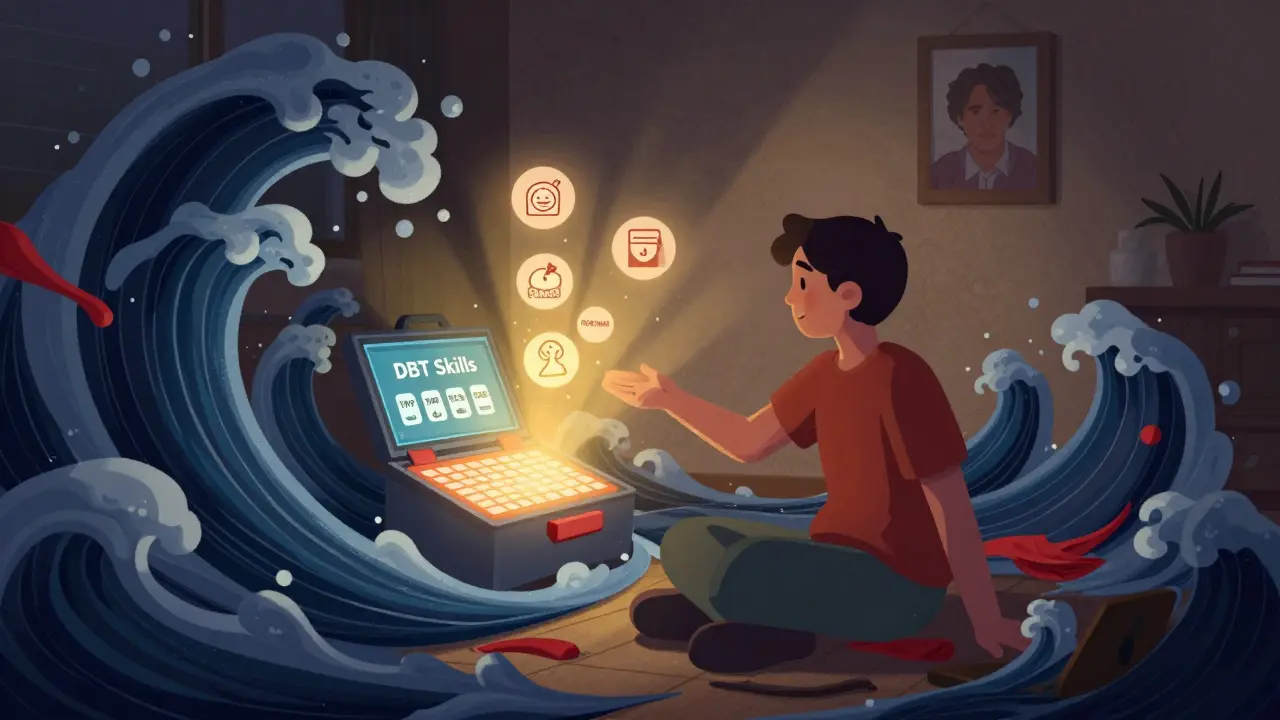
When you live with Borderline Personality Disorder (BPD), emotions don’t just come and go-they crash over you like a wave with no shore. One moment you’re fine, the next, you’re overwhelmed, angry, terrified, or convinced everyone has abandoned you. These feelings aren’t exaggerated. They’re real, intense, and often lead to impulsive actions: self-harm, lashing out, or shutting down completely. For years, therapy focused on understanding why these feelings happened. But for many people with BPD, understanding didn’t stop the pain. What was needed wasn’t just insight-it was skills.
What Is DBT, and Why Does It Work?
Dialectical Behavior Therapy, or DBT, was created in the late 1980s by Dr. Marsha Linehan. She noticed that traditional therapy often made people with BPD feel worse-like their emotions were wrong, or they were broken. So she built something different: a treatment that says, your feelings make sense, but here’s how to handle them without destroying yourself or your relationships.
DBT isn’t just one thing. It’s a full system. It combines talk therapy with structured skill-building. Studies show it cuts self-harm by 46% compared to standard care. It reduces suicide attempts by half in the first year. And it works because it doesn’t ask you to change how you feel. It teaches you how to survive the feeling until it passes.
The National Institute for Health and Care Excellence (NICE) has called DBT the gold standard for BPD treatment since 2009. The American Psychological Association gives it its highest rating: Level 1-strong research support. That’s rare. Most therapies don’t get this level of validation.
The Four Core Skill Modules
DBT breaks down emotional survival into four skill areas. Each one is designed to handle a different part of the crisis. You don’t need to master them all at once. You learn them step by step.
Mindfulness: The Foundation
Before you can change how you react, you need to notice what’s happening. Mindfulness in DBT isn’t about meditation on a cushion. It’s about noticing your thoughts, feelings, and body sensations without judgment. The goal? To get out of autopilot.
There are two parts: what you do (observe, describe, participate) and how you do it (non-judgmentally, one-mindfully, effectively). For example, instead of thinking, I’m a monster for yelling at my friend, you learn to say, I yelled. My heart was racing. I felt abandoned. That small shift changes everything. Research shows just eight weeks of mindfulness practice increases emotional regulation by 32% in people with BPD.
Distress Tolerance: Surviving the Storm
Some crises can’t be fixed right away. You can’t talk your way out of a panic attack. You can’t reason with a feeling of worthlessness that feels like a physical weight. That’s where distress tolerance comes in. It’s about getting through the moment without making things worse.
Three tools stand out:
- TIPP: Temperature (splash cold water on your face), Intense exercise (jumping jacks for 30 seconds), Paced breathing (inhale for 4, hold for 4, exhale for 6), Paired muscle relaxation (tense then release your fists, shoulders, jaw).
- ACCEPTS: Activities (watch a funny video), Contributing (text a friend who needs help), Comparisons (think of someone worse off), Emotions (watch a sad movie to cry), Pushing away (take a mental break), Thoughts (count backward from 100), Sensations (hold an ice cube).
- IMPROVE: Imagery (picture a safe place), Meaning (find a reason to keep going), Prayer (say a prayer or affirmation), Relaxation (breathe slowly), One thing in the moment (focus on your breath), Vacation (take a mental break), Encouragement (tell yourself, I’ve survived this before).
One study found that using these tools reduced emergency room visits for self-harm by 57% in the first four months. People who used TIPP reported feeling calmer within 90 seconds. It’s not magic-it’s physics. Cold water triggers the mammalian dive reflex, slowing your heart. Intense movement burns off adrenaline. Breathing resets your nervous system.
Emotion Regulation: Understanding and Changing Your Feelings
DBT doesn’t tell you to suppress emotions. It teaches you to understand them so you can respond, not react.
The PLEASE skill is simple but powerful:
- Treat Physical Illness
- Balanced Eating
- Avoid Mood-Altering Drugs
- Balanced Sleep
- Exercise
It sounds basic. But if you haven’t slept in 48 hours or skipped meals for days, your brain is running on fumes. Emotions go haywire. Fixing your body often fixes your mood. One study found that after six months of consistent PLEASE practice, emotional reactivity dropped by 40%.
Another tool is opposite action. If you feel like isolating because you’re ashamed, you reach out. If you feel like lashing out because you’re angry, you speak calmly. It’s counterintuitive-but it works. Your brain learns: acting differently changes how I feel.
Interpersonal Effectiveness: Talking Without Losing Yourself
People with BPD often feel stuck between two extremes: clinging too hard or cutting people off completely. DBT gives you tools to build relationships that last.
Three acronyms make this practical:
- DEAR MAN: Describe the situation, Express your feelings, Assert your needs, Reinforce the other person, Stay Mindful, Appear confident, Negotiate.
- GIVE: Be Gentle, Show Interest, Validate the other person, Use an Easy manner.
- FAST: Be Fair, No Apologies (for your needs), Stick to your values, Be Truthful.
A 2023 study from McLean Hospital found these skills improved relationship satisfaction by 28%. One Reddit user shared: “I used DEAR MAN to tell my partner I needed space after an argument-not to leave, but to cool down. She listened. We didn’t break up.”
Crisis Planning: Your Personal Emergency Kit
Crisis planning in DBT isn’t abstract. It’s written down. It’s specific. It’s kept where you can find it.
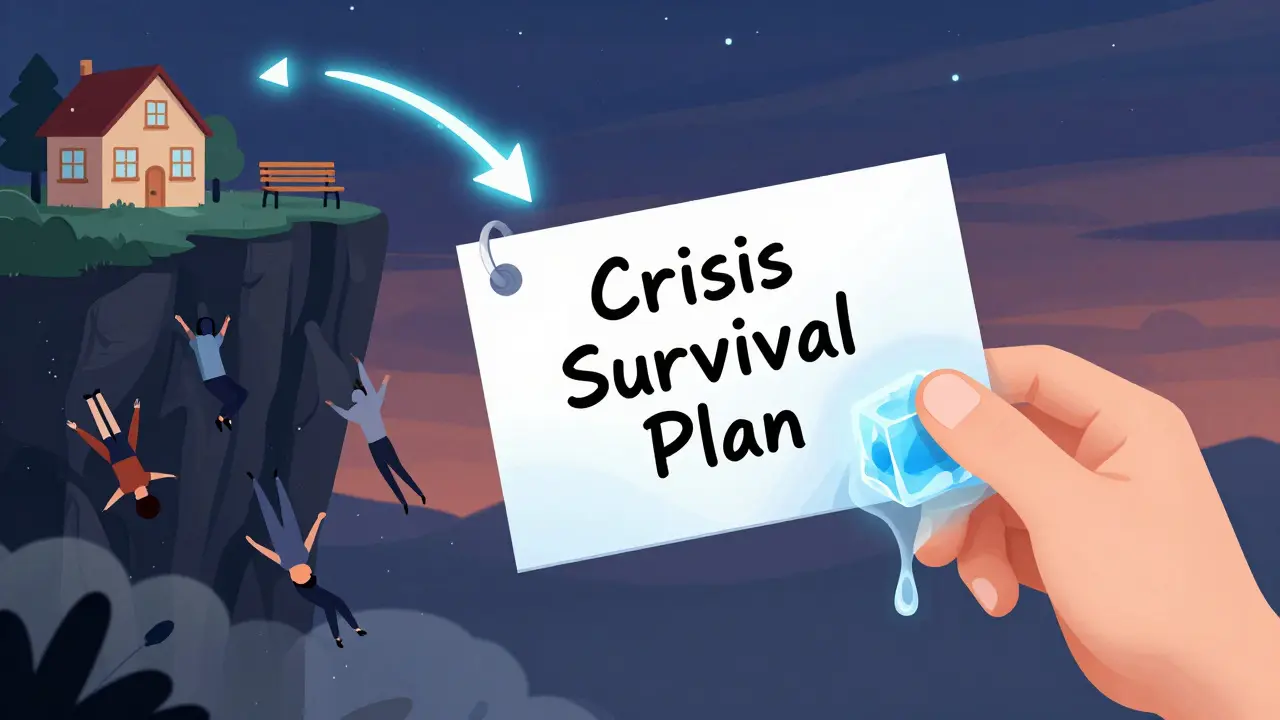
Every person in DBT builds a Crisis Survival Plan. It includes:
- Triggers (what usually leads to crisis-e.g., silence from a loved one, feeling criticized)
- Early warning signs (e.g., racing thoughts, clenched jaw, avoiding eye contact)
- Skills to use first (e.g., TIPP, then IMPROVE)
- People to call (name three, with phone numbers)
- Safe places (e.g., a friend’s house, a park, your bedroom with headphones)
- Emergency contacts (therapist, crisis line, 988)
Many people write this on index cards or save it in their phone. One woman kept hers in her wallet. She said, “When I felt like ending it, I pulled it out. I read it. I didn’t act. That was the first time in 12 years.”
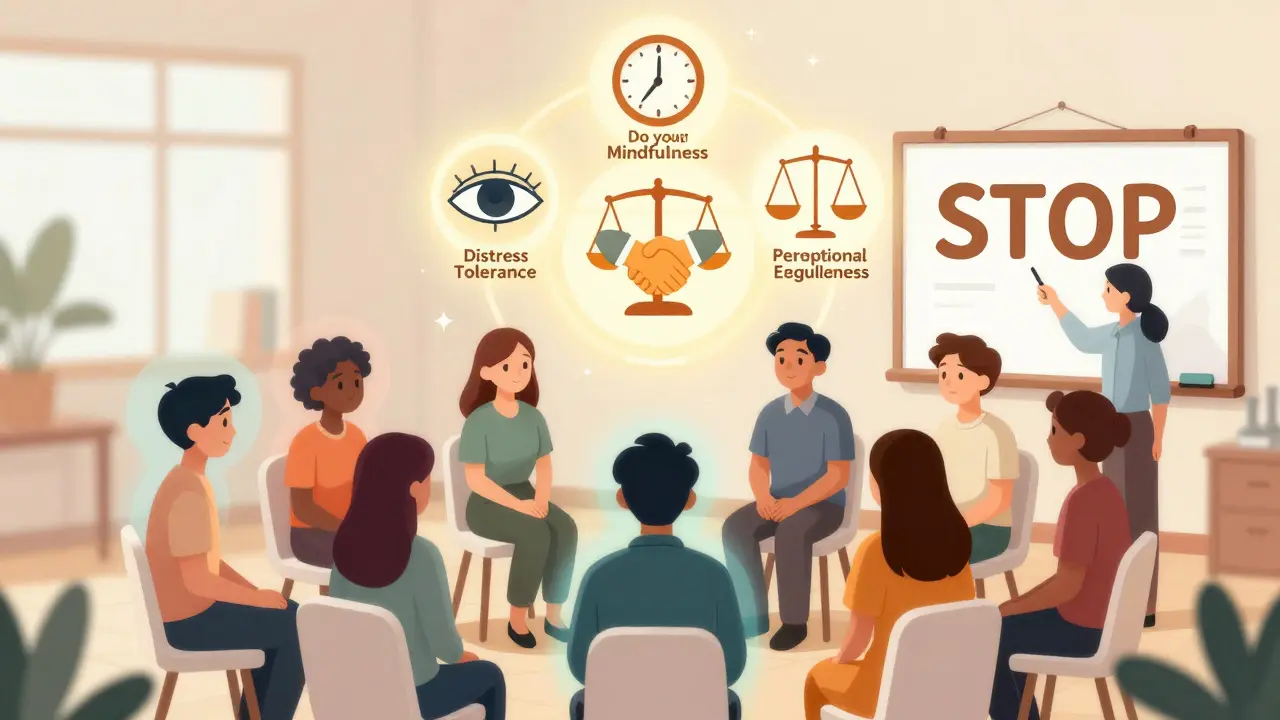
The STOP skill is used in the moment:
- Stop
- Take a step back
- Observed (your thoughts, body, surroundings)
- Proceed mindfully
It’s not about fixing the crisis. It’s about buying time. Even 30 seconds of pause can stop a spiral.
What to Expect When Starting DBT
DBT isn’t a quick fix. It’s a long-term commitment. Most programs last 6 to 12 months. You’ll attend:
- One 1-hour individual therapy session per week
- One 2-hour skills group session per week
- Access to 24/7 phone coaching (yes, you can call your therapist during a crisis)
It’s intense. In the first month, 65% of people say they feel worse before they feel better. Why? Because you’re learning to sit with feelings you’ve spent years avoiding. You’re doing homework. You’re practicing skills even when you don’t want to.
But here’s what changes: after 3 months, 78% of Reddit survey respondents said self-harm frequency dropped. After 6 months, 65% said they used TIPP or STOP during a crisis. The skills start sticking. They become automatic.
DBT vs. Other Treatments
There are other therapies for BPD. But DBT stands out.
Mentalization-Based Therapy (MBT) focuses on understanding others’ intentions. It helps, but it doesn’t give you tools for immediate crisis. Schema Therapy digs into childhood patterns. It’s deep, but slow. STEPPS is a group program that works well for symptoms but doesn’t include phone coaching.
DBT’s edge? It combines all of it. It gives you skills for the moment, tools for the week, and support when you’re falling apart. No other treatment does all four modules with this level of structure.
That said, DBT isn’t for everyone. If your main struggle is identity confusion without intense emotional swings, DBT might feel too behavioral. If you can’t commit to weekly sessions, it’s hard to stick with. But if you’ve been in crisis for years and need something that works now, DBT is the most proven path.
Real Stories, Real Results
On Reddit, someone wrote: “I used to cut myself every time I felt alone. I started DBT. I used the IMPROVE skill one night-I pictured my dog sleeping in my room. I held her stuffed animal. I didn’t cut. That was my first night sober in 10 years.”
Another said: “I used GIVE with my mom. I said, ‘I know you’re worried. I’m trying. I need you to stop yelling.’ She cried. We hugged. It was the first time in five years.”
These aren’t rare. They’re common. The data backs them up. The skills work. But only if you use them. Not when you feel like it. Not when it’s convenient. When you’re desperate.
Challenges and Barriers
DBT isn’t perfect. Finding a certified therapist is hard. As of 2023, there are only 1,842 certified DBT therapists worldwide. In rural areas, access is nearly zero. Even in cities, waitlists can be months long.
Cost is another issue. Insurance often covers 12-20 sessions per year. That’s not enough for full DBT. Some clinics offer sliding scales. Others have group-only programs. Apps like DBT Coach and Virtual Reality DBT are helping bridge the gap. One pilot study found 68% of users stuck with app-based skills-compared to 45% with paper worksheets.
And yes, the materials can feel overwhelming. The DBT Skills Workbook is 320 pages. The worksheets look like a math test. But you don’t need to do it all. Start with one skill. Practice it for a week. Then add another.
Where Do You Go From Here?
If you’re reading this because you’re struggling, you’re not alone. And you don’t have to suffer forever.
Start here:
- Download the free DBT Crisis Plan template from the Linehan Institute website.
- Write down one trigger and one skill you can use when it happens.
- Practice it once a day-even if you’re not in crisis.
- Find a DBT group near you. Many are now offered online.
- Call the 988 Suicide & Crisis Lifeline if you need support right now.
Recovery isn’t about being fixed. It’s about learning how to hold yourself when everything feels like it’s falling apart. DBT doesn’t promise happiness. It promises survival. And sometimes, that’s enough to keep going.
David L. Thomas
March 11, 2026 AT 11:00DBT is the closest thing we’ve got to a neurological reboot for BPD. The TIPP technique? Pure neurobiology. Cold water triggers the vagus nerve, slows HR, and hijacks the amygdala’s panic loop. It’s not ‘just breathing’-it’s biofeedback you can do in a bathroom stall. And the research backing this? Not anecdotal. Meta-analyses show effect sizes of d=0.8–1.2 for emotion regulation. That’s not therapy. That’s cognitive engineering.
Bridgette Pulliam
March 11, 2026 AT 14:13I’ve been in DBT for 18 months. I didn’t believe it at first. But the one thing that changed everything? Writing my crisis plan on my phone. Now when I feel the wave coming, I open it. I don’t think. I just read: ‘Call Mom. Hold ice. Breathe.’ It’s like having a version of myself who’s not in crisis giving me instructions. If you’re skeptical-try it for a week. No judgment. Just do it.
Gene Forte
March 12, 2026 AT 17:06This is the most important thing I’ve read all year. DBT isn’t about fixing yourself. It’s about learning how to be with yourself when everything feels like it’s burning down. That’s not a skill-it’s a revolution. And the fact that we now have evidence-based, structured tools to do that? That’s hope. Not vague hope. Measurable, repeatable, life-saving hope. If you’re reading this and you’re struggling-you’re not broken. You’re just waiting for the right tools. And they’re here.
Kenneth Zieden-Weber
March 14, 2026 AT 04:57So let me get this straight. You’re telling me the solution to being emotionally overwhelmed is… to hold an ice cube? And count backward? And text a friend who ‘needs help’? I mean, sure, it sounds like a self-help parody. But then I remember I did it last Tuesday. And I didn’t scream at my cat. And that’s… actually kind of a win? I’m not saying it’s magic. But maybe it’s magic for people who’ve tried everything else. And honestly? That’s enough.
Tom Bolt
March 15, 2026 AT 03:52DBT is not a cure. It’s a containment protocol. And let’s be honest-the fact that we need to teach people to ‘not cut themselves’ by using ice cubes and breathing exercises speaks volumes about how broken our mental healthcare system is. We’ve reduced emotional survival to a checklist. It’s clinical. It’s efficient. And it’s tragic. But I’ll take it over nothing.
Shourya Tanay
March 17, 2026 AT 03:28As someone from a culture where mental health is rarely discussed, DBT’s structure feels revolutionary. The emphasis on validation-‘your feelings make sense’-is radical here. In my community, emotion is weakness. DBT says: emotion is data. And data can be managed. The TIPP skill? I tried it last night. Cold shower. 15 seconds. Heart rate dropped. I didn’t text my ex. That’s progress. Small. But real.
LiV Beau
March 18, 2026 AT 18:51OMG I just used DEAR MAN with my roommate 😭 I said ‘Describe, Express, Assert’ and she actually LISTENED. We didn’t fight. We talked. I cried. She brought me tea. I didn’t think that was possible anymore. Also, I used IMPROVE and pictured my cat curled up. IT WORKED. I’m not okay, but I’m not falling apart. THANK YOU FOR THIS. 🙏💖
Adam Kleinberg
March 18, 2026 AT 19:36So let me get this straight. The gold standard treatment for BPD is a set of tricks you learn like a robot? Temperature. Exercise. Breathing. Like your emotions are a glitch in a Windows update. And the whole thing is built on a 1980s therapist’s napkin? No wonder people still die. This isn’t healing. It’s behavioral pacification. They’re teaching you to suppress, not heal. And don’t get me started on the 988 lifeline-another government distraction while the real rot festers.
Denise Jordan
March 20, 2026 AT 15:19Yeah, but did it work for anyone who actually has real trauma? Or just people who got diagnosed after watching a TikTok?
Chris Bird
March 21, 2026 AT 12:29You think this works? I’ve seen too many people try this and end up worse. They get stuck in the skills. They memorize TIPP but still feel empty. You can’t fix a soul with worksheets. This is just another way to make people feel like they’re doing something while the real pain stays buried. I’ve been there. I know.