
Every year, millions of Americans grab an OTC medicine off the shelf without reading the label. They see "Tylenol" or "Advil" and assume they know what’s inside. But here’s the truth: OTC drug facts labels aren’t just fine print-they’re your first line of defense against accidental overdose, dangerous interactions, and allergic reactions. If you’ve ever taken two pain relievers at once and felt uneasy, or wondered why your cold medicine made you drowsy, this guide will change how you use OTC meds forever.
What’s on the OTC Drug Facts Label?
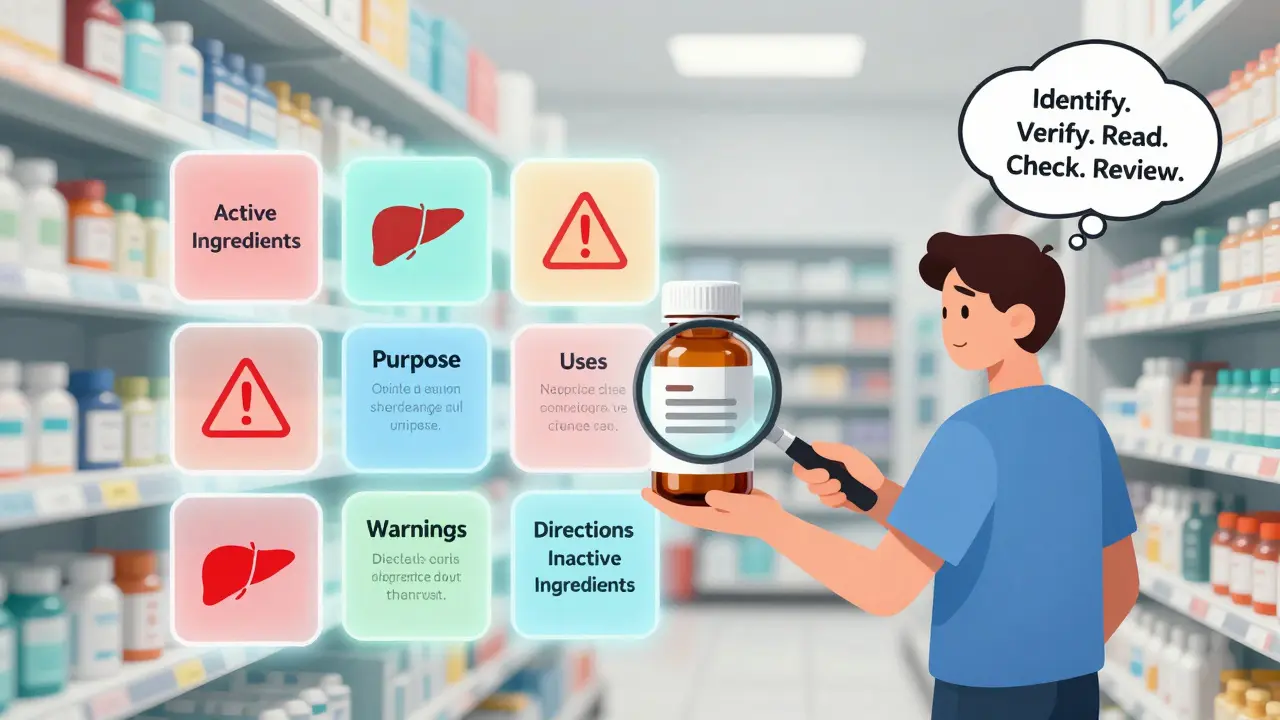
The U.S. Food and Drug Administration (FDA) made this label mandatory in 2017 after years of research showing that inconsistent packaging led to thousands of emergency room visits each year. Today, every OTC medicine sold in the U.S. must show six key sections in this exact order:
- Active Ingredients - The actual medicine in the pill or liquid.
- Purpose - What the ingredient does (e.g., "pain reliever").
- Uses - What symptoms it treats.
- Warnings - When NOT to use it, who should avoid it, and what to watch for.
- Directions - Exactly how much to take, how often, and for how long.
- Inactive Ingredients - Fillers, dyes, or preservatives that don’t treat symptoms but can cause reactions.
This isn’t marketing fluff. It’s a legal requirement. The FDA mandates font size, wording, and order. No company can change it. That means if you learn how to read it once, you’ll understand every OTC product you ever buy.
Active Ingredients: The Most Important Section
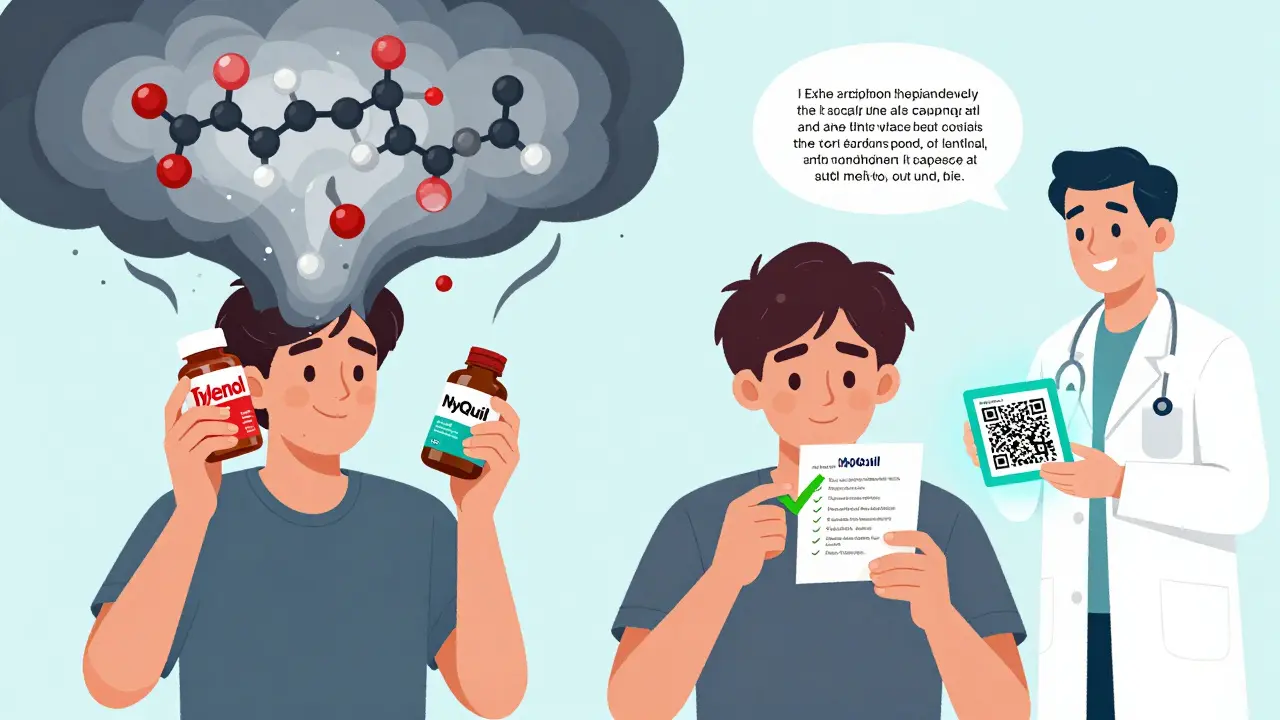
Here’s where most people get tripped up. You see "Tylenol" on the box and think, "I know what that is." But "Tylenol" is a brand. The active ingredient is acetaminophen. And acetaminophen is also in Excedrin, NyQuil, Sudafed PE, and dozens of other products.
Look at the label. It will say something like:
Active ingredient: Acetaminophen 325 mg (pain reliever/fever reducer)
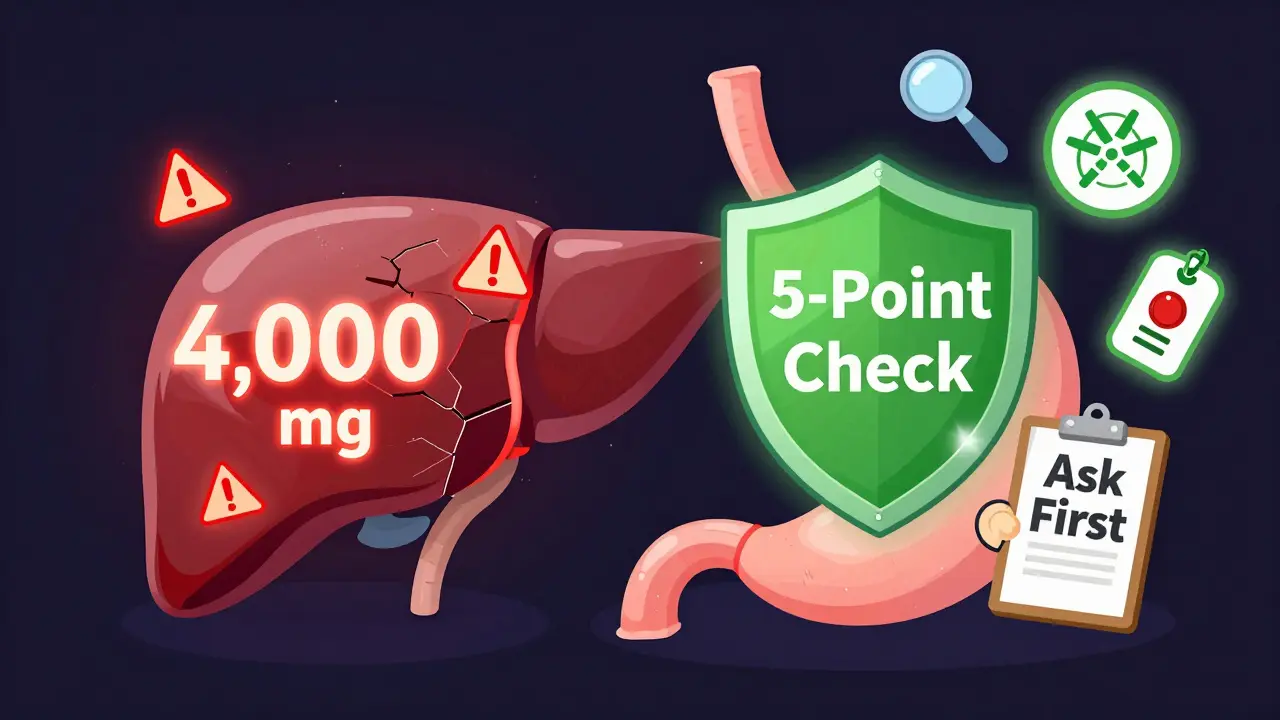
That number - 325 mg - is critical. It tells you exactly how much medicine is in each dose. If you take two different products that both contain acetaminophen, you could easily hit 1,000 mg or more in one day. The FDA says the maximum safe daily dose is 4,000 mg. But liver damage can happen at 3,000 mg if you drink alcohol regularly or have liver disease.
Studies show that 67% of people who check the active ingredient avoid accidental double-dosing. Those who don’t? They’re five times more likely to overdose.
Uses: Don’t Guess - Match It
The "Uses" section doesn’t say "relieves headaches" or "helps you sleep." It says exactly what the FDA has approved. For example:
Temporarily relieves these common cold/flu symptoms: sore throat, headache, body aches, fever, runny nose, sneezing, itching of the nose or throat
If your symptom isn’t listed, don’t take it. That cough syrup might help with runny nose and fever - but if you have a dry cough with no congestion, it won’t work. Worse, you’re exposing yourself to unnecessary chemicals.
Also, watch out for "multi-symptom" products. They combine several active ingredients. If you only have a headache, you don’t need a nasal decongestant or a cough suppressant. Taking them anyway increases your risk of side effects.
Warnings: The Section That Saves Lives
This is the most under-read part of the label - and the most important.
Here’s what you’ll find:
- Do not use if you’re allergic to any ingredient.
- Ask a doctor before use if you have liver disease, high blood pressure, heart problems, or take blood thinners.
- Liver warning for acetaminophen: "Severe liver damage may occur if you take more than 4,000 mg in 24 hours."
- Stomach bleeding warning for NSAIDs like ibuprofen: "May cause severe stomach bleeding. Risk is higher if you’re over 60, take blood thinners, or drink alcohol."
- Do not use if you’re under a certain age (e.g., "Not for children under 6").
According to the American Pharmacists Association, 89% of pharmacists say the Warnings section prevents the most serious mistakes. A 2024 CDC study found that pediatric acetaminophen overdoses dropped 43% after the standardized label was fully adopted.
And here’s something most people miss: the "Ask a doctor" line isn’t a suggestion. It’s a red flag. If you have diabetes, kidney disease, or take prescription meds, you’re not just being cautious - you’re avoiding a potentially deadly interaction.
Directions: Follow the Numbers, Not the Bottle
"Take two every four hours" sounds simple. But what if you’re 110 pounds? Or 72 years old? Or giving it to a child?
The directions must include:
- Dosage amount (e.g., "1 caplet")
- How often (e.g., "every 4 to 6 hours")
- Maximum daily limit (e.g., "Do not take more than 6 caplets in 24 hours")
- Duration limit (e.g., "Do not use for more than 10 days")
Here’s where confusion happens:
- "Per 5 mL" doesn’t mean the whole bottle. A 4-ounce bottle has 118 mL - that’s 23.6 doses. Don’t assume you have "enough" for a week.
- "Extra strength" means higher concentration. Extra strength Tylenol has 500 mg per tablet. Regular has 325 mg. Don’t treat them the same.
- "PM" versions almost always contain diphenhydramine (38 mg), an antihistamine that causes drowsiness. You might not realize you’re taking a sleep aid.
Older adults are especially vulnerable. A 2023 study found 78% of adults over 65 struggled with small print on directions. If you can’t read it, ask a pharmacist. Or use the FDA’s free "Drug Label Decoder" app - it’s been downloaded over 1.2 million times since 2023.
Inactive Ingredients: Hidden Triggers
These aren’t medicine. They’re fillers: dyes, preservatives, sugars, or starches. But for some people, they’re dangerous.
If you have:
- Gluten sensitivity - check for "wheat starch"
- Food allergies - look for "dextrose," "sucrose," or "sodium benzoate"
- Diabetes - watch for "sorbitol," "mannitol," or "sucrose"
- Vegetarian/Vegan - some capsules use gelatin from animals
One woman in Ohio had a severe reaction to a cold medicine because she didn’t realize it contained soy lecithin. She had a soy allergy but assumed "inactive" meant harmless. It wasn’t. The label listed it clearly. She just didn’t look.
The 5-Point Check: A Simple Routine
Pharmacists at CVS Health created a quick method called the "5-Point Check." It takes about 50 seconds - less time than scrolling through social media.
- Identify the active ingredient - What’s the actual medicine? Write it down if needed.
- Verify the uses - Does this match your symptom? If not, put it back.
- Read all warnings - Especially liver, stomach, and "do not use" lines.
- Check directions for age/weight - Are you taking the right dose? For kids, always use the measuring tool that came with it - never a kitchen spoon.
- Review inactive ingredients - Any allergens or sugars you need to avoid?
People who follow this method reduce medication errors by 68%, according to the BeMedWise Program. That’s not a small number. That’s life-changing.
What’s Changing in 2025?
The FDA isn’t done. In May 2024, Congress passed the OTC Drug Label Modernization Act. By the end of 2025, all OTC labels must include:
- Color-coded sections (red for warnings, green for directions)
- Standardized icons (like a liver symbol for acetaminophen risks)
- 20% larger font for active ingredient concentration
Some brands are already ahead. Johnson & Johnson and Bayer now include QR codes on packaging that link to video explanations. If you scan it, you’ll see a pharmacist walk you through the label.
These changes are designed to cut medication errors by another 25% by 2027. That could prevent 18,000 ER visits a year.
When to Call a Pharmacist
You don’t need to be a doctor to ask for help. Pharmacists are trained to explain OTC labels - and they’re paid to help you, not sell you something.
Go to Walgreens, CVS, or your local pharmacy and say: "I’m not sure how to read this label. Can you walk me through it?"
Walgreens reported a 40% increase in these kinds of consultations after launching their "Label Literacy" campaign in 2023. And it’s free. No appointment needed.
Especially if you:
- Take three or more medications daily
- Have chronic conditions like diabetes, kidney disease, or liver problems
- Are over 65
- Are giving medicine to a child or elderly parent
Don’t guess. Ask.
Final Thought: This Isn’t Just About Reading - It’s About Safety
OTC medicines are powerful. They’re not candy. They’re not harmless. A single pill can cause liver failure. A combination of two common products can lead to a stroke. And every year, people die because they didn’t take five minutes to read a label.
You don’t need to memorize every ingredient. You just need to know how to look. Use the 5-Point Check. Ask questions. Use the app. Scan the QR code. Talk to the pharmacist.
The label is there to protect you. But it only works if you read it.
What’s the difference between active and inactive ingredients?
Active ingredients are the medicines that treat your symptoms - like acetaminophen for pain or pseudoephedrine for congestion. Inactive ingredients are everything else: fillers, dyes, sugars, or preservatives that help the pill hold together or taste better. They don’t treat anything, but they can cause allergic reactions or affect people with dietary restrictions like diabetes or gluten intolerance.
Can I take two OTC medicines at once?
Sometimes - but only if you check the active ingredients. Many cold, flu, and pain medicines contain the same active ingredient, like acetaminophen or ibuprofen. Taking two products with the same ingredient can lead to overdose. For example, if you take Tylenol and NyQuil together, you’re doubling your acetaminophen dose. Always compare the active ingredients before combining products.
Why do some labels say "do not use" for people with high blood pressure?
Many OTC decongestants, like pseudoephedrine or phenylephrine, constrict blood vessels to reduce nasal swelling. But that same effect can raise blood pressure. For someone with uncontrolled hypertension, this can lead to stroke, heart attack, or dangerous spikes in pressure. The warning is there because it’s not a guess - it’s based on clinical evidence.
Is it safe to use OTC medicine past its expiration date?
The FDA says most OTC medicines remain safe and effective for years after the expiration date - but not always. Pain relievers like ibuprofen and acetaminophen usually hold up well. But liquids, eye drops, and antibiotics can degrade and become ineffective or even harmful. If the liquid is cloudy, smells strange, or the pills are cracked or discolored, throw them away. When in doubt, don’t take it.
Why do children’s medicines have different dosing than adult versions?
Children’s bodies process medicine differently. Their weight, liver function, and metabolism aren’t the same as adults’. A dose that’s safe for a 150-pound adult could be toxic for a 40-pound child. That’s why children’s labels list dosing by weight (e.g., "for 24-35 lbs: 5 mL") instead of age. Always use the dosing tool that comes with the product - never a kitchen spoon. A teaspoon varies in size and can lead to serious overdose.
Adebayo Muhammad
March 5, 2026 AT 23:08Let’s be real-OTC labels are designed to be read by people who still believe in the myth of "common sense." The FDA didn’t standardize this out of altruism; they did it because people were dying from "just one more pill." And yet, here we are, still treating medicine like a vending machine snack. You don’t need a degree to read a label-you just need to stop assuming. The active ingredient isn’t "Tylenol." It’s acetaminophen. And if you’re taking it with NyQuil? Congrats-you’re doing a liver slow roast. This isn’t paranoia. It’s arithmetic.
Pranay Roy
March 7, 2026 AT 08:54Did you know the FDA is working with Big Pharma to control what we take? The new color-coded labels? That’s not for safety-it’s to make you trust them more. They’ve been quietly replacing ingredients with cheaper synthetics since 2020. I checked the inactive list on my Advil-sodium benzoate, polysorbate 80, artificial dyes. All of them are linked to neurological disruption in peer-reviewed studies. You think they want you to read the label? No. They want you to scan the QR code and trust the video. That’s how they own your compliance.
Joe Prism
March 7, 2026 AT 18:26Read the label. It’s that simple.
Active ingredient. Uses. Warnings.
Don’t overthink it.
Don’t guess.
Just read.
Bridget Verwey
March 7, 2026 AT 22:43Oh honey. You took Tylenol AND DayQuil? And you’re surprised you felt like a zombie? Sweetie, that’s not a side effect-that’s a feature. You didn’t just double up on acetaminophen-you also added dextromethorphan, phenylephrine, and diphenhydramine. That’s not a cold remedy. That’s a pharmacological cocktail. Next time, just ask the pharmacist. They’re not there to sell you-they’re there to save you. And yes, they’ve seen this exact scenario. Like, every Tuesday.
Andrew Poulin
March 9, 2026 AT 05:24Stop overcomplicating this. The label says 325mg per pill. You take two. That’s 650mg. Maximum is 4000mg. So if you take 6 pills in 24 hours, you’re fine. Right? No. Because you’re probably also drinking wine. Or have fatty liver. Or are 65. So don’t be an idiot. Read the warnings. They’re there for people like you. Not for smart people. For you.
Vikas Verma
March 10, 2026 AT 02:36Adherence to standardized OTC labeling protocols represents a paradigm shift in pharmacovigilance. The integration of active ingredient transparency, coupled with structured dosage directives, significantly mitigates polypharmacy risks. The 5-Point Check framework is empirically validated-68% reduction in iatrogenic events per BeMedWise longitudinal cohort. Furthermore, QR-enabled contextual education enhances patient autonomy through just-in-time knowledge transfer. This is not merely regulatory compliance-it is a public health imperative.
Sean Callahan
March 11, 2026 AT 12:30i just read this and i think… like… wow. i used to take 2 advil and a nyquil and think "im fine" but now i realize i was basically doing a science experiment on my liver. i dont even know what acetaminophen is. is it like… sugar? i think i need to go to the pharmacy and ask someone. they dont judge right? i hope not. also can i get a free sample of the decoder app? thanks.
Ferdinand Aton
March 11, 2026 AT 20:40Actually, the FDA didn’t make these rules because people were overdosing. They did it because pharmaceutical companies wanted to standardize packaging so they could bundle more products together. The "5-Point Check"? That’s a marketing campaign by CVS. Real pharmacists don’t use it-they just tell you to read the damn label. Also, QR codes? That’s how they track your purchases. You think they care about your liver? Nah. They care about your data.
Jeff Mirisola
March 12, 2026 AT 05:12This is the kind of information that saves lives-and honestly, it’s beautiful that someone took the time to break it down like this. No one’s teaching this in school. No one’s talking about it at dinner. But here it is: clear, practical, and urgent. If you’ve ever taken medicine and felt weird afterward? This is your wake-up call. Don’t wait for a hospital visit to learn this. Read the label. Ask the pharmacist. Share this. We can do better. We’re already doing better. Keep going.
Ian Kiplagat
March 12, 2026 AT 19:03👏👏👏
Label literacy = life literacy.
QR codes + pharmacist = 🚀
Also, I now check inactive ingredients. Soy lecithin? Nope. Not today. 🌱