

Hypoglycemia Risk Calculator
This tool assesses your risk of hypoglycemia unawareness when taking insulin and beta-blockers based on your medical factors. Results reflect the latest clinical guidelines.
When you’re managing diabetes with insulin, your body already walks a tightrope between too high and too low blood sugar. Now add a beta-blocker - a common heart medication - and that tightrope gets even narrower. For many people, the danger isn’t obvious until it’s too late. Insulin lowers blood sugar. Beta-blockers hide the warning signs that your blood sugar is dropping. Together, they can lead to hypoglycemia unawareness - a silent, life-threatening condition where you don’t feel the warning signals until you’re already confused, fainting, or seizing.
Why You Might Not Feel Your Low Blood Sugar
Most people with diabetes learn to recognize the early signs of low blood sugar: shaking, sweating, fast heartbeat, hunger, or anxiety. These are your body’s alarms - triggered by adrenaline and other stress hormones when glucose drops below safe levels. But beta-blockers, especially non-selective ones like propranolol, block those adrenaline signals. That means your heart doesn’t race. Your hands don’t tremble. You might not feel anything at all - until your brain starts to shut down.This isn’t just theoretical. Around 40% of people with type 1 diabetes develop hypoglycemia unawareness over time, especially if they’ve had frequent low blood sugar episodes. Add a beta-blocker, and that risk spikes. The problem isn’t that beta-blockers cause low blood sugar - they don’t directly make glucose drop. They silence your body’s ability to scream for help when it does.
The One Warning Sign That Still Works
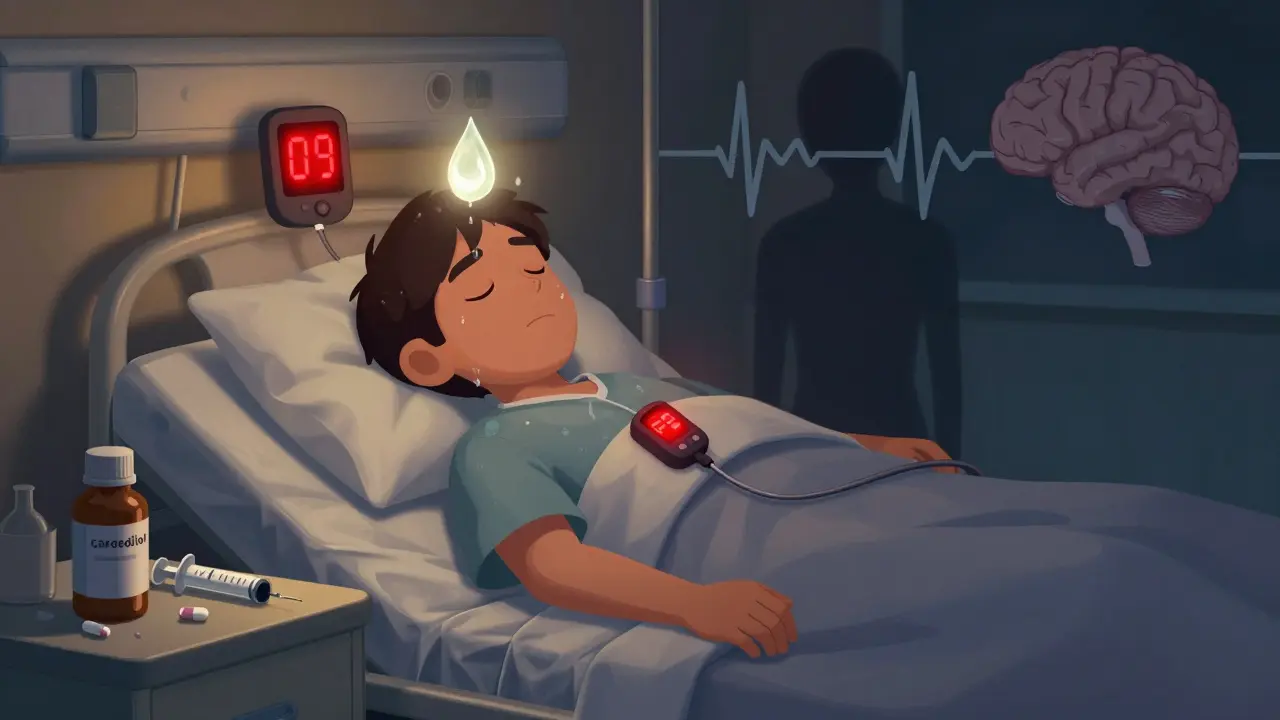
Here’s something most people don’t know: not all warning signs disappear. Sweating? That’s still there. Why? Because sweating during hypoglycemia is controlled by acetylcholine, not adrenaline. That means your sweat glands keep working even when your heart stops racing. If you’re on a beta-blocker, sweating might be your only reliable clue that your blood sugar is dropping.That’s why patient education is critical. If you’re taking insulin and a beta-blocker, you need to treat sweating - even if it’s just a light dampness on your forehead - as a red flag. Don’t wait for shaking or palpitations. They might never come. Check your blood sugar the moment you notice sweat, especially during exercise, meals, or at night.
Not All Beta-Blockers Are the Same
There’s a big difference between types of beta-blockers. Non-selective ones like propranolol block both beta-1 and beta-2 receptors. That means they shut down almost all adrenaline responses - including the liver’s ability to release stored glucose. This makes recovery from low blood sugar much harder.Cardioselective beta-blockers - like metoprolol or atenolol - mainly target the heart. They’re less likely to interfere with glucose recovery, but they still mask the warning signs. And even then, studies show they can double the risk of hypoglycemia in hospitalized patients.
Carvedilol is different. It’s not just a beta-blocker - it’s also an alpha-blocker. This extra action helps preserve some of the body’s natural glucose response. Research shows patients on carvedilol have 17% fewer severe hypoglycemic events than those on metoprolol. In fact, carvedilol is now recommended as a first-choice beta-blocker for diabetic patients who need one, especially if they’ve had low blood sugar before.
Why This Matters Most in the Hospital
The highest risk isn’t at home - it’s in the hospital. Nearly 70% of beta-blocker-related hypoglycemia events happen within the first 24 hours of admission. Why? Because hospital routines disrupt meals, stress levels change, insulin doses get adjusted, and glucose checks are often spaced too far apart.Guidelines now recommend checking blood sugar every 2 to 4 hours for diabetic patients on beta-blockers during hospitalization. That’s not optional. It’s lifesaving. If you’re admitted for heart failure, surgery, or even pneumonia, make sure your care team knows you’re on insulin and a beta-blocker. Ask for frequent checks. Don’t assume they’ll think of it.
Technology Is Changing the Game
Continuous glucose monitors (CGMs) have become essential for people on this combination. Since 2018, their use among diabetic patients on beta-blockers has tripled. Why? Because CGMs don’t rely on how you feel. They alert you when glucose drops - even if you’re asleep or in a meeting. In one major registry study, CGM use cut severe hypoglycemia events by 42% in this high-risk group.If you’re on insulin and a beta-blocker, and you don’t have a CGM, you’re playing Russian roulette with your health. Talk to your doctor about getting one. Medicare and most private insurers cover them for patients with frequent lows or those on high-risk drug combinations.

The Bigger Picture: Heart Health vs. Blood Sugar Safety
This is the toughest part. Beta-blockers save lives. After a heart attack, they reduce the chance of dying by 25%. For people with high blood pressure or heart failure, they’re often the best option. But for someone with diabetes, especially type 1, the trade-off is real.Studies like the ADVANCE trial found no long-term increase in severe hypoglycemia with beta-blockers over five years. But those studies were mostly outpatient. In hospitals - where things move fast and mistakes happen - the risk spikes. That’s why the American Heart Association says: keep the beta-blocker, but monitor like your life depends on it.
There’s no one-size-fits-all answer. Your doctor needs to weigh your heart condition against your diabetes history. If you’ve had a severe low before, or you have hypoglycemia unawareness, carvedilol is safer than metoprolol. If you’re stable on a beta-blocker and have no history of lows, you might not need to change. But you still need to check your blood sugar more often.
What You Can Do Right Now
- If you’re on insulin and a beta-blocker, check your blood sugar before meals, at bedtime, and anytime you feel off - even if it’s just a little sweaty.
- Ask your doctor if you’re on the safest beta-blocker for your situation. If you’re on propranolol or nadolol, ask if switching to carvedilol is an option.
- Get a CGM if you don’t have one. It’s not a luxury - it’s your safety net.
- Teach family members or caregivers to recognize sweating as a sign of low blood sugar. They might notice it before you do.
- Wear a medical ID bracelet that says “Diabetes + Beta-Blocker - May Not Feel Low Blood Sugar.”
There’s no magic pill to fix this. But awareness, better monitoring, and smarter drug choices can turn a dangerous interaction into a manageable one.
What’s Next for Treatment?
Researchers are looking at ways to restore hypoglycemia awareness. Early studies suggest that blocking opioid receptors or using substances like alanine might help reset the body’s warning system. But these are still experimental. For now, the best tools we have are simple: know your risk, monitor closely, choose safer drugs, and never ignore sweating.The goal isn’t to stop beta-blockers. It’s to use them safely. With the right approach, you can protect your heart - without putting your brain or your life at risk.
Joanna Brancewicz
January 7, 2026 AT 11:52Non-selective beta-blockers like propranolol are the silent killers in diabetes management. They blunt adrenergic responses-heart rate, tremor, anxiety-leaving sweating as the last standing biomarker. If you’re on insulin + propranolol and not using a CGM, you’re essentially flying blind. This isn’t speculation. It’s clinical reality.
Studies show 40% of T1D develop unawareness over time. Add beta-blockade? That number jumps. The body’s alarm system isn’t broken-it’s muted. And no, caffeine won’t help. It doesn’t restore epinephrine signaling.
Carvedilol’s alpha-blockade preserves some counterregulatory response. It’s not perfect, but it’s the least worst option. If your doc prescribes propranolol for hypertension in a diabetic, push back. Ask for alternatives.
And yes-sweating is the red flag. Not shaking. Not palpitations. Sweating. Even a damp forehead at 3 a.m. means check your glucose. Now.
Lois Li
January 8, 2026 AT 21:27I’ve been on insulin for 18 years and metoprolol for heart issues since 2020. I didn’t realize how much I’d lost awareness until I passed out in the grocery store. No shaking. No dizziness. Just… sudden blackness. Turns out I’d been sweating for 20 minutes before it hit. My wife noticed my shirt was soaked.
Now I check every time I feel even a little damp. I got a CGM last year. Life changed. I sleep through the night now. No more 3 a.m. panic attacks.
Also, if you’re on beta-blockers and have a family member who doesn’t know about the sweating thing-teach them. My sister now checks my armpits before I wake up. Weird? Maybe. Life-saving? Absolutely.
Prakash Sharma
January 9, 2026 AT 20:09This is why American medicine is broken. You give a man insulin and then a beta-blocker like it’s a combo meal. No one takes responsibility. In India, we don’t just hand out prescriptions-we assess. We know a diabetic on beta-blockers needs monitoring. Here, you get a pill and a pamphlet and told to ‘stay healthy.’
And now you’re surprised people are passing out? This isn’t science. It’s negligence dressed up as guidelines. If your heart is failing, fine. But if you’re just hypertensive? Try lifestyle. Not drugs that blind you to your own dying body.
Donny Airlangga
January 11, 2026 AT 15:17I’m a nurse in the ICU and I see this every week. Patient comes in for pneumonia, on insulin and propranolol, gets a stress dose of steroids, gets no glucose checks for 6 hours… and wakes up seizing.
It’s not the meds alone. It’s the system. Nurses are stretched thin. Doctors assume someone else checked. Families don’t know to ask.
But here’s the thing: if you’re on this combo, you have to be your own advocate. Ask for q2h glucose checks. Write it on the whiteboard. Don’t wait for someone to notice you’re cold and clammy. That’s your body screaming.
Evan Smith
January 12, 2026 AT 12:51So let me get this straight… we’re telling people with diabetes to sweat more? Like, that’s the warning sign now? What’s next? ‘If your socks get wet, check your sugar’?
Jk. Kinda. But seriously, this is wild. You’re basically saying: ‘Your body’s alarm system is broken, so just pay attention to your armpits.’
Anyway, CGMs are the real MVP here. I got mine last year. It beeped while I was in the shower. Saved my life. Also, I now have a tattoo that says ‘I’m diabetic and my heart meds lie.’
Manish Kumar
January 14, 2026 AT 10:26There’s a metaphysical truth here, and I think most of you are missing it. The body doesn’t lie. But we’ve trained it to be silent. Beta-blockers don’t just block adrenaline-they block our relationship with our own physiology. We’ve outsourced awareness to machines. CGMs are not a cure. They’re a crutch. A digital pacifier for a generation that forgot how to listen.
When your heart stops racing, when your hands stop trembling, when your sweat becomes the only voice left-that’s not a medical problem. That’s a spiritual one. We’ve lost the art of feeling. And now we need a device to tell us we’re dying.
Perhaps the real question isn’t which beta-blocker to take-but whether we should be taking any at all. Is survival the same as living? Or are we just prolonging a state of disconnection?
Kristina Felixita
January 15, 2026 AT 15:58OMG I JUST REALIZED I’VE BEEN IGNORING MY SWEATING FOR YEARS!!!
Like last week I was at yoga and my shirt was soaked but I thought it was just ‘hot yoga vibes’?? NOPE. I checked my glucose after and it was 58. I almost fainted.
I’m getting a CGM tomorrow. I’m telling my mom to check my neck for dampness before bed. I’m wearing a medical ID. I’m gonna make a whole Instagram post about this.
Also-carvedilol? I’ve never heard of it. My doc gave me metoprolol. I’m gonna demand a switch. This is life or death, people. Sweating is not optional. It’s your body’s last scream.
Ken Porter
January 17, 2026 AT 12:24Overdiagnosis. Overmedication. Overreaction.
People on insulin shouldn’t be on beta-blockers. Period. If you have heart disease, fix your diet. Exercise. Lose weight. Don’t mask symptoms with drugs that blind you to hypoglycemia.
And CGMs? They’re expensive. Insurance shouldn’t cover them just because doctors are too lazy to educate patients.
Stop treating diabetes like a software bug that needs a patch. It’s a lifestyle disease. Fix the lifestyle. Not the meds.
swati Thounaojam
January 18, 2026 AT 04:58My uncle died from this. No one knew he was sweating. He was found in bed. No signs of struggle. Just cold. Sugar was 32.
He was on propranolol. No CGM. Didn’t know sweating mattered.
Now my whole family checks each other’s foreheads. We’re not taking chances anymore.
Dave Old-Wolf
January 19, 2026 AT 01:14I’ve been on insulin since I was 12. Beta-blocker since 32. I thought my low blood sugar episodes were just ‘bad days.’ Turns out I was having silent lows for years.
My wife noticed I’d get weirdly quiet after dinner. No shaking. Just… zoning out. I thought I was tired.
Got a CGM last year. First alert was at 2 a.m. I didn’t even know I was asleep. Now I know the difference between ‘just tired’ and ‘dangerously low.’
Also-carvedilol is way better. My doc switched me. No more midnight panic attacks.
Don’t wait for a seizure. Check your sweat. Ask for a CGM. Ask for carvedilol. Your brain deserves better than silence.
Molly Silvernale
January 20, 2026 AT 23:01There’s something haunting about the body’s silence. We’ve built a civilization that measures everything-heartbeats, blood pressure, glucose levels-but we’ve forgotten how to listen to the whisper of our own biology. Beta-blockers don’t just block adrenaline-they mute the soul’s emergency signal.
Sweating becomes the only prayer left. A damp brow, a clammy palm-these are not symptoms. They’re sacraments. Sacred signs of survival in a world that prefers data over sensation.
And yet, we outsource our survival to machines. CGMs are miracles, yes-but they’re also monuments to our failure to trust our own flesh.
What if the real cure isn’t a drug switch, but a return to presence? To feeling. To listening. Before the body has to scream through sweat, because its voice has been silenced by science?
christy lianto
January 21, 2026 AT 13:11Look-I’ve been in the ER three times for this. I didn’t know sweating was the clue. I thought I was just ‘anxious.’ Turns out, I was dying.
I’m not a doctor. I’m not a scientist. I’m just someone who almost died because no one told me.
So here’s what I do now: I check my glucose before I leave the house. Before I drive. Before I go to bed. If I’m even a little damp-I check.
I also yell at my doctor every visit: ‘Is this the right beta-blocker?’
Don’t be like me. Be proactive. Sweat isn’t weakness. It’s your body’s last stand.
Annette Robinson
January 23, 2026 AT 10:13As a diabetes educator, I see this every day. Patients assume beta-blockers are ‘safe’ because they’re common. But the interaction with insulin is one of the most dangerous in endocrinology.
Teaching patients to recognize sweating as a hypoglycemic cue is the single most effective intervention we have. It’s low-cost, non-pharmacological, and life-saving.
And yes-carvedilol is the preferred agent. If your provider resists, ask for a referral to an endocrinologist. This isn’t a ‘cardiology issue.’ It’s a diabetes complication.
Don’t wait for a seizure. Check your skin. Check your glucose. Advocate for yourself. You’re worth it.
Luke Crump
January 23, 2026 AT 14:25What if the real problem isn’t beta-blockers… but the fact that we’re forcing people with heart disease to live with diabetes at all?
Why are we medicating people into a fragile equilibrium instead of curing the root causes? Obesity. Inflammation. Insulin resistance?
And why are we giving beta-blockers to people who don’t even need them? ‘Just in case’? That’s not medicine. That’s fear dressed in a white coat.
Maybe the answer isn’t ‘which beta-blocker?’
Maybe it’s ‘why are we giving this to anyone?’
Aubrey Mallory
January 24, 2026 AT 00:15Thank you for writing this. I’ve been telling my patients this for years and no one listens.
Here’s what I tell them: If you’re on insulin and a beta-blocker, your body is like a car with a broken fuel gauge-but the dashboard still shows ‘full.’
Don’t trust the dashboard. Check the tank.
CGM = your new fuel gauge.
Carvedilol = the least broken engine.
Sweating = your last warning light.
Do not ignore it.
Joanna Brancewicz
January 24, 2026 AT 12:13Replying to @6658: Exactly. And if your doctor says ‘it’s fine, just monitor,’ ask: ‘Monitor how?’
Because ‘monitor’ without a CGM is just hoping. And hope isn’t a medical plan.
Also-carvedilol isn’t just ‘better.’ It’s the only one that doesn’t completely shut down hepatic glucose release. That’s not a nuance. That’s survival.
Stop settling for ‘good enough.’