
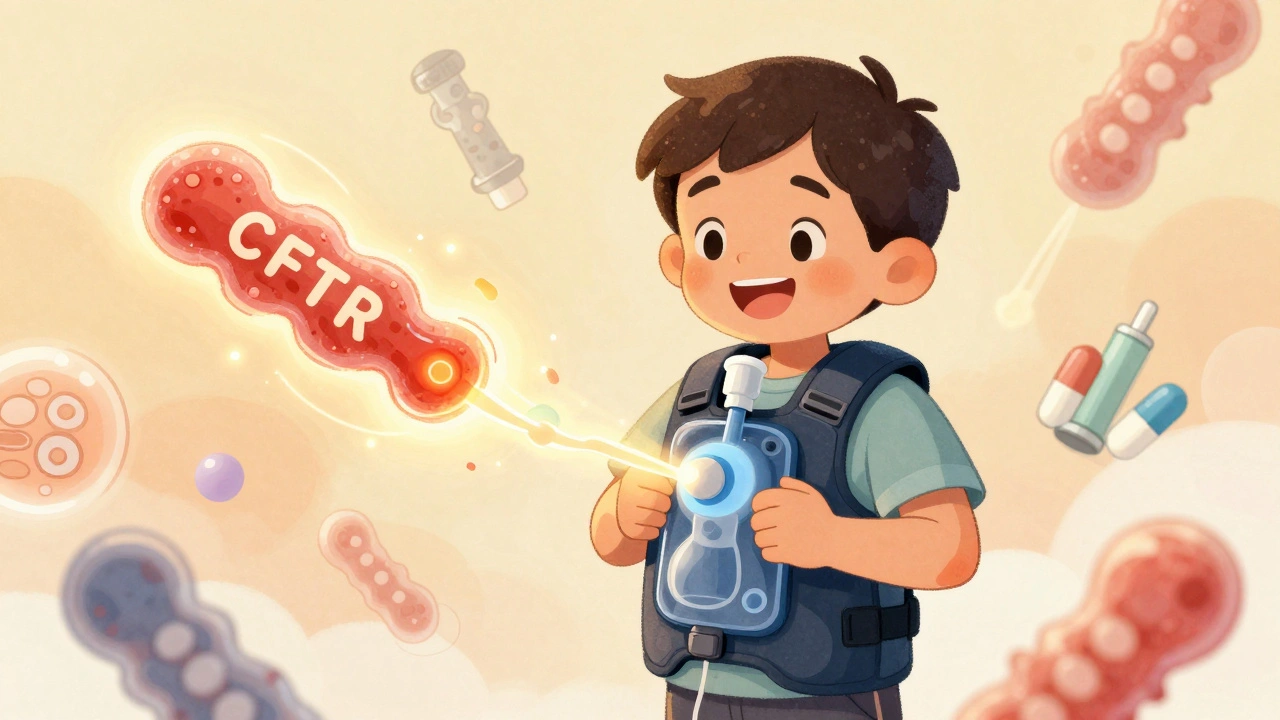
Before 2012, cystic fibrosis (CF) was a disease that stole childhoods. Kids with CF spent hours each day coughing, doing chest physiotherapy, and swallowing enzyme pills with every meal. Many didn’t live to see their 18th birthday. Today, the median life expectancy for someone born with CF is over 50 years. That’s not magic. It’s science-and it’s happening right now.
What Exactly Is Cystic Fibrosis?
Cystic fibrosis is a genetic disorder caused by mutations in the CFTR gene. This gene makes a protein that acts like a gate for salt and water in and out of cells. When the gate breaks, mucus turns thick and sticky instead of thin and slippery. That mucus clogs the lungs, pancreas, liver, and reproductive system.
It’s not contagious. You can’t catch it. You’re born with it. To get CF, you need two broken copies of the gene-one from each parent. If you only have one, you’re a carrier. You won’t have symptoms, but you can pass it on. About 1 in 30 people in the U.S. carries a CF mutation without knowing it.
The most common mutation, called F508del, shows up in about 70% of all CF cases. But there are over 2,000 known mutations. Some are rare. Some are so rare, they’ve only been seen in a handful of people. That’s part of what made treating CF so hard for so long.
How CF Hits the Body
Thick mucus doesn’t just make you cough. It turns everyday body systems into battlegrounds.
- In the lungs, mucus traps bacteria. Pseudomonas aeruginosa and Staphylococcus aureus love it. Chronic infections lead to inflammation, scarring, and eventually, lung failure-the #1 cause of death in CF.
- In the pancreas, mucus blocks the ducts that carry digestive enzymes to the intestines. About 85% of people with CF can’t break down food properly. They need enzyme pills with every meal-sometimes 12 a day.
- In the liver, bile ducts get plugged. Around 30% develop liver damage over time.
- In males, the vas deferens (the tube that carries sperm) is often missing from birth. Nearly all men with CF are infertile, though they can still become fathers with assisted reproductive tech.
The classic diagnostic test? Sweat test. People with CF have sweat with way too much salt-over 60 mmol/L. It’s simple, reliable, and still the gold standard.
The Old Way: Managing Symptoms, Not the Disease
For decades, treatment was about damage control. Airway clearance techniques-hitting the chest with a vest or clapping on the back-were daily rituals. Inhaled antibiotics, bronchodilators, and anti-inflammatories piled up. People spent 2 to 3 hours a day just on treatments. Nutrition was a constant battle. Many needed high-calorie shakes, vitamin supplements, and feeding tubes.
Compliance was tough. Studies show only 65-75% of patients stuck to their full regimens. It’s exhausting. It’s expensive. And it didn’t stop the disease from progressing.
Still, these efforts bought time. In 1960, the median survival was 14 years. By 2000, it was 30. By 2022, it hit 50.9. That’s a 36-year leap in just over 60 years. The reason? The arrival of something entirely new.
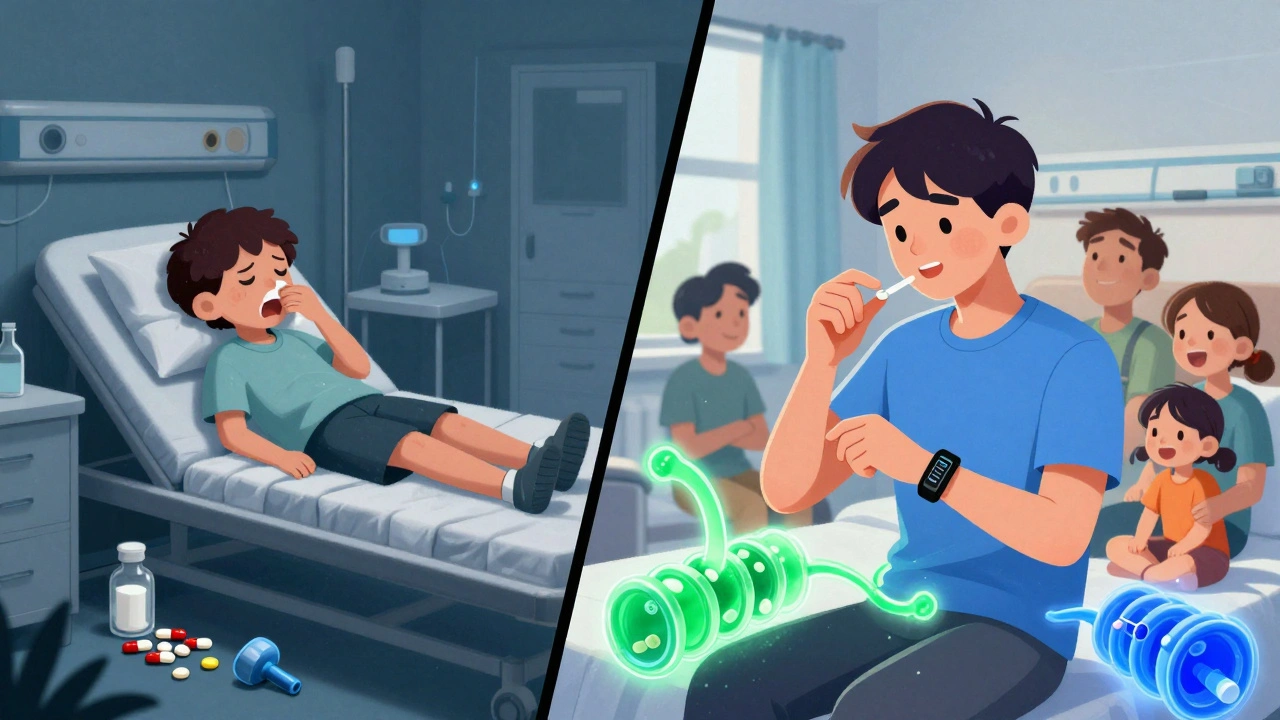
The Revolution: CFTR Modulators
In 2012, everything changed. The FDA approved ivacaftor (Kalydeco), the first drug that didn’t just treat symptoms-it fixed the broken CFTR protein itself. It worked for people with the rare G551D mutation. In clinical trials, lung function jumped by 10.6%-a huge win for CF.
But that was just the start. In 2019, Trikafta (elexacaftor/tezacaftor/ivacaftor) came out. It’s a triple combo that works for about 90% of people with CF, including those with two F508del mutations. In trials, it boosted lung function by 13.8% and cut lung flare-ups by 63%. Real people reported cutting their daily airway clearance from 90 minutes to 20. Some gained 20 pounds without changing their diet. Many stopped needing antibiotics.
By 2023, 90% of people with CF in the U.S. had access to at least one modulator. That’s not just progress-it’s a transformation. CF is no longer just a childhood disease. More than half of all people with CF in the U.S. are now adults.
The Catch: Cost and Access
Trikafta costs about $300,000 a year in the U.S. Even with insurance, many families pay $1,200 a month out of pocket. A 2022 survey of nearly 8,000 CF patients found 42% struggled financially because of treatment.
Globally, the gap is brutal. In low- and middle-income countries, less than 10% of people with CF can get modulators. The World Health Organization calls this a crisis of equity. Of the 105,000 people with CF worldwide, only about 35% have access to these life-changing drugs.
Vertex Pharmaceuticals holds 95% of the modulator market. The Cystic Fibrosis Foundation invested $150 million in early research that made these drugs possible. But now, the price tag leaves millions behind.
Who Still Doesn’t Benefit?
Not everyone can take modulators. About 10% of people have mutations that current drugs can’t fix. These include Class I mutations-where the body makes no CFTR protein at all.
For them, the old treatments remain the only option. One patient in the European registry, 34, with a rare mutation, developed worsening lung damage despite aggressive therapy. No modulator helped. His story isn’t rare-it’s the reality for a group that’s being left behind.

What’s Next? The Pipeline
Research hasn’t stopped. The Cystic Fibrosis Foundation is funding 15 active clinical trials right now.
- mRNA therapies are being tested to trick cells into making working CFTR protein-even for nonsense mutations.
- CRISPR gene editing is in early trials, aiming to fix the broken gene at its source.
- New antibiotics are being developed to fight the stubborn Pseudomonas infections that survive even with modulators.
Vertex and others are also working on treatments for kids under 2. Trikafta was approved for children as young as 2 in early 2023. Now, trials are underway for babies as young as 4 months.
The Foundation’s ‘Path to a Cure’ initiative has committed $100 million to target the 10% left out. This isn’t just about new drugs-it’s about making sure no one is forgotten.
Living With CF Today
For many, CF is no longer a death sentence. It’s a chronic condition-like diabetes or asthma-with daily management but a future.
People with CF are going to college, starting careers, traveling, having families. They’re still doing airway clearance. Still taking pills. Still watching their nutrition. But now, they’re doing it with more energy, fewer hospital stays, and hope.
The tools are better. The support is stronger. There are 260 accredited CF care centers in the U.S. with teams of specialists. Online communities like CF Buddy Connect have over 12,500 active users sharing tips, venting frustrations, and celebrating wins.
But the fight isn’t over. Access is still unequal. Side effects happen-some patients see liver enzyme spikes. A small number have to stop treatment. And for those without modulator options, the burden hasn’t changed.
What You Should Know
If you or someone you know has CF:
- Get tested for CFTR mutations. Not all labs test the same ones. Ask for comprehensive sequencing.
- Find an accredited CF care center. They’re not just hospitals-they’re hubs of coordinated care.
- Ask about modulators. Even if you think your mutation is rare, new options are coming fast.
- Connect with the Cystic Fibrosis Foundation. They offer financial aid, counseling, and up-to-date guidelines updated every 18-24 months.
If you’re a parent of a child diagnosed through newborn screening: start early. Work with the team. Don’t wait. The earlier modulators start, the better the long-term outcome.
If you’re wondering whether CF still matters: it does. It’s not just a rare disease. It’s a model for how precision medicine can change everything. And if we can fix CF, we can learn how to fix other genetic diseases too.
Can cystic fibrosis be cured?
There is no cure yet, but CFTR modulator therapies have turned CF into a manageable chronic condition for most people. These drugs fix the underlying protein defect, dramatically improving lung function, reducing infections, and extending life expectancy. Research into gene editing and mRNA therapies is ongoing and may one day lead to a true cure.
How do CFTR modulators work?
CFTR modulators are precision drugs that target specific defects in the CFTR protein. Some, like ivacaftor, help the protein open properly. Others, like elexacaftor and tezacaftor, help the protein reach the cell surface. When combined, they restore chloride flow, thin mucus, and reduce infections. They don’t fix the gene-but they fix the protein the gene makes.
Are CFTR modulators safe?
Most people tolerate them well, but side effects occur. The most common are headaches, stomach pain, and elevated liver enzymes. In rare cases (about 3.2%), liver damage requires stopping treatment. The FDA requires long-term safety studies because of risks like cataracts and liver issues. Regular blood tests are needed while on these drugs.
Why is CF more common in some ethnic groups?
The F508del mutation is most common in people of Northern European descent, which is why CF is diagnosed more often in white populations. It’s rarer in Black, Asian, and Hispanic populations-but it still occurs. Genetic screening and newborn testing are critical for all groups, because underdiagnosis in minority populations can delay treatment.
Can someone with CF have children?
Most women with CF can conceive and carry pregnancies, though they need extra care due to lung and nutritional demands. Nearly all men with CF are infertile because they’re born without the vas deferens. But with assisted reproductive technology-like extracting sperm directly from the testicles and using IVF-they can become biological fathers. Genetic counseling is recommended before trying to conceive.
Is newborn screening for CF universal?
Yes. All 50 U.S. states and the District of Columbia screen newborns for CF as of 2010. Early diagnosis means treatment can start before symptoms appear, which significantly improves long-term outcomes. Screening involves a blood test for elevated immunoreactive trypsinogen (IRT), followed by genetic testing and a sweat test if needed.
What’s the biggest challenge for CF patients today?
The biggest challenge isn’t medical-it’s access. Even in the U.S., high drug costs create financial strain. Globally, most people with CF live in countries where modulators are unaffordable or unavailable. For the 10% who don’t respond to current drugs, treatment options are still limited. Equity in care is the next frontier.
Iris Carmen
December 9, 2025 AT 18:28Michael Robinson
December 10, 2025 AT 01:23Kathy Haverly
December 11, 2025 AT 17:16Raja Herbal
December 12, 2025 AT 18:30Sarah Gray
December 13, 2025 AT 17:12Rich Paul
December 15, 2025 AT 12:35Andrea DeWinter
December 17, 2025 AT 04:47Ruth Witte
December 18, 2025 AT 03:48Noah Raines
December 19, 2025 AT 20:13Delaine Kiara
December 21, 2025 AT 16:40George Taylor
December 22, 2025 AT 21:34