

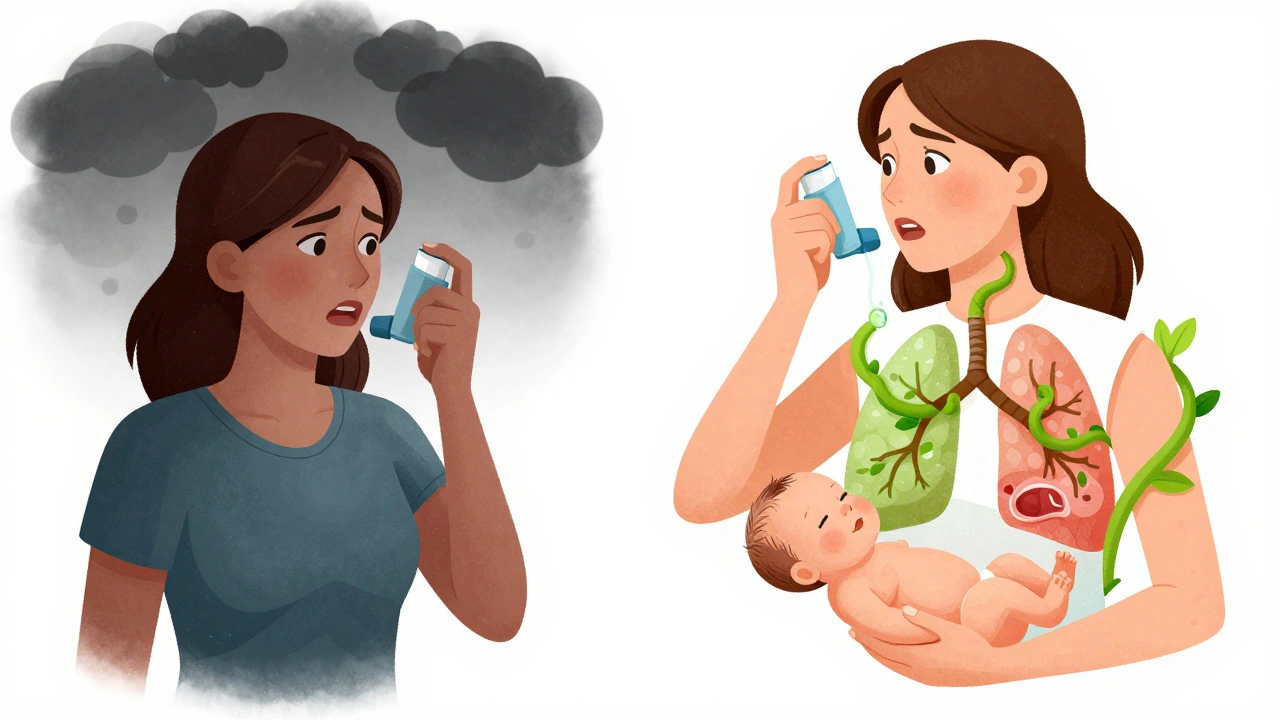
When you're pregnant or breastfeeding, every decision about your health feels heavier. Should you keep using your inhaler? Is it safe for your baby? These aren't just questions-they're fears that keep many women from taking the medicines they need. The truth is simple: asthma medication safety during pregnancy and breastfeeding is well-studied, and most treatments are safer than not treating asthma at all.
Why Uncontrolled Asthma Is Riskier Than Medication
Many women stop their asthma meds during pregnancy because they’re scared of harming the baby. But here’s what the data shows: if your asthma isn’t under control, your baby is at higher risk. Uncontrolled asthma increases the chance of preeclampsia, preterm birth, low birth weight, and even stillbirth. A study from the American College of Obstetricians and Gynecologists found that women with well-managed asthma had 30-40% lower rates of newborn complications than those who didn’t take their meds. Your baby gets oxygen through you. If you’re struggling to breathe, so is your baby. Oxygen levels below 95% can affect fetal development. That’s why doctors say: if you can’t breathe, neither can your baby.Which Asthma Medications Are Safe During Pregnancy?
Not all asthma drugs are the same. The safest options are inhaled medications because they work right where they’re needed-your lungs-with almost no amount reaching your bloodstream, let alone your baby.- Inhaled corticosteroids (ICS) like budesonide (Pulmicort) are the gold standard. Over 10,000 pregnancy outcomes have been tracked, and no increase in birth defects has been found. Budesonide is the most studied and recommended ICS during pregnancy.
- Short-acting beta agonists (SABAs) like albuterol (Ventolin, ProAir) are used for quick relief. Studies show no link to birth defects at standard doses (90-180 mcg per puff). They’re safe to use anytime you need them.
- Long-acting beta agonists (LABAs) like salmeterol are safe when combined with an ICS. Never use LABAs alone.
- Leukotriene modifiers like montelukast (Singulair) have limited but reassuring data. Levels in breast milk are far lower than what’s given to infants over six months.
What About Breastfeeding?
Breastfeeding and asthma meds? You can do both. Inhaled medications are the easiest to manage because very little of the drug enters your blood-and even less makes it into your milk.- For inhaled corticosteroids, less than 1% of the dose reaches your milk. The amount your baby gets is tiny-far less than what’s in infant asthma sprays.
- Albuterol transfers minimally. No special timing between inhaler use and feeding is needed.
- Prednisone passes into milk at about 5-25% of your blood level. If you’re on a high dose (more than 40mg daily), some experts suggest waiting 4 hours after taking it before nursing. But for most daily doses, no changes are needed.
- Theophylline requires monitoring. It transfers more than other drugs, so your doctor may check your levels if you’re taking it while breastfeeding.
What About Newer Biologics Like Xolair or Nucala?
This is where things get trickier. Biologics like omalizumab (Xolair), mepolizumab (Nucala), and dupilumab (Dupixent) are powerful tools for severe asthma. But they’re newer-and we don’t have as much data on them during pregnancy or breastfeeding. The FDA lists them as Pregnancy Category B, meaning animal studies show no harm, but human data is limited. The American Academy of Allergy, Asthma & Immunology says: "There’s less experience with newer agents during breastfeeding." If you were already using a biologic before pregnancy and your asthma is stable, many doctors will continue it. Stopping suddenly can cause a dangerous flare. But if you’re starting one now, your doctor will weigh the benefits carefully.What You Should Do Before and During Pregnancy
Don’t wait until you’re pregnant to figure this out. Here’s what works:- See your doctor before conception. Get your asthma under control before you get pregnant. This is the single best thing you can do for your baby.
- Create a written asthma action plan. Include your triggers, symptoms, when to use your rescue inhaler, and when to call your doctor. Update it every trimester.
- Monitor your lung function. Use a peak flow meter at home. In late pregnancy, lung capacity drops naturally by 5-10%. Your doctor will help you adjust your target numbers.
- Keep regular check-ups. Pregnant women with asthma should be seen every 4-6 weeks. That’s more often than non-pregnant patients.
- Don’t mistake normal pregnancy breathlessness for asthma. Up to 70% of pregnant women feel short of breath in the third trimester-even if they’ve never had asthma. That doesn’t mean your asthma is worsening.

What to Avoid
- Stopping your meds without talking to your doctor. One study found that 22% of pregnant women reduced or stopped their asthma meds without medical advice. Those women had 37% more emergency room visits than those who stayed on track.
- Using oral steroids unless necessary. They’re effective for flares, but long-term use increases risks like gestational diabetes and high blood pressure.
- Believing myths. "My inhaler will make my baby addicted." "My baby will grow up with asthma because I used albuterol." None of this is true.
Real Stories, Real Outcomes
One National Jewish Health study followed 327 pregnant women with asthma who stuck to their treatment plan. 98.7% delivered full-term babies with normal birth weights. In the group that skipped or cut back on meds, only 76.4% did. On Reddit, a woman named Sarah wrote: "I was terrified to use my inhaler. I thought I was poisoning my baby. After my OB told me the facts, I used it every time I needed it. My son was born healthy at 39 weeks. I wish I’d known sooner."The Bottom Line
Asthma medication safety during pregnancy and breastfeeding isn’t about avoiding risk-it’s about managing it. The risks of uncontrolled asthma are real. The risks of inhaled asthma medications? Minimal. Proven. Manageable. Your body is doing something incredible. Don’t let fear stop you from taking care of it. Talk to your doctor. Get a plan. Stick to it. You’re not just protecting yourself-you’re giving your baby the best start possible.Is it safe to use my rescue inhaler during pregnancy?
Yes. Short-acting beta agonists like albuterol are safe and recommended for quick relief during pregnancy. They work locally in the lungs, with very little entering your bloodstream. Using your rescue inhaler when needed prevents dangerous drops in oxygen that can affect your baby.
Can I keep using my steroid inhaler while breastfeeding?
Absolutely. Inhaled corticosteroids like budesonide transfer minimally into breast milk-less than 1% of your dose. The amount your baby receives is far smaller than the doses given to infants for asthma treatment. No timing adjustments are needed.
What if I need oral steroids for a bad flare-up?
Short courses of oral steroids like prednisone are safe during pregnancy and breastfeeding when used as directed. For breastfeeding, doses under 40mg daily for five days are unlikely to affect your baby. Higher doses may require waiting 4 hours after taking the pill before nursing, but this isn’t always necessary. Always discuss with your doctor.
Are biologics like Xolair safe during pregnancy?
There’s limited human data, but no red flags so far. If you were already on a biologic before pregnancy and your asthma is stable, most doctors will continue it. Stopping can trigger dangerous flares. Starting one during pregnancy is done cautiously, only if benefits clearly outweigh unknowns.
I’m scared my baby will get asthma because I used medication. Is that true?
No. There’s no evidence that using asthma medication during pregnancy causes asthma in your child. In fact, uncontrolled asthma increases the risk of preterm birth and low birth weight, which are linked to higher asthma rates later in life. Controlling your asthma is one of the best ways to give your baby a healthier start.
Should I stop my asthma meds if I’m planning to get pregnant?
No. The best time to optimize your asthma control is before pregnancy. Work with your doctor to find the safest, most effective regimen. Stopping meds increases your risk of flares, which are more dangerous than the medications themselves.
How often should I see my doctor during pregnancy if I have asthma?
Every 4 to 6 weeks. This is more frequent than for non-pregnant patients because your body changes quickly. Your lung capacity drops naturally in the third trimester, so your treatment plan may need adjustments. Regular visits help catch problems early.
Is it normal to feel short of breath during pregnancy even if I have asthma?
Yes. Up to 70% of pregnant women feel more winded in the third trimester, even without asthma. This is due to hormonal changes and the growing uterus pressing on the diaphragm. It doesn’t mean your asthma is worse. Use your peak flow meter and symptoms to tell the difference.
val kendra
December 4, 2025 AT 20:17Just had my second baby while on budesonide and albuterol. No issues. My kid’s 3 now and runs like a cheetah. Don’t let fear write your script - your doctor and science have your back.
jagdish kumar
December 5, 2025 AT 12:20They say it’s safe… but who really knows what’s in the air we breathe? Maybe the real danger is the system that tells us to trust pills over nature.
michael booth
December 7, 2025 AT 03:39Thank you for this comprehensive breakdown. As a healthcare provider, I can’t tell you how many patients I’ve seen who stopped their inhalers out of fear - and then ended up in the ER. This is exactly the kind of clarity we need.
Carolyn Ford
December 7, 2025 AT 12:02Oh please. 'Safe'? That’s what they said about thalidomide. And now we’re just supposed to swallow (pun intended) whatever Big Pharma tells us? I’ve read studies - the long-term neurodevelopmental data is STILL missing.
Heidi Thomas
December 8, 2025 AT 15:30Stop lying to women. Budesonide isn’t 'safe' - it’s 'less bad.' And you think 1% in breast milk is nothing? My cousin’s baby had a rash for months. Coincidence? I think not.
Alex Piddington
December 9, 2025 AT 07:35Hey everyone - I’m a dad whose wife had severe asthma during both pregnancies. We followed the guidelines. Two healthy kids, no issues. If you’re scared, talk to your OB and allergist. Don’t guess. This isn’t a risk worth taking.
Libby Rees
December 9, 2025 AT 11:49I’m from the UK and we use the same guidelines here. The NHS says inhaled meds are safe. No need to overthink it. Your baby needs oxygen more than they need to avoid a trace of medication.
Dematteo Lasonya
December 9, 2025 AT 13:12I was terrified too. I stopped my inhaler for the first trimester. I felt guilty every day. When I started again at 16 weeks, my breathing improved instantly. My daughter is now 2 and thriving. Please don’t wait until you’re in crisis to listen to your body.
Rudy Van den Boogaert
December 9, 2025 AT 19:52My wife used Singulair while breastfeeding. No problems. The amount in milk is tiny. I read the pharmacokinetics - it’s like giving your baby a drop of water with a hint of medicine. Don’t panic.
Gillian Watson
December 11, 2025 AT 07:45My sister in London had a baby while on Xolair. No red flags. She’s still on it now. The NHS doesn’t make you stop unless there’s a clear danger. Trust the data, not the fear.
Pavan Kankala
December 11, 2025 AT 21:10They’re all lying. The FDA approves drugs based on corporate funding. You think they care about your baby? Or just profit? I’ve seen the documents. They bury the bad stuff.
Martyn Stuart
December 13, 2025 AT 09:00Important note: if you’re on a biologic and pregnant, register with the pregnancy registry! It’s how we get better data. Your participation helps future moms. Ask your doctor how to enroll.
Jessica Baydowicz
December 13, 2025 AT 14:43Y’all need to chill. My kid was born with a lung crackle at 37 weeks - turned out it was just mucus from me having a mild asthma flare. I used my inhaler 3x that day. He’s a 5-year-old ninja now. Breathe. Trust the science. You got this.
Shofner Lehto
December 14, 2025 AT 13:24As someone who’s managed asthma for 20 years and had two kids while on maintenance meds - I can say with certainty: the risks of not treating are far greater than any theoretical risk from the drugs. Don’t sacrifice your health for a myth.