
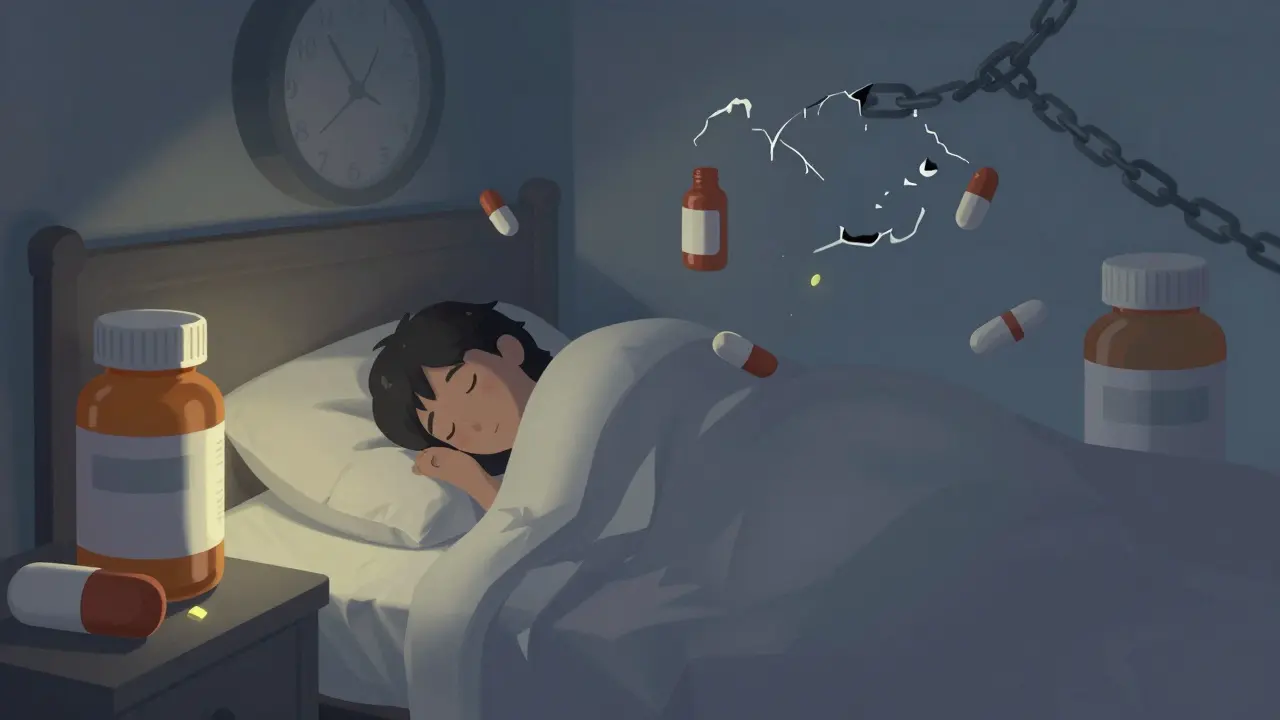
Depression doesn’t just make you feel low-it makes you forget to take your pills
Imagine you’re on three different medications for high blood pressure, diabetes, and heart failure. You know they’re important. You’ve been told they could save your life. But some days, getting out of bed feels impossible. The thought of opening pill bottles, reading tiny labels, or remembering which pill goes when? Too much. That’s not laziness. That’s depression.
Depression doesn’t just sit in your mind-it rewires your behavior. And one of the most dangerous ways it shows up is through medication adherence. People with depression are far more likely to skip doses, stop taking meds early, or never fill prescriptions in the first place. This isn’t rare. It’s common. And if you’re a clinician, caregiver, or even someone managing their own health, missing this link can cost lives.
How much does depression really affect medication use?
The numbers don’t lie. In a 2022 review of 31 studies, patients with heart failure who had depression were 2.3 times more likely to miss their medications than those without depression. That’s not a small bump. That’s a cliff. And it wasn’t just random forgetting. Depression specifically hurt adherence to critical drugs like ACE inhibitors, beta-blockers, and mineralocorticoid receptor antagonists. For every point increase in depression score, the odds of skipping a dose went up by 4% to 6%-depending on the drug.
This pattern repeats across conditions. In a study of 83 people with major depressive disorder, nearly 40% were classified as non-adherent using the Morisky Medication Adherence Scale (MMAS-8). Only 6% scored perfectly. The rest? Either skipping doses or taking them inconsistently. And it wasn’t just depression-those with the worst adherence also had the highest anxiety and stress levels. Depression doesn’t work alone. It teams up with other mental health struggles to break routines.
What does non-adherence look like in real life?
You won’t always hear someone say, “I’m not taking my meds because I’m depressed.” You’ll notice it in the details:
- Pill bottles still sealed after three months
- Refills never requested, even when the prescription is due
- Patients say they “feel better,” so they stopped the meds
- Missed appointments, but no explanation
- Side effects are reported more often-dry mouth, drowsiness, weight gain-than in non-depressed patients
One study found that 83% of people on SSRIs like sertraline or escitalopram stopped taking them because of side effects. But here’s the twist: those same side effects were reported just as often by people who stayed on the meds. The difference? Depressed patients felt them more. The same dry mouth, the same fatigue-it felt unbearable. That’s not just physical. That’s depression amplifying discomfort.
Another study in Spain used the GARSI scale to measure how patients rated their side effects. Non-adherent patients scored significantly higher-not because their side effects were worse, but because their depression made them focus on them more. It’s not about the drug. It’s about the mind.
Tools to spot the problem early
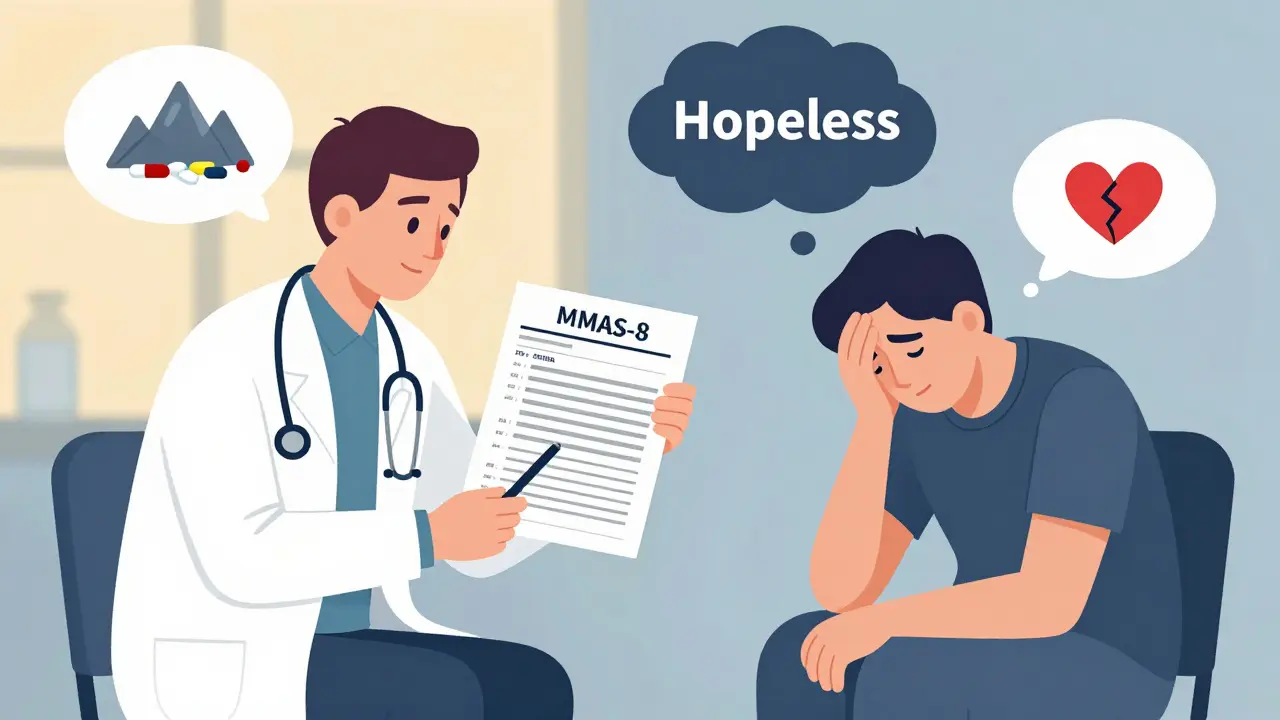
There are two simple, validated tools that can help you catch this before it turns dangerous.
PHQ-9 is the go-to depression screener. It’s nine questions about sleep, energy, appetite, concentration, and hopelessness. A score of 10 or higher means moderate to severe depression-and that’s the red zone for adherence risk. For every 5-point increase on the PHQ-9, the chance of missing doses drops by 23%.
MMAS-8 is the gold standard for measuring adherence. It asks eight questions like: “Do you ever forget to take your medicine?” or “Have you ever cut back or stopped taking your meds because you felt worse?” A score below 6 means non-adherent. Below 8 means inconsistent. Only an 8 means perfect adherence.
When you combine them? You get 37% better accuracy than using either alone. That’s not a little boost. That’s game-changing. Clinics in the U.S. and Europe are now using both tools together during routine visits. If someone scores high on PHQ-9 and low on MMAS-8? That’s a signal to dig deeper-not to scold, but to support.
Why does depression break adherence? It’s not just forgetfulness
People think depression causes missed doses because patients forget. That’s only part of it.
Depression attacks motivation. It drains energy. It makes even small tasks feel impossible. Taking five pills a day isn’t just a chore-it’s a mountain. The brain’s decision-making centers slow down. Memory falters. Planning becomes overwhelming.
And then there’s hopelessness. If you believe nothing will help, why keep taking the pills? One patient told a nurse, “I’ve been on this medicine for six months. I still feel awful. What’s the point?” That’s not non-compliance. That’s despair.
Side effects matter more too. In a depressed brain, the same nausea or dizziness that a non-depressed person might shrug off becomes unbearable. The body’s signals are amplified. The mind interprets discomfort as proof the treatment is wrong. That’s not irrational-it’s neurological.
What works to fix it
Blaming patients doesn’t help. Punishing them with “you should’ve known better” makes things worse.
What does work? Simple, structured support.
- Side effect mapping: Ask patients to track daily-how they feel mentally, and how they feel physically after taking meds. Patterns emerge. Maybe they skip pills every time they feel fatigued. Maybe they stop when their appetite drops. Mapping those links helps tailor solutions.
- Collaborative care: When a primary care doctor, a mental health counselor, and a pharmacist work together, adherence jumps by nearly 30%. One study in Spain showed this model increased adherence from 52% to 80.5% over a year.
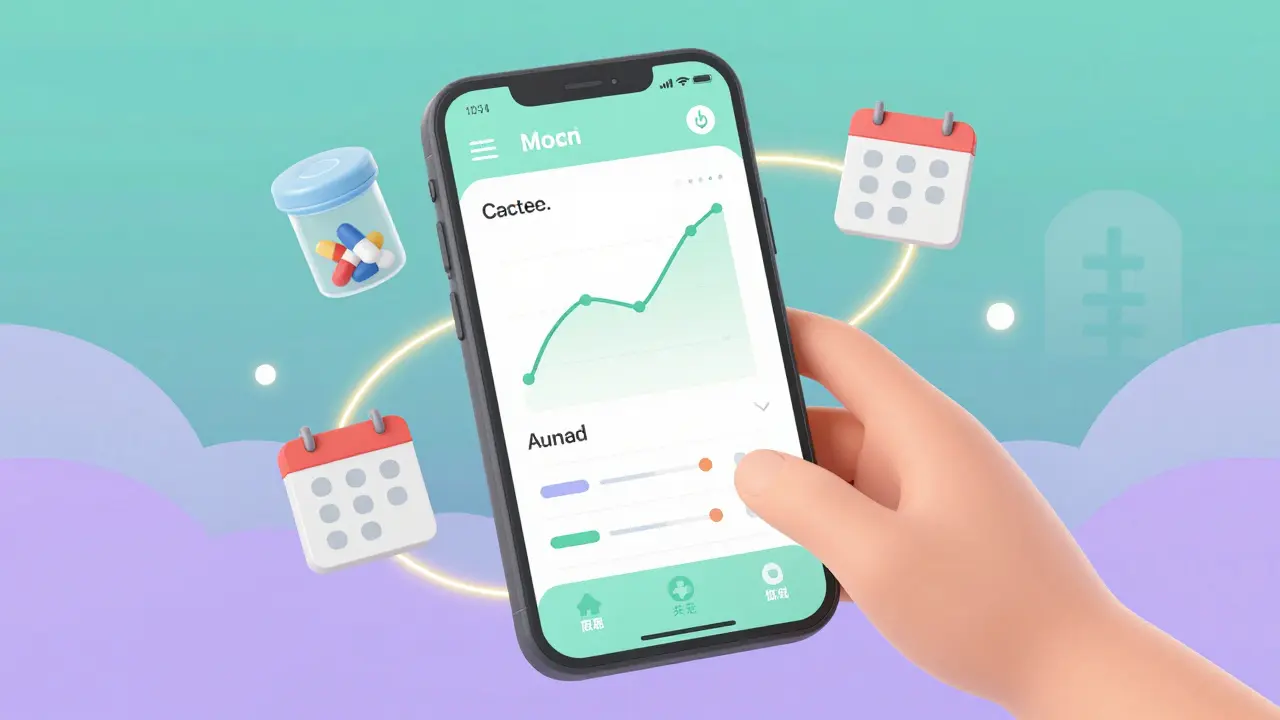
- Smartphone apps: New tools now let patients log mood and medication intake. Some can predict a missed dose 72 hours in advance with 82% accuracy. That’s enough time for a nurse to call and ask, “Hey, you seemed down yesterday. Everything okay with your meds?”
- Reduce pill burden: If someone’s on seven pills a day, can some be combined? Can dosing be simplified to once daily? Every fewer pill reduces the mental load.
And don’t underestimate the power of asking. Not “Why didn’t you take your pill?” but “What’s making it hard to take your meds?” That opens the door. People will tell you the truth if you listen without judgment.
The bottom line: Depression isn’t a side effect-it’s a treatment barrier
If you’re treating someone for diabetes, heart disease, or high cholesterol, and they’re also struggling with mood, you’re not treating two separate problems. You’re treating one-where mental health is the root cause of physical risk.
Screening for depression isn’t optional. It’s essential. Using PHQ-9 and MMAS-8 together isn’t extra work-it’s prevention. Catching non-adherence early means fewer hospitalizations, fewer complications, fewer deaths.
Depression doesn’t make people lazy. It makes them exhausted. Overwhelmed. Hopeless. And when someone’s that far down, the right question isn’t “Why aren’t you taking your pills?”
It’s “How can I help you take them?”
How do I know if someone’s not taking their meds because of depression?
Look for patterns: missed refills, unexplained side effect complaints, sudden disengagement from care, and low scores on the PHQ-9 (10+) and MMAS-8 (below 6). People often say they feel better and stopped the meds-that’s a red flag. Depression can make someone believe treatment is pointless, even when it’s working.
Is depression the only mental health issue that affects medication adherence?
No, but it’s the strongest. Anxiety and stress also reduce adherence, but depression has the deepest impact because it drains motivation, energy, and hope. People with anxiety might forget pills due to racing thoughts; people with depression often don’t even try.
Can simplifying a medication regimen help with adherence in depressed patients?
Yes. Reducing the number of daily doses-even from three times a day to once-can improve adherence by 25% or more in depressed patients. Pill organizers, once-daily formulations, and combining drugs into single pills all help lower the cognitive load.
What’s the best way to talk to a patient about missed doses?
Avoid accusations. Say: “I’ve noticed you haven’t refilled your prescription. I’m not here to judge-I want to understand what’s getting in the way.” Most people will open up if they feel safe. Depression thrives in silence. Talking breaks it.
Are there digital tools that help track adherence in depressed patients?
Yes. Apps that link mood tracking with pill reminders have shown 82% accuracy in predicting missed doses 72 hours ahead. These tools aren’t perfect, but they give providers a heads-up to reach out before a crisis happens. Some even let patients share data directly with their care team.
phara don
February 2, 2026 AT 01:54Vatsal Srivastava
February 2, 2026 AT 20:58Brittany Marioni
February 3, 2026 AT 10:17Ellie Norris
February 4, 2026 AT 22:09Marc Durocher
February 6, 2026 AT 13:46larry keenan
February 7, 2026 AT 21:14Nick Flake
February 9, 2026 AT 19:02Akhona Myeki
February 10, 2026 AT 18:36