
Medication Review Tool
This tool helps identify medications that may be candidates for deprescribing based on common guidelines for older adults. Remember: This is not medical advice. Always consult your healthcare provider before making changes to your medications.
Enter Your Medications
Add medications you're currently taking. We'll identify which ones may be candidates for deprescribing.
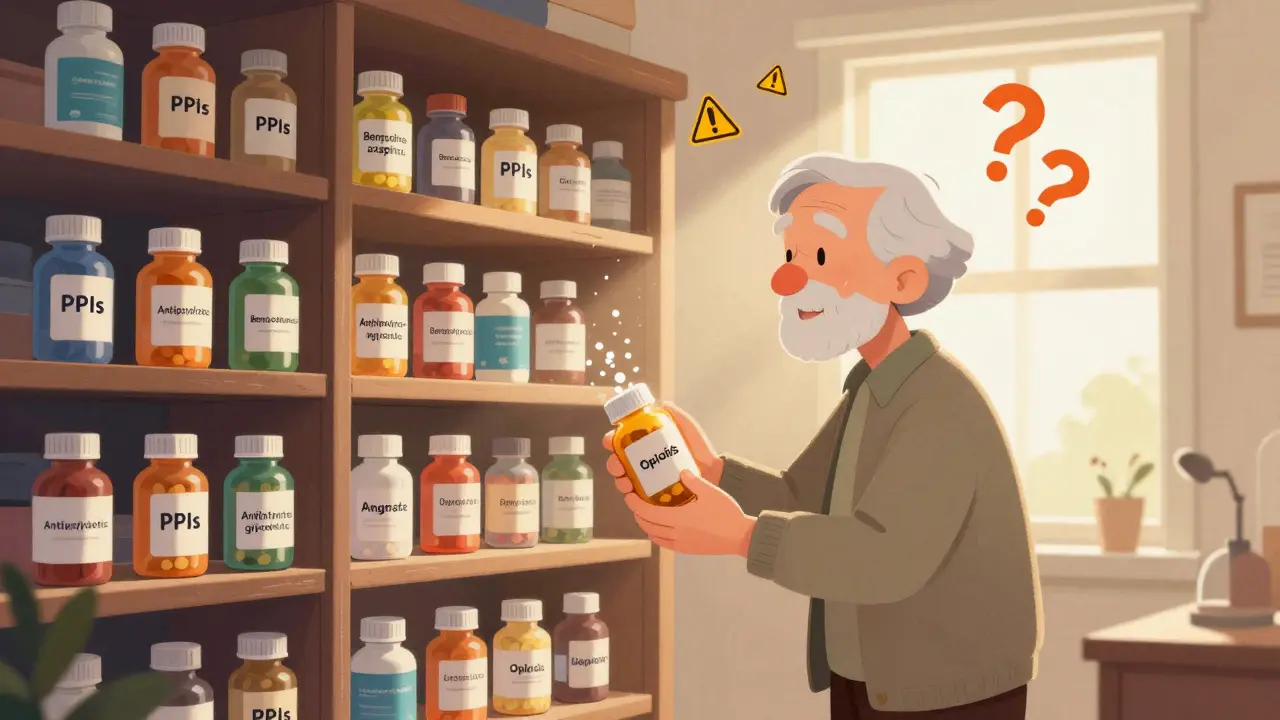
Every year, millions of older adults take more medications than they need. Some of these drugs were prescribed years ago for conditions that have changed-or even disappeared. But no one ever stopped them. The result? A growing pile of pills, each one adding risk: dizziness, confusion, falls, stomach bleeds, even kidney damage. This isn’t just a side effect-it’s a crisis. And the solution isn’t adding more drugs. It’s removing the ones that don’t belong.
What Is Deprescribing, Really?
Deprescribing isn’t just stopping pills. It’s a careful, step-by-step process to get rid of medications that do more harm than good. Think of it like cleaning out a cluttered closet. You don’t toss everything at once. You look at each item: Is it still useful? Is it safe? Do I even need it anymore? This approach started gaining real traction around 2012, led by researchers in Canada who saw how often older patients were stuck on drugs that no longer helped. Today, deprescribing is backed by solid science. The World Health Organization says about 40% of older adults take medications that could be doing more harm than good. And it’s not just seniors. People with multiple chronic conditions, especially those in nursing homes or recovering from hospital stays, are at highest risk. The goal? Reduce side effects, lower the chance of hospital visits, and improve daily life. A 2023 study in JAMA Internal Medicine followed 372 older adults who had their medications carefully reviewed. They cut an average of 1.8 pills per person-and not one more person ended up in the hospital than those who didn’t change their meds. In fact, many felt better. Less confusion. More energy. Fewer falls.The Five Big Targets for Deprescribing
Not every drug is a good candidate. But five classes of medications show the clearest benefits when reduced or stopped:- Proton-pump inhibitors (PPIs) - These acid blockers are often taken for years for heartburn, even when symptoms are gone. Long-term use raises the risk of bone fractures, kidney disease, and infections. Guidelines say: try stopping after 4-8 weeks if there’s no clear reason to keep going.
- Benzodiazepines and sleep meds - Drugs like lorazepam or zolpidem help with anxiety or insomnia, but they dull reflexes, increase fall risk, and can cause memory problems. Tapering slowly over weeks cuts these risks without triggering rebound insomnia in most cases.
- Antipsychotics - Often prescribed off-label for dementia-related agitation, even though they increase stroke risk and can make people sluggish or confused. Non-drug approaches (like routines, music, sunlight) work better-and safer.
- Antihyperglycemics - Tight blood sugar control isn’t always better for older adults. Drugs like sulfonylureas can cause dangerous low blood sugar. For someone with limited life expectancy or frailty, a slightly higher A1C is safer than risking a fall from hypoglycemia.
- Opioids - Chronic pain meds often get continued long after the injury heals. They’re linked to addiction, constipation, breathing problems, and cognitive decline. A slow taper, with support, often leads to improved function and less pain over time.
How Deprescribing Works: The 4-Step Process
There’s no one-size-fits-all method, but most successful deprescribing follows a clear pattern:- Identify the right candidates - Use tools like STOPP/START criteria or the Beers Criteria (updated in 2023) to flag high-risk drugs. Look for people on five or more medications, those with recent falls, or anyone reporting confusion or fatigue.
- Check the reason for each drug - Why was this started? Is the original condition still active? Has the patient’s health changed? Sometimes, a drug was prescribed for a short-term issue that never got re-evaluated.
- Plan a slow taper - Never stop cold turkey. Benzodiazepines? Reduce by 10-25% every 1-2 weeks. PPIs? Cut the dose in half, then switch to every-other-day use before stopping. Monitor for rebound symptoms, but most people tolerate this well.
- Follow up and adjust - Schedule a check-in in 2-4 weeks. Did their sleep improve? Are they walking steadier? Did their stomach feel better? If symptoms return, reassess. Maybe the drug was needed after all.
Who Should Be Doing This?
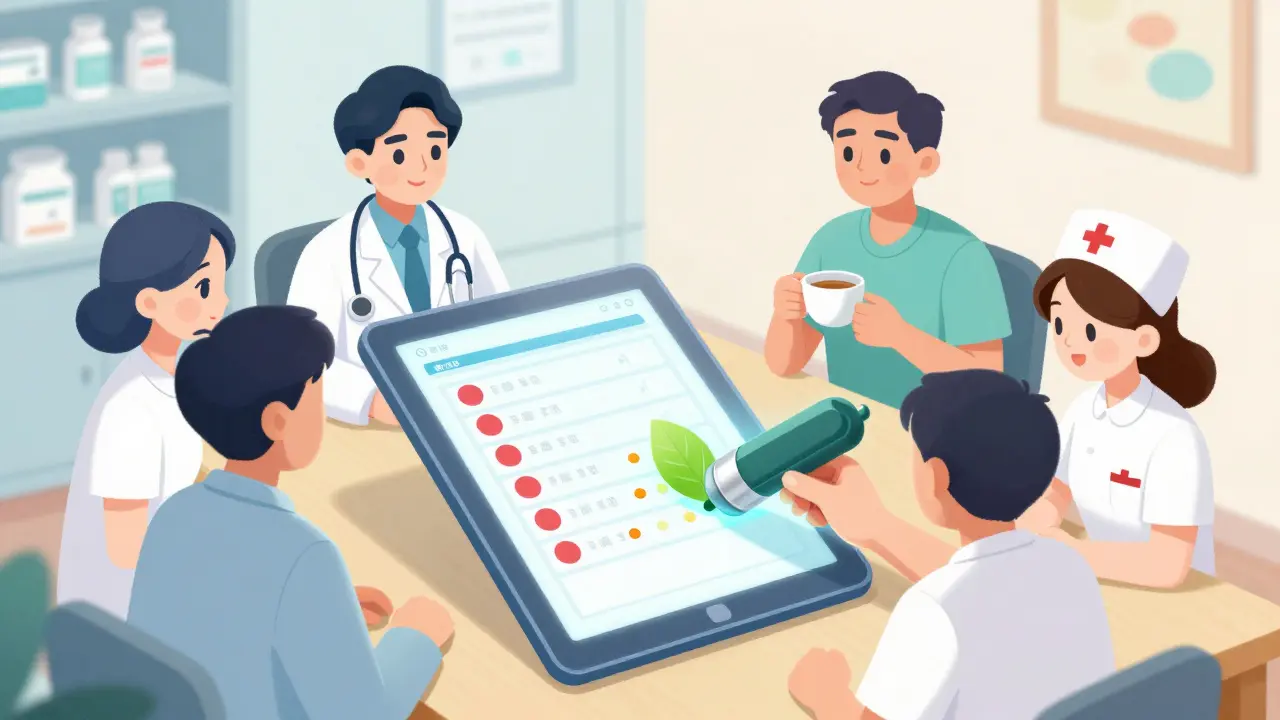
Deprescribing isn’t just a doctor’s job. It’s a team effort. Pharmacists are key-they’re the ones who see the full list of meds, spot duplicates, and know the tapering schedules. A 2022 study found clinics with pharmacist involvement had 35-40% higher success rates in reducing medications. But here’s the problem: most primary care visits last just 7-8 minutes. There’s no time to review 12 pills, talk about goals, and build trust. That’s why successful programs bring in nurse practitioners, clinical pharmacists, or even trained medical assistants to do the initial review. Then the doctor signs off. In Canada, where deprescribing is built into national guidelines, over 60% of primary care practices have formal protocols. In the U.S., only 28% do. The gap isn’t because doctors don’t care. It’s because the system doesn’t support it.Why Don’t More Doctors Do It?
The biggest barrier? Fear. Fear that stopping a drug will make the patient worse. Fear of being blamed if something goes wrong. Fear that the patient won’t agree. But the data says otherwise. A 2023 trial showed no increase in hospitalizations or deaths after deprescribing-even when patients stopped multiple high-risk drugs. In fact, the control group (who kept all their meds) had the same rate of bad events. Another problem: guidelines are scattered. There are clear deprescribing rules for five drug classes. But what about antidepressants? Blood thinners? Muscle relaxants? There’s no consensus. A 2024 analysis of over 3,500 clinical guidelines found only 7% even mentioned deprescribing. Most still focus only on adding drugs, not removing them. And electronic health records? Most don’t help. They don’t flag when a drug is no longer needed. They don’t suggest tapering plans. They just keep listing pills on the screen, year after year.What Patients Really Think
Patients aren’t always eager to stop meds. Many have been taking the same pills for a decade. They trust them. They think they’re helping. A 2022 study found 65% of older adults were happy to reduce their pill count. But 22% were anxious. One woman, 78, had been on a sleep aid for 12 years. When her pharmacist suggested stopping, she cried. “I don’t know how to sleep without it,” she said. But after a 10-week taper, she slept better naturally-and didn’t need the pill anymore. The key? Communication. Not just telling patients to stop. Asking: What matters most to you right now? Is it sleeping through the night? Walking without falling? Avoiding stomach pain? Then match the deprescribing plan to those goals.
What’s Changing in 2026?
The tide is turning. In June 2024, the American Medical Association officially recognized deprescribing as a core part of responsible prescribing. Starting in 2026, Medicare will start measuring how often doctors review and reduce inappropriate medications-and tie that to payment. The FDA has funded over $8 million in research since 2020 to build better tools. One project at Columbia University is developing AI that scans EHRs and flags patients who could safely stop a drug. Another team is creating deprescribing guidelines for antidepressants and blood thinners-two of the most common but least studied classes. By 2030, experts predict deprescribing checks will be as routine as checking blood pressure. But we’re not there yet.What You Can Do Today
If you or a loved one takes five or more medications:- Ask your doctor: Which of these drugs are still necessary?
- Ask your pharmacist: Can you review all my meds together?
- Write down: What’s the goal of this pill? What happens if I stop it?
- Don’t be afraid to say: I’d like to try reducing this.
Is deprescribing safe?
Yes, when done properly. Multiple studies, including a 2023 randomized trial with 372 older adults, show that carefully planned deprescribing reduces medication burden without increasing hospitalizations or deaths. The key is tapering slowly, monitoring symptoms, and involving a pharmacist or trained clinician. Stopping cold turkey or without a plan can be dangerous-but that’s not deprescribing. That’s just stopping.
Can I stop my medications on my own?
No. Some medications, like benzodiazepines, antidepressants, or steroids, can cause serious withdrawal symptoms if stopped suddenly. Others, like blood pressure or diabetes drugs, may cause rebound effects. Always work with your doctor or pharmacist. They’ll help you create a safe, step-by-step plan based on your health and history.
What if I feel worse after stopping a drug?
It’s common to feel uncertain or notice minor changes-like a return of mild heartburn or trouble falling asleep. That doesn’t always mean the drug was necessary. Often, these are temporary withdrawal effects or your body adjusting. Track them for 2-4 weeks. If symptoms persist or worsen, talk to your provider. Sometimes, the drug needs to be restarted at a lower dose. Other times, a non-drug solution works better.
How do I know if I’m on too many medications?
You’re likely on too many if you take five or more daily medications, especially if you’re over 65. Other signs: frequent falls, confusion, fatigue, stomach upset, or feeling like your meds are more of a burden than a help. Ask for a full medication review. Use tools like the Beers Criteria or deprescribing.org to see which drugs are flagged as potentially inappropriate for older adults.
Does deprescribing save money?
Yes. A 2023 Canadian study found that for every $1 spent on deprescribing programs, healthcare systems saved $3.20 through reduced medication costs and fewer hospital visits. On average, patients cut 1.5-2.5 medications per person. That’s hundreds of dollars a year in prescriptions alone-not counting emergency room visits or nursing home admissions avoided.
Patrick Merrell
January 26, 2026 AT 08:12This is the kind of common sense medicine that gets buried under corporate profit margins. I’ve seen grandmas on 12 pills just because no one had the guts to ask if they still needed them. The system rewards prescribing, not stopping. It’s broken.
And yet here we are-still letting pharmacists do the heavy lifting while doctors collect paychecks for doing the bare minimum.
Ryan W
January 27, 2026 AT 03:03Let’s be real: deprescribing is just another woke healthcare fad masquerading as evidence-based practice. The JAMA study? Tiny sample. Tapering protocols? Unstandardized. And don’t get me started on the ‘non-drug approaches’-music therapy for dementia? Next they’ll prescribe yoga for hypertension.
Meanwhile, real medicine-like statins, antihypertensives, and insulin-saves lives. Don’t throw the baby out with the bathwater because someone’s afraid of polypharmacy.
Rakesh Kakkad
January 27, 2026 AT 12:21Respected colleagues, I must express profound concern regarding the sociocultural implications of deprescribing in resource-constrained settings. In India, where access to primary care remains uneven, the abrupt discontinuation of medications without structured follow-up may exacerbate health inequities.
Moreover, the cultural reverence for pharmaceutical interventions as symbols of medical authority cannot be overlooked. Patients often perceive cessation as abandonment, not optimization. A top-down, protocol-driven approach risks alienating vulnerable populations who rely on the ritual of pill-taking as reassurance.
Simran Kaur
January 28, 2026 AT 14:01I cried reading this. My mom was on 11 meds for years-sleep pills, heartburn pills, muscle relaxers, you name it. She was always so tired, like she was walking through molasses. Then her pharmacist sat with us for an hour, one by one, asking, ‘Does this help you live the life you want?’
We stopped the zolpidem first. She didn’t sleep perfectly at first… but then she started waking up *happy*. She started gardening again. She laughed more. I didn’t know how much she’d lost until she got it back.
Thank you for saying this out loud. I wish every doctor had this conversation.
Angie Thompson
January 29, 2026 AT 02:06OMG YES. I’ve been begging my doc to cut my PPI for 3 years. She said ‘it’s fine’ every time. Finally found a pharmacist who said ‘you’ve been on this since 2017-your stomach isn’t even bothering you anymore.’ We tapered. I haven’t had heartburn in 6 months. And I feel like I can breathe again.
Also-why do we still have to beg to get OFF meds? Why isn’t this the default? 🙏
Skye Kooyman
January 30, 2026 AT 19:50My grandma’s on 8 meds. She forgets half of them. She’s confused. She falls sometimes. We’re gonna start with the sleep pill. No big drama. Just… see what happens.
Easy.
SWAPNIL SIDAM
February 1, 2026 AT 04:57This is beautiful. In my village, elders take medicines like rituals. No one questions. But when my uncle stopped his antipsychotic after talking to a nurse, he smiled more. He remembered his wife’s name. That’s not side effects-that’s life coming back.
We need more of this. Not less.
Geoff Miskinis
February 2, 2026 AT 06:10Let’s not romanticize deprescribing as some noble crusade. The ‘372-patient JAMA study’ is statistically underpowered. The ‘40% of seniors on harmful meds’ statistic is pulled from a WHO meta-analysis with significant heterogeneity. And let’s not pretend that tapering benzodiazepines is as simple as ‘cutting by 10% every two weeks’-I’ve seen patients spiral into delirium after poorly managed discontinuation.
This is not a checklist. It’s clinical judgment. And most clinicians don’t have the time, training, or reimbursement to do it right.
So don’t pretend this is easy. It’s not. And pretending it is? That’s the real danger.
Sally Dalton
February 2, 2026 AT 06:35so i just had my first med review and we cut 3 pills!! i was so scared but my pharmacist was so nice and we did it slow and now i dont feel like a zombie anymore??
also i found out i was taking two different heartburn pills?? no wonder my stomach felt weird 😅
thank you for writing this. i feel like i finally get to be in charge of my body for once.
Betty Bomber
February 3, 2026 AT 05:09My mom’s doc told her to stop the PPI. She said ‘but I’ve been on it since my hip surgery!’ He said ‘you’re not having pain anymore, right?’ She said ‘no.’ He said ‘then stop.’
She did. No rebound. No drama. Just… less pills.
Why isn’t this the norm?
Mohammed Rizvi
February 4, 2026 AT 03:02So let me get this straight-you want to take away my grandma’s sleep pill because… she might get a little confused? Cool. Meanwhile, her neighbor’s on a new cancer drug that costs $12,000 a month and no one bats an eye.
Deprescribing is great. But let’s not pretend we’re being ‘responsible’ when we’re just cutting corners on the cheap.
Fix the system before you fix the pills.
eric fert
February 4, 2026 AT 05:22Okay, but let’s talk about the elephant in the room-this whole deprescribing movement is basically a Trojan horse for healthcare rationing disguised as patient empowerment. The AMA’s endorsement? Coincidence that it came right after Medicare started pushing value-based payments? Of course not.
And let’s not ignore the fact that every single ‘successful’ deprescribing study is funded by organizations with anti-pharma agendas. The JAMA paper? Sponsored by the National Institute on Aging, which has been pushing for ‘cost containment’ since 2015.
Meanwhile, the real crisis isn’t polypharmacy-it’s that we’ve turned medicine into a bureaucratic checklist where doctors are incentivized to remove drugs instead of treat patients.
And don’t get me started on the ‘non-drug approaches.’ Music therapy? Sunlight? You’re telling me we’re going to replace pharmacology with Pinterest boards? That’s not medicine. That’s wellness influencer content.
And the AI tool at Columbia? It’s going to flag every elderly patient on more than five meds and auto-recommend cuts. No clinical nuance. No individual context. Just algorithmic austerity.
Deprescribing isn’t the solution-it’s the symptom. The real problem is a healthcare system that treats people like data points, not humans. And if you think removing pills fixes that, you’re not seeing the forest for the trees.
Also-why are we still using Beers Criteria? It was published in 1991. It’s outdated. And the STOPP/START? It’s a glorified checklist. We need real clinical autonomy, not algorithmic compliance.
And for the love of God, stop calling this ‘cutting risk.’ It’s not risk reduction. It’s risk shifting-from one drug to another, from one side effect to another, from the pharmacy to the ER when someone falls because they were ‘tapered’ too fast.
And who’s paying for the follow-up visits? Who’s covering the cost of the nurse practitioners and pharmacists who are now supposed to do the work doctors used to do? No one. Because it’s cheaper to just cut the pill.
So yes-stop the pills. But stop pretending this is about patient care. It’s about cost. And if you think that’s not the real story, you’re not paying attention.