
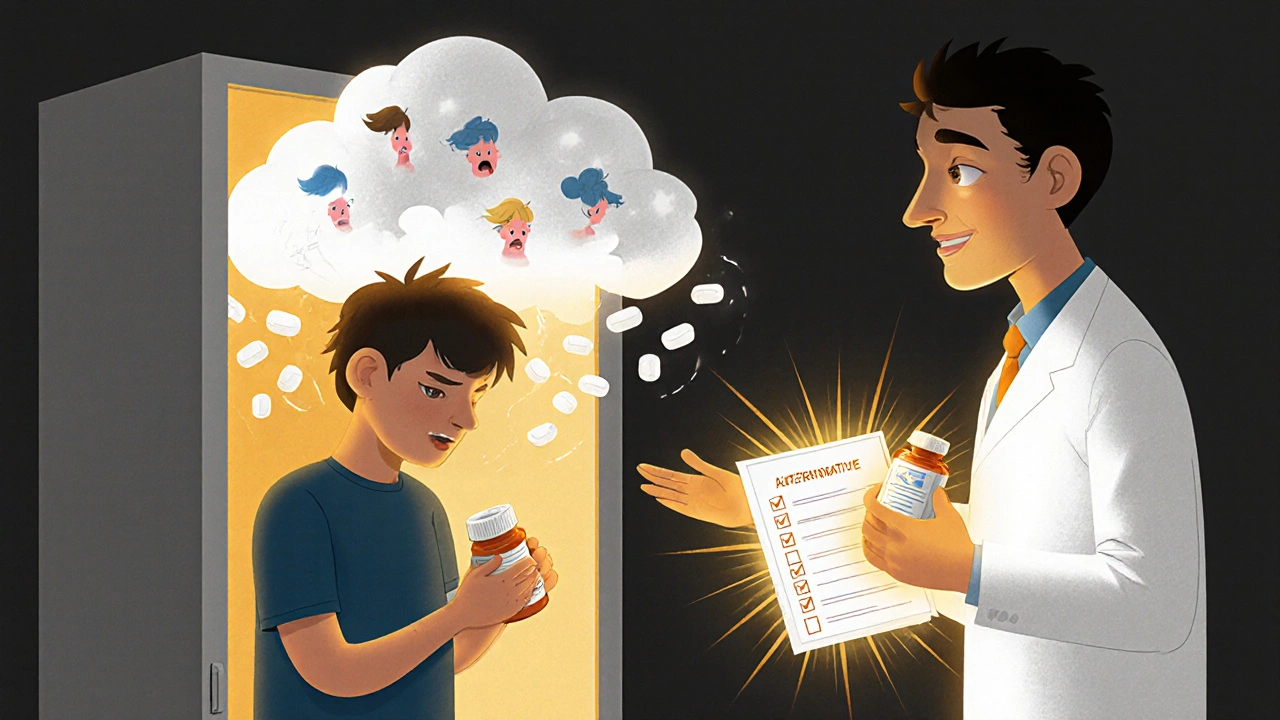
Why You Stop Taking Your Medication (And Why It’s Not Just Forgetting)
You meant to take it. You even set the alarm. But then the headache hit. Or the nausea. Or the dizziness that made you feel like you were on a slow-spinning merry-go-round. So you skipped a dose. Then another. And suddenly, you’re not taking it at all.
This isn’t laziness. It’s not carelessness. It’s a very real reaction to how your body responds to medicine. And it’s happening to millions of people in the U.S. every year. According to the National Library of Medicine, medication adherence means taking your drugs exactly as prescribed-right dose, right time, right frequency. But here’s the hard truth: about half of all people taking meds for chronic conditions don’t stick to the plan. That’s not a small number. That’s 50% of people with high blood pressure, diabetes, depression, or heart disease skipping, delaying, or stopping their meds.
And side effects? They’re the #1 reason why.
The Real Cost of Skipping Doses
It’s easy to think, “I’ll just skip it today-I feel fine.” But skipping meds doesn’t just mess with your health. It messes with the whole system.
In the U.S., nonadherence causes up to 125,000 preventable deaths every year. That’s more than car accidents. It leads to about 25% of all hospitalizations. And the cost? Billions. Each person who stops taking their meds can add up to $44,000 in extra healthcare spending annually. For someone with high cholesterol or diabetes, missing doses isn’t just risky-it’s financially dangerous.
Here’s what happens when you don’t take your meds:
- Your blood pressure spikes, increasing your risk of stroke.
- Your blood sugar goes wild, damaging nerves and kidneys.
- Your depression worsens, making it harder to get out of bed, let alone take pills.
- Your heart condition gets worse, and you end up in the ER.
And here’s the worst part: doctors and pharmacists often don’t even know you’ve stopped. A 2025 study found pharmacists documented nonadherence only 52% of the time-less than doctors or nurses. So you’re not just risking your health. You’re flying blind in your own care.
Side Effects Are the Silent Treatment Killer
Let’s be clear: side effects aren’t just annoying. They’re deal-breakers.
One study showed people with depression were twice as likely to skip their meds because of side effects. That’s not surprising. If your antidepressant makes you feel like a zombie, or gives you terrible nausea, or causes weight gain you didn’t sign up for-you’re going to quit. And once you quit one, you’re more likely to quit others too.
It’s not just mental health. Blood pressure meds can cause dizziness. Cholesterol drugs can cause muscle pain. Diabetes pills can cause stomach upset. And if you don’t know these are normal-or worse, if you think they’re dangerous-you’ll stop.
Here’s the pattern most people don’t realize:
- First, you fill your prescription (only 50-70% of written scripts are even picked up).
- Then you take it for a few days. Side effects start.
- You skip a dose. Then two.
- You stop filling refills. After 90 days, only 15-20% of people are still taking their meds as directed.
That’s not a failure of willpower. It’s a failure of support.
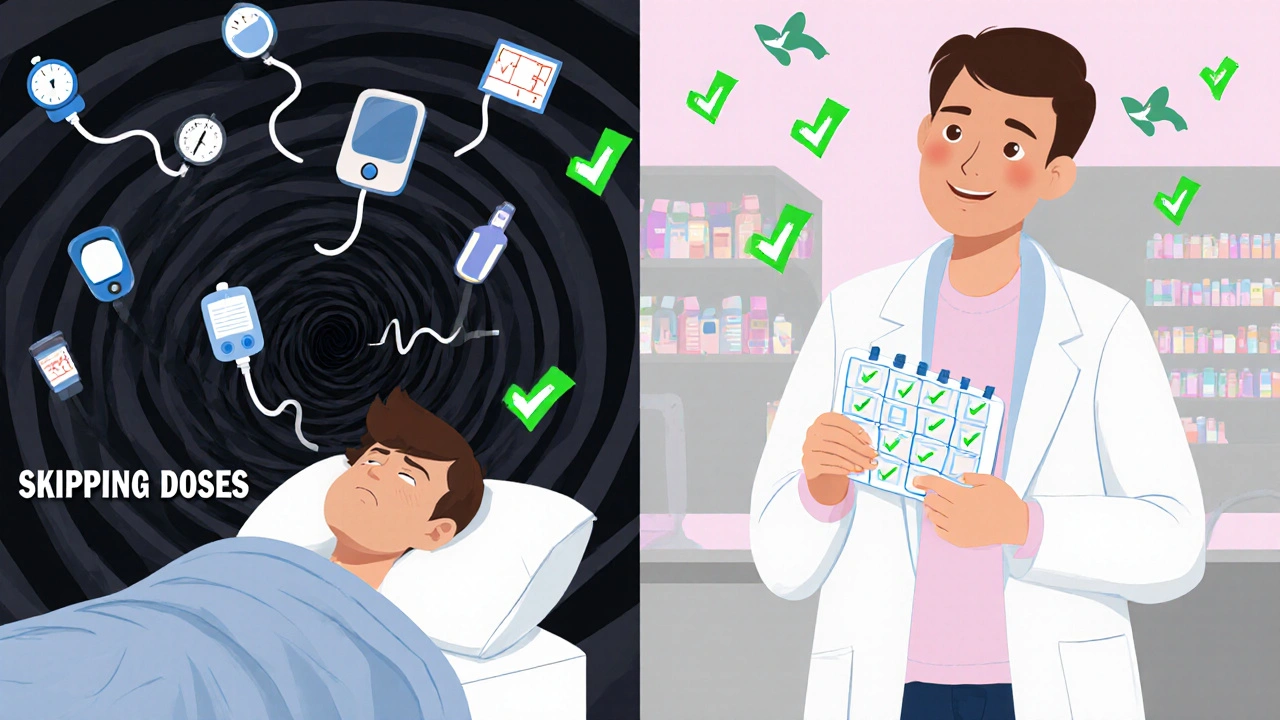
What Works: Real Ways to Stay on Track
You don’t need to suffer through side effects to stay healthy. There are proven ways to keep taking your meds-even when they’re hard to tolerate.
1. Talk to your pharmacist. Not your doctor. Your pharmacist.
Pharmacists are the hidden heroes of medication adherence. They know every drug in your cabinet. They know what side effects are common, what’s dangerous, and what can be fixed. Studies show pharmacist-led interventions boost adherence by up to 40%. And face-to-face visits? They work best-83% success rate.
Ask them:
- “Is this side effect normal?”
- “Can I take this with food to reduce nausea?”
- “Is there a different version of this pill that’s gentler?”
- “Can I split my dose to spread out the side effects?”
They can often switch you to a different brand, adjust timing, or suggest over-the-counter fixes-like ginger for nausea or taking blood pressure meds at night to avoid dizziness during the day.
2. Simplify your routine
Too many pills? Too many times a day? That’s a recipe for failure. Ask your doctor or pharmacist if you can switch to once-daily versions. Many blood pressure and cholesterol meds now come in combo pills. One pill instead of four? Huge difference.
3. Use tools that actually work
Smart pill dispensers? Helpful. Phone alarms? Good start. But the most effective tool? A simple paper checklist taped to your mirror. Or a pill organizer with days of the week. Seeing it physically helps your brain remember. And if you miss a dose, write it down-not to feel guilty, but to track patterns. Are side effects worse in the morning? Maybe take it at night.
4. Don’t suffer in silence
If a side effect is making you feel worse than your condition, tell someone. Don’t wait. Don’t assume it’s “just part of it.” Some side effects can be managed. Others mean you need a different drug. You deserve to feel better-not just survive.
When You’re Afraid It’s More Harm Than Help
Some people stop because they think the medicine is causing more harm than good. That’s a real fear. And it’s not irrational.
But here’s the data: for every 100 people who stop their statin because of muscle pain, only 5-10 actually had a true drug-related reaction. The rest? The pain was from aging, inactivity, or another cause. But without testing, you can’t tell the difference.
That’s why you need professional help. A pharmacist can help you test for true drug reactions. A doctor can run blood work to check for liver or muscle damage. You don’t have to guess.
And if your meds are causing real problems? There’s almost always another option. There are 10+ different blood pressure drugs. 5+ antidepressants. 8+ diabetes pills. You’re not stuck with the first one your doctor gave you.
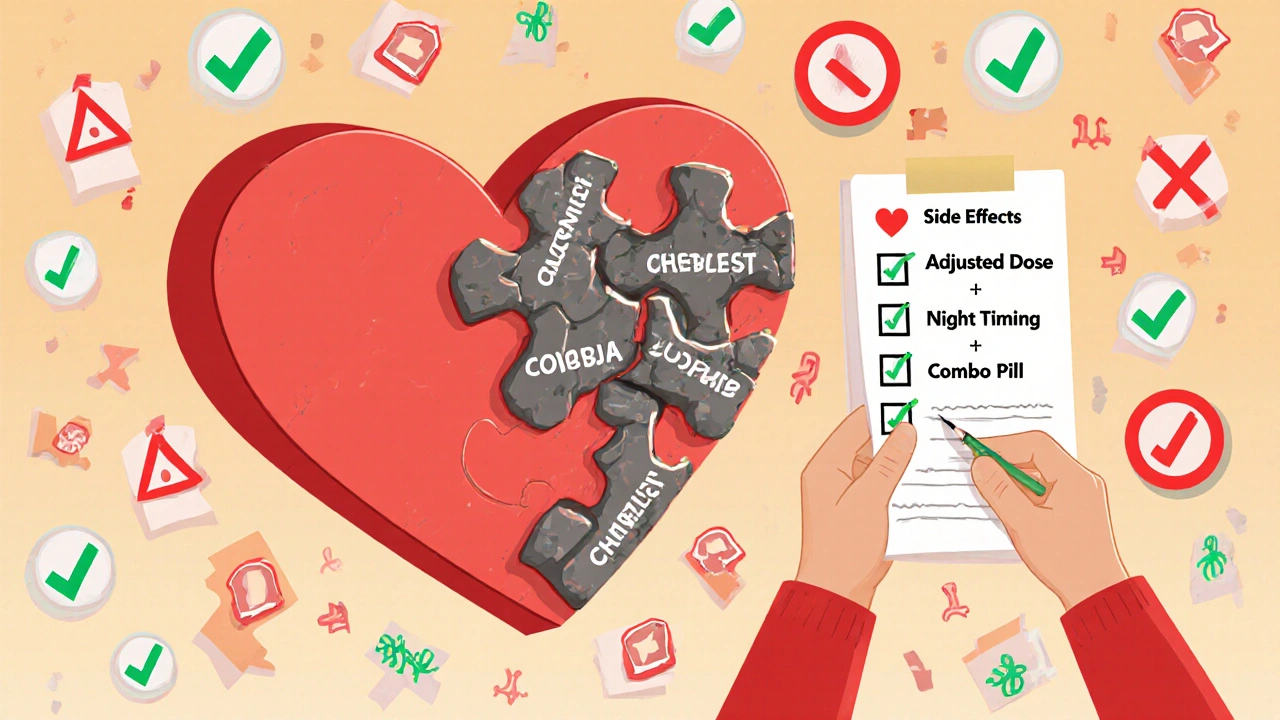
Why This Isn’t Just About You
Medication adherence isn’t a personal failure. It’s a system failure. Our healthcare system still treats pills like magic bullets-hand them out, hope they’re taken, and move on.
But the best care now is proactive. Medicare Star Ratings, HEDIS scores, and insurance reimbursements are now tied to how well patients stick to their meds. That means hospitals and pharmacies are starting to pay attention. Pharmacist-led programs are now common in clinics, and AI tools are being used to predict who’s at risk of quitting-so someone can reach out before they stop.
And it’s working. One study showed patients who got personalized side effect management had 89% adherence-compared to 74% in regular care. That’s not a small win. That’s life-changing.
What You Can Do Today
You don’t need to fix everything at once. Start here:
- Look at your pill bottle. What side effects are listed? Write them down.
- Which ones are you actually feeling? Be honest.
- Call your pharmacy. Ask to speak to the pharmacist. No appointment needed.
- Ask: “Can we make this easier?”
That’s it. No guilt. No pressure. Just one step. Because staying on track isn’t about being perfect. It’s about staying in the game.
Side Effects Don’t Have to End Your Treatment
Medication adherence isn’t about willpower. It’s about smart support. Side effects are real. But they’re not a reason to quit. They’re a signal-something in your treatment plan needs adjusting.
You’re not broken. Your meds might just need tweaking. And you don’t have to figure it out alone.
Reach out. Speak up. Ask for help. Your body-and your future self-will thank you.
Darrel Smith
November 26, 2025 AT 22:59Let me tell you something straight - people aren't failing because they're lazy. They're failing because the system is designed to make them fail. You get handed a pill bottle like it's a magic wand and told to just 'take it.' No explanation. No follow-up. No one asking if you're sleeping, if you're dizzy, if you're crying in the shower because your antidepressant turned you into a robot. And then they wonder why 50% of people quit? DUH. It's not willpower. It's neglect. And it's criminal.
I've seen my dad die twice - once from a stroke, once from being told to 'just take the blood pressure pill' while his pharmacist was on lunch. He didn't skip doses because he forgot. He skipped because he was terrified of the side effects and nobody told him they could be managed. Nobody even asked. That's not healthcare. That's a numbers game.
And don't get me started on the 'smart pill dispensers' they push like they're the answer. My grandma had one. It beeped. It flashed. It didn't stop her from throwing it in the trash because it made her feel like a science experiment. What works? A person. Someone who calls. Someone who cares. Someone who says, 'Hey, I see you're struggling. Let's fix this.' That's not tech. That's humanity.
And yes, pharmacists? They're the real MVPs. But they're overworked, underpaid, and treated like glorified cashiers. Fix the system, not the pillbox. Stop blaming patients. Start blaming the people who hand out prescriptions like candy and walk away.
We treat chronic illness like it's a homework assignment. It's not. It's a full-time job with no pay, no breaks, and no support. And we wonder why people give up? I'm not mad. I'm just tired. And I'm not alone.
Aishwarya Sivaraj
November 27, 2025 AT 12:17so many people think taking meds is about discipline but its really about feeling heard you know? i had a friend on diabetes meds who stopped because her stomach hurt so bad she thought she was dying and no one told her it might go away in 2 weeks or that ginger tea helps. she just felt alone with it. and then she felt guilty for quitting and that made it worse. its not about forgetting alarms its about being scared and unheard. pharmacists are heroes honestly. just talk to one. even if its just for 5 minutes. they know more than you think. and you deserve to feel better not just survive.
also if you feel weird after starting a new med dont wait 3 months to say something. call today. its not weak. its smart.
Iives Perl
November 27, 2025 AT 16:07Ever notice how the ‘common side effects’ are always ‘headache, nausea, fatigue’? Coincidence? Nah. That’s the placebo effect they *want* you to feel. They know you’ll quit… then come back when it gets worse. Profit cycle complete.
Pharmacist? Ha. They’re paid by the same companies. Don’t trust the system. Trust yourself. And maybe go herbal. #BigPharmaLies
steve stofelano, jr.
November 28, 2025 AT 00:50It is with profound respect for the complexities of human behavior and systemic healthcare design that I offer the following observation: medication nonadherence is not an isolated behavioral failure, but rather a systemic symptom of fragmented care delivery, insufficient patient education, and a lack of longitudinal, empathetic engagement. The data presented in this article are not merely statistical-they are human narratives rendered in clinical terms. The pharmacist-led intervention model, with its documented 40% improvement in adherence, represents not merely a procedural adjustment, but a paradigm shift toward patient-centered care. It is imperative that policy, reimbursement structures, and institutional priorities align to elevate the role of the pharmacist as a primary point of contact-not as an ancillary provider, but as a clinical partner in chronic disease management. The cost of inaction is not merely financial; it is moral.
Savakrit Singh
November 29, 2025 AT 10:39shawn monroe
November 29, 2025 AT 17:00Let me break this down in plain terms: your body doesn’t care about your doctor’s script. It cares about how you feel. If your statin gives you muscle pain that feels like you’ve been hit by a truck, your nervous system is screaming ‘DANGER.’ And guess what? It’s probably not even the drug. But no one checks. No one runs a CK test. No one says, ‘Hey, let’s try a different statin or lower the dose.’ Instead, you’re labeled noncompliant. That’s not medicine. That’s medical gaslighting.
And don’t get me started on the ‘one pill a day’ myth. Yeah, combo pills sound great. But if you’re on 8 meds and they cram 3 into one tablet? You’re now taking a chemical cocktail with unknown interactions. And the pharmacist? They’re too busy scanning barcodes to ask if you’re seeing double or if your tongue feels like sandpaper.
Real talk: if you’re skipping doses because you’re terrified of the side effects, you’re not weak. You’re smart. You’re listening to your body. The problem is no one taught you how to talk back to the system. You need a translator. That’s the pharmacist. Go. Now. Bring your bottle. Ask for a med review. They’re legally required to help you. Use it.
And if you’re on antidepressants and feel like a zombie? That’s not ‘normal.’ That’s a dosage issue. Or a drug mismatch. There are 15+ SSRIs. One of them won’t turn you into a ghost. But you’ll never find it if you don’t speak up. Stop suffering in silence. You’re not broken. Your treatment is.
marie HUREL
December 1, 2025 AT 16:43I just wanted to say… I get it. I’ve been there. I stopped my blood pressure meds for six months because I felt so dizzy I couldn’t walk to the fridge. I didn’t tell anyone. I felt ashamed. Like I was letting everyone down. But then I called my pharmacy on a whim - just to ask if it was normal. The pharmacist said, ‘Try taking it at bedtime.’ I did. The dizziness vanished. I’ve been on it for two years now.
It wasn’t willpower. It was a tiny shift. And someone listening. That’s all it took. You’re not alone. And you don’t have to suffer to be ‘good’ at this.
Lauren Zableckis
December 1, 2025 AT 18:03Asha Jijen
December 3, 2025 AT 04:51Edward Batchelder
December 4, 2025 AT 18:52Thank you for this piece. It is rare to see the human experience behind clinical statistics so clearly articulated. I have worked with elderly patients in rural communities, and I can confirm: the greatest barrier to adherence is not forgetfulness, but isolation. Many do not know who to ask. They fear being judged. They assume their discomfort is normal. They believe their doctor has no alternatives.
One of the most powerful interventions I’ve witnessed is a simple community health volunteer who visits weekly - not to enforce compliance, but to sit, listen, and say, ‘Let’s figure this out together.’ That human connection, that quiet presence - it restores dignity. And dignity, more than any pill, keeps people in the game.
Please, if you are reading this and you are struggling - you are not failing. You are surviving. And you deserve better. Reach out. One call. One question. One moment of courage. That is all it takes to begin again.