
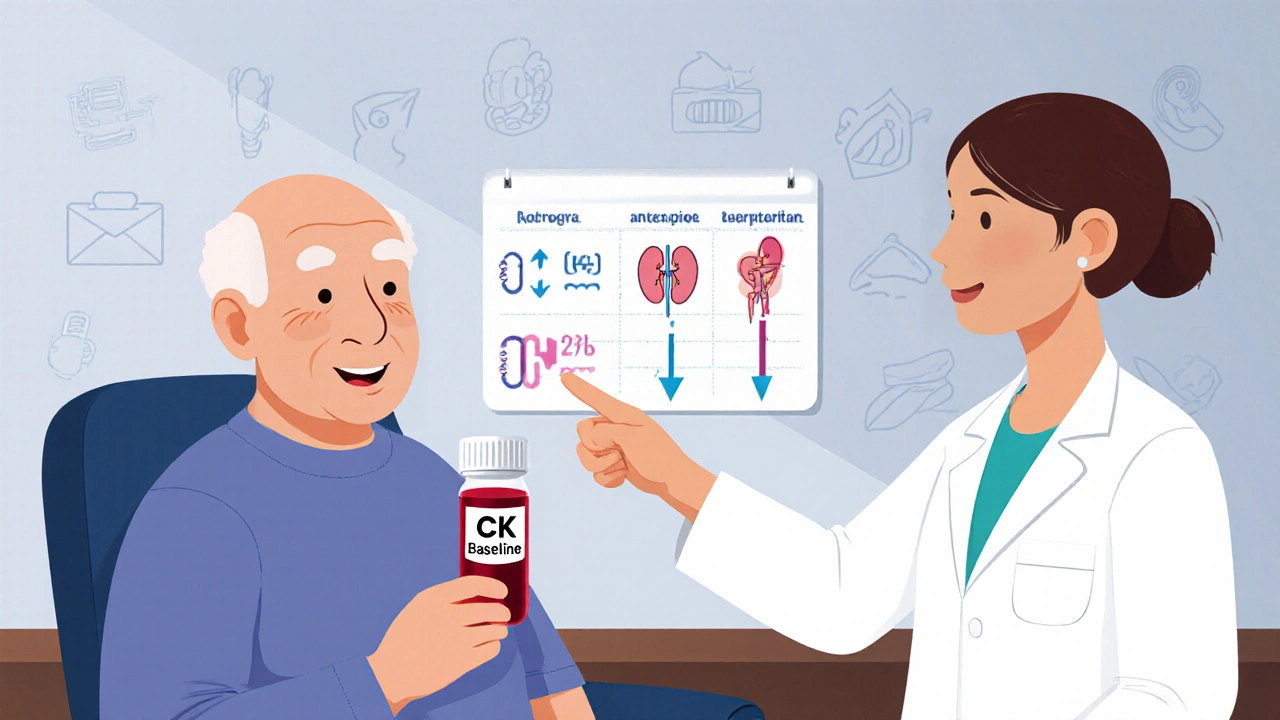
Starting a statin can feel like a big step. You’ve been told it lowers your risk of heart attack or stroke, and you trust your doctor. But then you hear about muscle pain, weakness, or worse-rhabdomyolysis. That’s where a baseline CK test comes in. Not everyone needs it. But for some people, getting this simple blood test before starting statins isn’t just smart-it’s essential.
What Is a CK Test, and Why Does It Matter?
Creatine kinase (CK) is an enzyme found mostly in your muscles. When muscle cells get damaged-whether from intense exercise, an injury, or a drug like a statin-CK leaks into your bloodstream. A blood test measures how much CK is floating around. High levels mean something’s wrong with your muscles. For statin users, this test helps doctors tell the difference between muscle pain caused by the drug and muscle pain caused by something else. Maybe you’ve been hiking more. Maybe you have an undiagnosed thyroid issue. Or maybe you’re one of the rare people who truly can’t tolerate statins. Without knowing your starting CK level, you’re flying blind.Who Actually Needs a Baseline CK Test?
The short answer: not everyone. But certain people have a much higher chance of muscle problems with statins-and for them, a baseline CK test is a must.- People over 75: Aging muscles are more sensitive. Kidney function drops with age, and that changes how statins are cleared from your body.
- Those with kidney problems: If your eGFR is below 60, your body can’t flush out statins as easily. That raises the risk of muscle buildup and damage.
- People taking statins with other drugs: Fibrates (like fenofibrate), amiodarone, or certain antibiotics can boost statin levels in your blood. This combo can push CK levels dangerously high.
- Those with hypothyroidism: About 1 in 8 people starting statins also have an underactive thyroid. Untreated, this condition alone can raise CK levels and mimic statin side effects.
- Anyone who had muscle pain on statins before: If you stopped a statin in the past because of muscle aches, you’re at higher risk again. A baseline test helps decide if you can try another one safely.
- People on high-dose statins: Atorvastatin 40-80 mg or rosuvastatin 20-40 mg carry a slightly higher risk-about 0.3% per year-of serious muscle injury. That’s still rare, but knowing your baseline helps catch problems early.
For healthy adults under 65 with no other risk factors, routine baseline CK testing isn’t recommended. The cost and hassle outweigh the benefit. But if you’re in one of these higher-risk groups? Get the test.
What’s a Normal CK Level? It’s Not What You Think
Lab reports say “normal” CK is between 65 and 195 U/L. But that’s a range. It’s not a single number.- Men typically have higher CK than women-sometimes double.
- African Americans often have CK levels 50-100% higher than other groups, even when perfectly healthy.
- Recent weightlifting, a deep tissue massage, or even a flu shot in the arm can spike CK for days.
That’s why a baseline matters. If your CK was 300 U/L before starting a statin, and it goes to 400 U/L later, you’re probably fine. But if your baseline was 80 U/L and now it’s 800 U/L? That’s a red flag.
Studies show that 25-30% of healthy people have CK levels above the lab’s “normal” range-not because they’re sick, but because their body just works differently. Without knowing your personal baseline, you might get wrongly labeled as having statin toxicity.
When a High CK Level Means Trouble
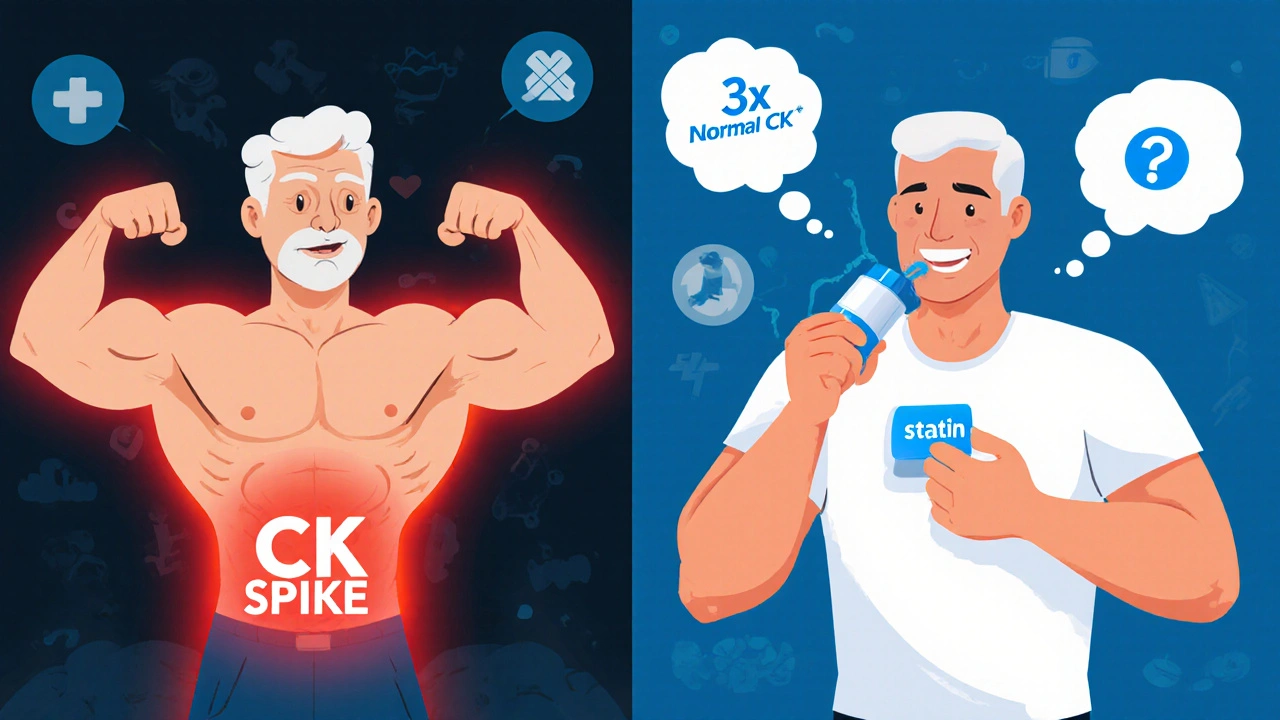
If your CK rises after starting a statin, here’s what doctors look at:- CK under 3x the upper limit of normal with no symptoms? Keep taking the statin. No need to panic.
- CK between 3x and 10x the upper limit and you have muscle pain? Pause the statin. Get checked by your doctor. You might need a lower dose or a different one.
- CK above 10x the upper limit? Stop the statin immediately. This could be rhabdomyolysis-a rare but dangerous condition that can damage your kidneys.
Important: CK levels alone don’t tell the whole story. A patient with CK at 5x ULN but no pain and normal kidney function might be fine. Another with CK at 4x ULN and severe weakness needs help fast. Doctors weigh symptoms, kidney function, and CK together.
Why Some Experts Say Skip the Test
Not everyone agrees that baseline CK testing is worth it. Some argue it causes more harm than good. A 2016 Cochrane review of nearly 48,000 patients found no difference in muscle injury rates between people who got baseline CK tests and those who didn’t. In other words, testing didn’t prevent harm-it just created more anxiety. In Canada, a 2023 analysis found that baseline CK testing costs $14.7 million a year. But only 1.2% of abnormal results actually changed treatment. That’s a lot of money for very little gain. Plus, many patients panic when they see a “high” CK on their lab report-even if it’s normal for them. They quit their statin, then end up having a heart attack they could’ve avoided. Dr. John Kastelein, a top European heart specialist, says: “Baseline CK testing creates false positives and unnecessary anxiety without improving clinical outcomes.”When the Test Actually Saves Time and Money
But here’s the flip side. A 2023 registry of over 84,000 statin users showed that clinics that routinely checked baseline CK had 22% fewer unnecessary statin discontinuations. Why? Because when a patient said, “My legs hurt,” the doctor could say, “Your CK was 280 before you started this drug. Now it’s 310. That’s not your statin. Let’s look at your vitamin D or your shoes.” That’s huge. Stopping a statin in someone who needs it for heart protection can raise their risk of heart attack by up to 50% in the first year. Avoiding that mistake saves lives-and about $2,850 per person in avoided hospital visits and repeat prescriptions. Dr. Robert Giugliano from Brigham and Women’s Hospital puts it simply: “Baseline CK is most useful when someone says they have muscle pain. It helps us decide: Is this the drug, or is it something else?”
What to Do Before the Test
If your doctor recommends a baseline CK test, here’s how to make sure it’s accurate:- Avoid intense exercise for 48 hours before the blood draw. Even a long hike or heavy lifting can raise CK.
- Tell your doctor about any recent injections (like vaccines or cortisone shots) in your arms or legs.
- Let them know if you’ve been sick, had a fall, or started a new supplement.
- Don’t skip your statin unless told to. The test is meant to reflect your real-world state.
And always ask for the actual number-not just “normal” or “abnormal.” Write it down. You’ll need it later if symptoms show up.
What Comes Next? Genetic Tests and New Tools
Science is moving beyond CK. Some people carry a gene variant called SLCO1B1 that makes them more likely to get muscle pain from simvastatin. Testing for this gene can predict risk before you even start a statin. But it’s not widely used yet. It’s expensive. Insurance doesn’t always cover it. And it only applies to certain statins. Meanwhile, point-of-care CK devices are in clinical trials. Imagine getting your CK result during your appointment-no waiting days for the lab. If these tools become standard, baseline testing could become routine, not optional.The Bottom Line
Baseline CK testing isn’t for everyone. But if you’re over 65, have kidney issues, take other medications, or have a history of muscle pain on statins-it’s one of the smartest things you can do. It’s not about fear. It’s about clarity. It helps your doctor know whether your muscle pain is from the statin… or from something else entirely. And that can mean the difference between staying healthy on your medication-or stopping it too soon and putting your heart at risk.Ask your doctor: “Do I need a baseline CK test before starting this statin?” If they say no, ask why. If they say yes, make sure you get the number. Write it down. Keep it with your meds list.
Because when it comes to statins, the right test can keep you on the right drug-for life.
Debbie Naquin
November 30, 2025 AT 21:34CK as a biomarker is fundamentally flawed because it’s non-specific by design-muscle damage isn’t monolithic, and the enzyme’s half-life varies wildly across populations. We’re treating a noisy signal like a diagnostic oracle. The real issue isn’t the test-it’s the clinical overinterpretation of a biochemical artifact.
ariel nicholas
December 2, 2025 AT 12:16Why are we even doing this? In America, we turn every damn thing into a lab test! Back in my day, you didn’t need a blood draw to know if your legs hurt from lifting weights or from statins-you just stopped the damn pill and saw if it went away! Now we’ve got people crying over numbers that mean nothing!
Rachel Stanton
December 3, 2025 AT 09:29This is such a nuanced topic-and I love how you broke it down. For patients with polypharmacy or comorbidities, baseline CK is a safety net, not a hurdle. It’s not about fear-it’s about context. I’ve seen so many older patients stop statins because their CK was ‘high’-only to find out they had undiagnosed hypothyroidism. The test didn’t cause anxiety-it revealed the real problem.
Doctors need to sit with patients and say: ‘Your baseline was 320. Now it’s 340. That’s you. Not toxicity.’ That conversation changes everything.
Amber-Lynn Quinata
December 3, 2025 AT 22:50Ugh. I just had my CK tested and it was 420!!! My doctor said ‘it’s fine’ but I KNOW something’s wrong!! I’ve been feeling weak since I started the pill!! And now I’m scared to take it!! 😭 I just want to be healthy but I feel like I’m being gaslit by the medical system!! 🤬
Lauryn Smith
December 4, 2025 AT 02:08I’m 68 and started a statin last year. My CK was 280 before. Now it’s 295. No pain. No issues. My doc said ‘that’s your normal.’ I wrote it down. I didn’t panic. I just kept taking it. If you’re not hurting and your numbers are stable, don’t freak out. Statins saved my life. Don’t let a number scare you away.
Bonnie Youn
December 5, 2025 AT 08:13STOP OVERCOMPLICATING THIS!! If you’re over 65, on multiple meds, or have kidney issues-GET THE TEST. PERIOD. If you’re young and healthy and just scared because you read a scary article-stop it. Statins prevent heart attacks. CK tests prevent unnecessary panic. Do the test. Write the number. Keep moving. Your heart will thank you 💪
Edward Hyde
December 5, 2025 AT 23:42This whole thing is a cash grab disguised as medicine. Labs make bank on CK tests. Pharma doesn’t care as long as you keep taking the pill. Meanwhile, people are getting scared off life-saving meds because some intern saw ‘high CK’ and panicked. We’ve turned healthcare into a horror movie with lab reports.
Charlotte Collins
December 7, 2025 AT 00:21Let’s not pretend this is about patient care. The 2016 Cochrane review is the real story here: zero benefit in outcomes. The 2023 Canadian analysis? $14.7 million spent for 1.2% clinical impact. That’s not medicine-that’s administrative theater. And now we’re rewarding anxiety with blood draws instead of addressing the real issue: poor patient education.
People don’t need more tests. They need better communication. And a damn placebo-controlled conversation about risk.
Margaret Stearns
December 8, 2025 AT 22:35My CK was 190 before starting statin. Now it's 210. I didn't know normal ranges vary by race and gender until I read this. I'm black and male. My doctor didn't explain that. I thought I was sick. I almost quit. Please tell your patients their baseline isn't a universal number. Thank you for this post.
amit kuamr
December 10, 2025 AT 07:42In India we dont do this test. People take statins and live long. Why are you Americans so scared of everything? Muscle pain is normal when you get old. Take painkiller. Dont waste money on blood test. Your system is broken.
Scotia Corley
December 10, 2025 AT 09:37It is imperative to underscore that the absence of clinical guidelines mandating baseline creatine kinase assessment does not equate to clinical irrelevance. The data from the 2023 registry of 84,000 patients demonstrates a statistically significant reduction in inappropriate statin discontinuation, thereby preserving cardiovascular benefit. This is not anecdotal-it is evidence-based stewardship.
elizabeth muzichuk
December 12, 2025 AT 02:45I’ve been waiting for someone to say this. My doctor refused to order the test. Said I was ‘too young.’ I’m 58. I had muscle pain on a statin before. I went to three other doctors. All said ‘it’s in your head.’ I finally got the test on my own. My CK was 380. I started a new statin. Now it’s 410. I’m still on it. No pain. I almost died because they didn’t listen. This isn’t about medicine. It’s about being heard.
Kelly Essenpreis
December 12, 2025 AT 05:23So we're paying for a test that doesn't prevent anything? And now we're telling people to write down numbers like they're keeping a diary? Next they'll make us track our sneezes before taking aspirin. This is the dumbest thing I've read all week. Statins are fine. Stop overtesting.
Alexander Williams
December 13, 2025 AT 17:12SLCO1B1 genotyping is the future. CK is a blunt instrument. We’re using a hammer when we need a scalpel. The pharmacogenomic data is solid-especially for simvastatin. But insurance won’t cover it because it’s not profitable. So we default to CK, which is cheaper to bill but worse for patients. That’s not science. That’s capitalism.
Suzanne Mollaneda Padin
December 14, 2025 AT 03:29I’m a nurse in rural Texas. We don’t have easy access to labs. But we do have patients who can’t afford to stop statins. I tell them: if you’re not hurting, and you’ve been on it for a while, don’t panic. But if you’re new to statins and have risk factors? Ask for the test. Write the number. Bring it back next time. Simple. No drama. Just care.