
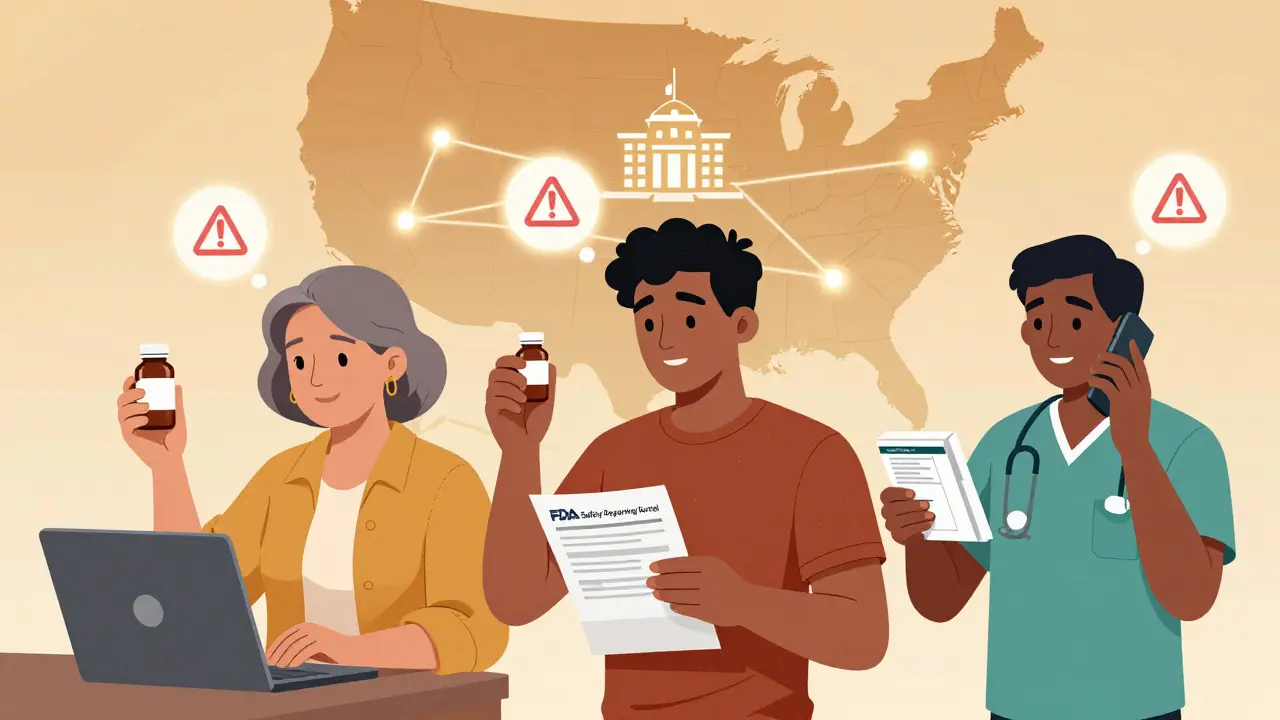
Every year, thousands of people in the U.S. experience unexpected side effects from medications, faulty medical devices, or contaminated supplements. But most never report them. If you’ve had a bad reaction to a drug, noticed a device malfunction, or seen a product that didn’t work as it should, you have the power to alert the FDA-and you don’t need to be a doctor to do it.
What counts as a reportable issue?
You don’t need to be sure something is dangerous to report it. The FDA wants to hear about anything serious or unusual. That includes:- Severe side effects like allergic reactions, liver damage, seizures, or unexplained bleeding
- A medical device that broke, stopped working, or gave incorrect readings (like a glucose monitor showing wrong numbers)
- A drug that didn’t work at all, even when taken exactly as directed
- Product contamination-like pills with foreign objects, or insulin pens leaking
- Use errors that weren’t your fault-like a label that was unclear or a device that was hard to use as intended
Even if you think it’s "just one case," your report could be the clue that leads to a safety warning or recall. The FDA’s own data shows that patient reports are 2.3 times more likely than other reports to describe new ways people misuse or accidentally harm themselves with a product.
How to file a report: 4 ways to submit
The FDA gives you four ways to report, so you can pick what works for you.- Online via the Safety Reporting Portal (SRP) - This is the fastest method. Go to safetyreporting.hhs.gov and fill out the FDA Form 3500. It walks you through each step. But be warned: since August 2024, the portal has had frequent crashes and timeouts. If it fails, try again later or switch to another method.
- Print and mail the paper form - Download the FDA Form 3500 (or the Spanish version, 3500B) from the FDA website. Fill it out by hand or type it, then mail it to: FDA MedWatch, 5600 Fishers Lane, Rockville, MD 20852. This method works even when the website is down. Many patients who’ve had trouble with the portal say this is their go-to.
- Call the FDA - Dial 1-800-FDA-1088 (1-800-332-1088) between 8 a.m. and 8 p.m. Eastern Time, Monday through Friday. A specialist will take your report over the phone and file it for you. This is helpful if you’re not comfortable typing or if you’re dealing with a medical emergency.
- Use a manufacturer’s app or portal - Some companies, like Medtronic, now let you report directly through their apps. But remember: these reports still need to go to the FDA to count in official safety tracking. Ask if your device maker sends reports automatically.
What information do you need?
You don’t need to be a medical expert, but having these details ready makes your report more useful:- Product details: Brand name, generic name, lot number, expiration date. (Lot numbers are often printed on the box or bottle. If you can’t find it, skip it-your report still counts.)
- Your info: Age, sex, weight. You don’t have to give your name, but providing contact info helps if the FDA needs to follow up.
- The event: What happened? When did it start? How long did it last? Did you go to the hospital? Did it get better? Use plain language: "I felt my heart racing after taking the pill," not "I experienced tachycardia."
- Other meds: List any other drugs, supplements, or OTC products you were taking at the time.
The FDA’s own analysis shows that patient reports lacking product details (like lot numbers) are 41% more likely to be incomplete. But even partial reports can trigger alerts. One report in early 2024 about insulin pens leaking in the fridge led to a safety notice after 287 similar reports came in.
Why your report matters
Clinical trials test drugs on a few thousand people. Real life? Millions. That’s where problems hide.For example, a drug might cause a rare heart rhythm issue only visible after years of use. Or a glucose meter might work fine in the lab but fail in cold weather. These issues rarely show up in trials-but they show up in patient reports.
Studies show patient reports contain 37% more detail about when symptoms started and 28% more info about over-the-counter meds taken alongside prescriptions. That’s because you know your body better than any doctor can from a chart.
The FDA says patient reports helped trigger 17 safety actions in 2023 and 2024 alone. That includes changes to warning labels, product recalls, and even new guidelines for how to use certain devices.

What you won’t get
It’s important to know what to expect after you file:- No immediate response: The FDA doesn’t call you back. They don’t investigate every report individually. They look for patterns.
- No medical advice: The FDA won’t tell you what to do about your symptoms. Talk to your doctor.
- No guarantee of action: Not every report leads to a change. But every one adds to the data.
Also, don’t expect a confirmation email right away. Only 34% of patients know they get one within five business days. Check your spam folder. If you don’t see it, you can call 1-800-FDA-1088 to ask if your report was received.
Common problems-and how to avoid them
Most people who file reports face the same hurdles:- The website crashes. Try early in the morning or late at night. Or just use the paper form.
- Can’t find the lot number. Check the packaging, the bottle, or the receipt. If it’s gone, write "not available." The FDA accepts that.
- Don’t know how to describe symptoms. Use simple words. "My arm went numb after the injection," not "I developed paresthesia."
- Think it’s not serious enough. If it scared you, it’s worth reporting. The FDA says even "minor" issues can be early signs of bigger problems.
One patient in Boston reported her insulin pen leaking after she dropped it. She didn’t think much of it-until she found three others online with the same issue. The FDA issued a warning two months later.
Your privacy is protected
You might worry about privacy. But under FDA rules (21 CFR 10.75), your name and contact info are confidential. They can’t be shared without your permission. Only 32% of patients know this. You’re not just reporting-you’re helping protect others.
What’s changing in 2025 and beyond
The FDA is working on big upgrades:- Next Generation Safety Reporting System (NGSRS): Launched in January 2025, this new system automatically checks lot numbers and uses AI to categorize symptoms faster.
- Faster processing: Reports now take 9 business days to enter the system-down from 22.
- More languages: By 2027, you’ll be able to report in Spanish, Mandarin, Vietnamese, Arabic, and French.
- One portal for everything: Right now, you need different forms for drugs, devices, and supplements. By 2028, the FDA plans to merge them into one system.
These changes mean your report will matter more than ever.
What to do next
If you’ve had a bad experience with a medication, device, or supplement:- Write down what happened-dates, symptoms, product names.
- Go to safetyreporting.hhs.gov or call 1-800-FDA-1088.
- Submit your report-even if you’re not sure it’s "important enough."
- Keep a copy of your submission for your records.
One report won’t change the system. But 10,000? That’s how safety alerts start.
Can I report an adverse reaction if I didn’t take the product myself?
Yes. You can report on behalf of a family member, caregiver, or even a pet (for veterinary products). The FDA accepts reports from anyone who witnessed the event or has access to the medical records. Just indicate your relationship to the patient on the form.
Do I need a doctor’s note to file a report?
No. You don’t need medical documentation to file a patient report. The FDA accepts your personal account of what happened. However, including details like hospital visits, lab results, or doctor’s diagnoses can help them evaluate the report more fully-but it’s not required.
What if I don’t know the product’s lot number?
You can still file the report. Lot numbers are helpful but not mandatory. If you don’t have the box or bottle, write "unknown" or "not available." The FDA still processes these reports. In fact, nearly 40% of patient reports lack lot numbers, and many have led to safety actions.
Can I report a problem with a dietary supplement or cosmetic?
Yes. The FDA regulates dietary supplements and cosmetics under the same reporting system. If you had a reaction to a weight-loss pill, a skincare cream, or a hair dye, file a report. These products aren’t tested as rigorously as drugs, so patient reports are especially important.
Will filing a report get me in trouble if I misused the product?
No. The FDA’s goal is safety, not punishment. Even if you took a drug differently than directed, your report helps them understand how people actually use products. Misuse patterns are a key part of safety monitoring. Your report will not be used against you.
Final thoughts
You don’t need to be a scientist or a doctor to make a difference. Your lived experience with a medication or device is valuable data. The FDA doesn’t have eyes everywhere-but when patients speak up, they see what clinical trials never could.Don’t wait for someone else to report it. If something felt wrong, it probably was. Take five minutes. File the form. You might save someone else from the same problem.
Jasmine Yule
December 30, 2025 AT 10:59I reported my insulin pen leak last year after dropping it-thought it was just me. Turns out, 287 others had the same issue. FDA issued a warning two months later. Don’t underestimate your story. It matters. 💥
Greg Quinn
December 31, 2025 AT 01:52It’s wild how clinical trials miss so much. Millions of real people using stuff in real life-cold kitchens, tired moms, kids mixing meds-that’s where the real data lives. The FDA’s system is clunky, but it’s the only thing we’ve got to turn pain into protection.
Lisa Dore
December 31, 2025 AT 08:39If you’re reading this and hesitating-just do it. Five minutes. One form. You’re not just protecting yourself-you’re protecting someone’s mom, their kid, their grandpa. I reported my daughter’s reaction to a supplement last spring. No response, no email-but I slept better knowing I tried. You’re not alone in this. 🤍
Manan Pandya
January 1, 2026 AT 16:46It is important to note that while the FDA accepts reports without lot numbers, approximately 41% of incomplete reports lack critical product identifiers, which may delay pattern recognition. Nevertheless, even partial submissions contribute meaningfully to aggregate safety analytics. Always include date of onset, duration, and concomitant medications if possible.
Paige Shipe
January 1, 2026 AT 20:58Why is this even a thing? The government can't even keep a website up. I had to mail a form in 2023 because the portal crashed 17 times. And now they're talking about AI and Mandarin translations? Fix the basics first. Also, why do I have to explain that my arm went numb? Why can't they just listen?
David Chase
January 3, 2026 AT 06:17AMERICA NEEDS TO STOP LETTING PEOPLE REPORT THINGS LIKE THIS WITHOUT VERIFICATION!! 🤬 This isn’t a Yelp review! People lie! I bet half these reports are from people who didn’t read the label! And now they want to add FIVE MORE LANGUAGES?! We’re drowning in noise while real doctors get ignored! 🇺🇸🔥
Emma Duquemin
January 3, 2026 AT 20:09OMG I JUST REALIZED-I reported my weird rash from a new skincare cream last fall and forgot all about it. Then last month, the FDA sent out a recall notice for that exact brand. I almost cried. I didn’t think I was doing anything, but I was part of the chain. You don’t need a PhD to be a hero. Just a phone, a memory, and the guts to hit submit. 🙌💥
Kevin Lopez
January 4, 2026 AT 17:13Adverse event reporting is a data pipeline, not a therapy session. The FDA’s system is designed for signal detection, not individual validation. Lot numbers are mandatory for traceability. Lack thereof reduces actionable fidelity by 41%. Submitting without them is statistically noise. Don’t romanticize the process.
Duncan Careless
January 6, 2026 AT 09:32Just wanted to say thanks for this. I reported my wife’s reaction to a blood pressure med last year. Didn’t know if it’d go anywhere. Got a confirmation email after 6 days-thought it was spam. Turns out, it was real. Small thing, but it helped. Keep going, folks. We’re all in this together.