
Prescription Abbreviations: What They Mean and Why They Matter
When you see prescription abbreviations, shortened forms of medical terms used by doctors and pharmacists to write orders quickly. Also known as drug order shorthand, these codes are everywhere—from your pill bottle to your doctor’s notes. But if you don’t know what they stand for, you could miss critical dosing info or take meds at the wrong time. A simple mistake like reading "q.d." as "every day" instead of "once daily" might seem harmless, but it’s how errors start. The FDA and WHO have warned that misinterpreted abbreviations cause thousands of preventable medication errors every year.
These abbreviations aren’t just random shortcuts. They’re tied to real-world systems like drug labels, official documents that list how a medicine should be used, its risks, and its interactions. When you look up a drug on the FDALabel Database, the FDA’s official source for detailed drug information, you’ll find these same abbreviations used in sections like "Dosage and Administration" or "Warnings." For example, "BID" means twice a day, "TID" is three times a day, and "QHS" means before bed. Even "PRN"—which stands for "as needed"—can be dangerous if you don’t know the limits. Some patients take extra doses thinking "as needed" means "whenever I feel like it," but that’s how overdoses happen.
These codes also show up in pharmacy terms, the language pharmacists use to process and explain prescriptions. When your pharmacist says "Sig: ii tab po qd," they’re telling you to take two pills by mouth once daily. If you don’t understand that, you’re relying entirely on someone else to get it right. And while most pros know these codes, not everyone does—especially older patients or those on multiple meds. That’s why the Joint Commission and other safety groups have pushed to ban dangerous abbreviations like "U" for unit (which can look like a zero) or "q.o.d." (every other day, which is often confused with daily).
You don’t need to memorize every abbreviation, but knowing the top 10 can save your life. Look at your prescription label. If you see something like "q4h," "AC," or "HS," ask your pharmacist to spell it out. Don’t guess. Many of the posts below show how small misunderstandings lead to big problems—like INR spikes from antibiotics, muscle breakdown from statin combos, or heart rhythm issues from QT-prolonging drugs. All of those risks can be worsened by misreading a prescription. The good news? You don’t need a medical degree to protect yourself. Just learn what the abbreviations mean, write them down, and double-check with your pharmacist every time you pick up a new script.
Below, you’ll find real-world guides that connect prescription abbreviations to actual drug safety issues—from how to read FDA labels correctly to why certain drug combinations turn dangerous when dosing is off. These aren’t theory pieces. They’re practical tools built by people who’ve been there. Whether you’re managing antidepressants, warfarin, or antibiotics, understanding these codes isn’t optional. It’s your first line of defense.
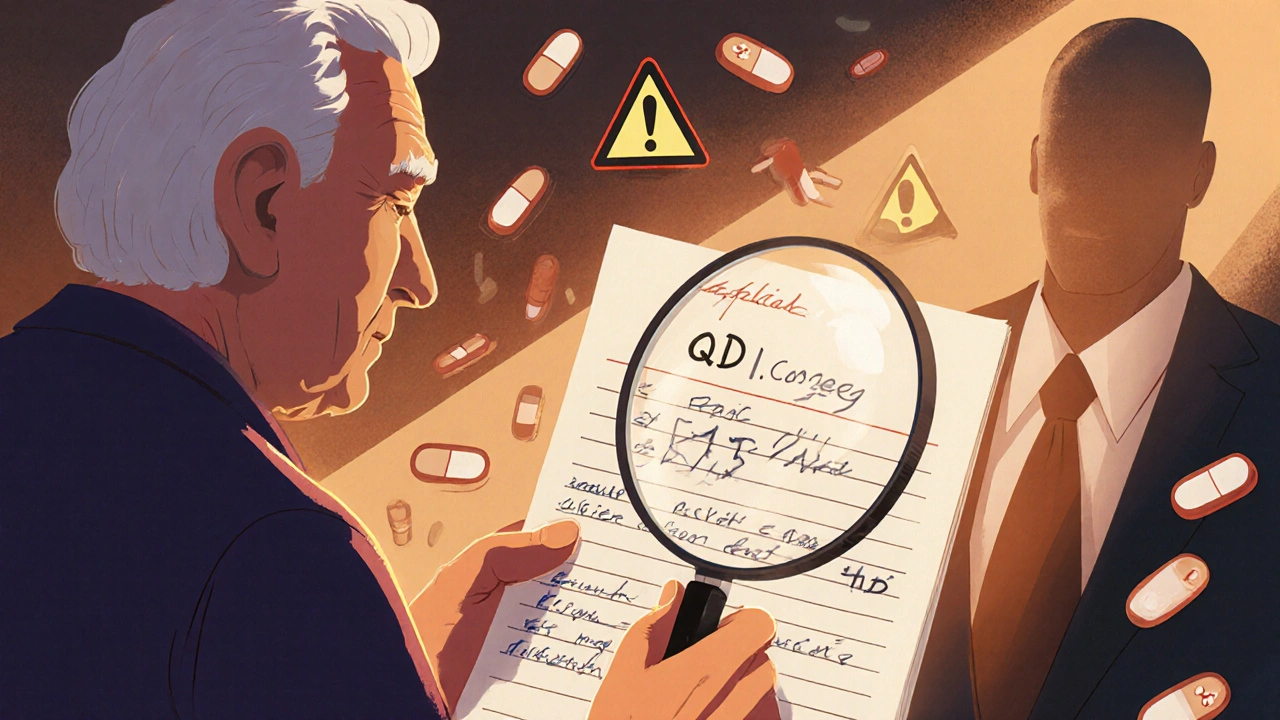
QD vs. QID: How Prescription Abbreviations Cause Dangerous Medication Errors and How to Stop Them
- by Colin Edward Egan
- on 25 Nov 2025
QD and QID are dangerous prescription abbreviations that cause patients to take four times the intended dose. Learn why they're still used, how they lead to deadly errors, and what’s being done to stop them.