
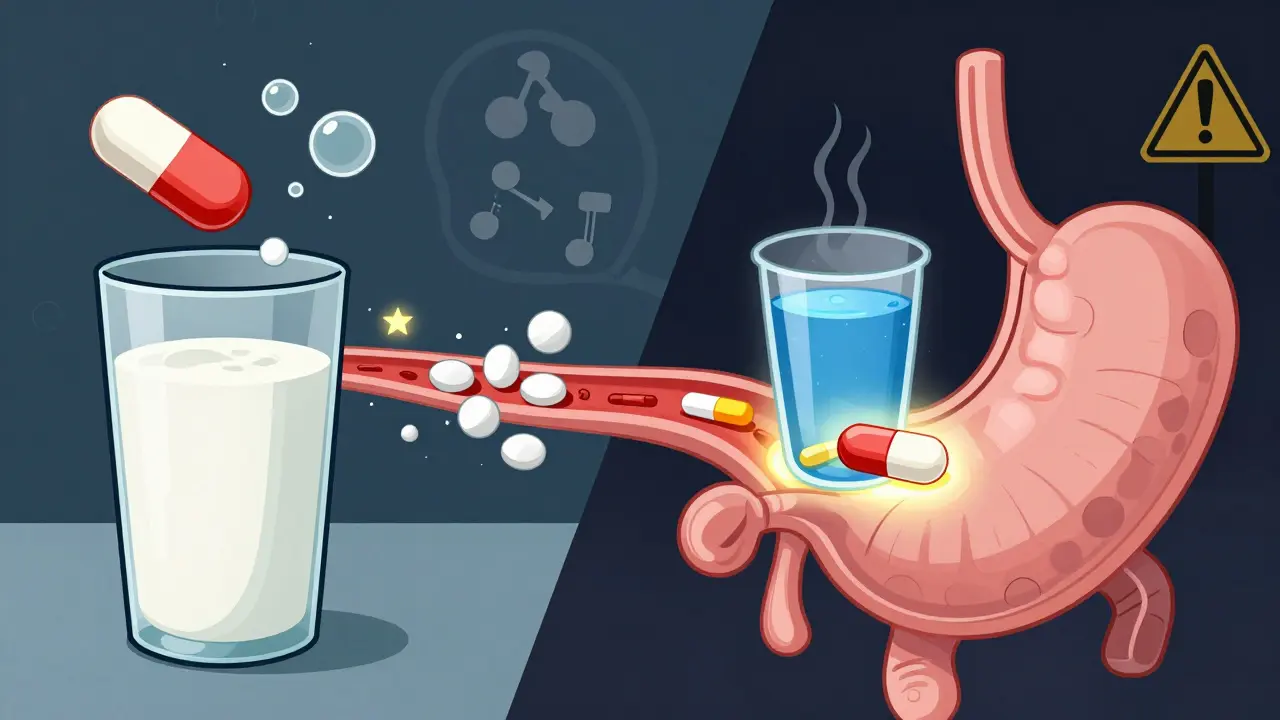
Ever taken a pill and wondered if it really matters whether you ate first? It’s not just a habit-it’s science. Taking your prescription medicine with food or on an empty stomach can make the difference between it working perfectly and not working at all. For some drugs, eating the wrong thing at the wrong time could mean your treatment fails. For others, skipping food could land you in the ER with stomach bleeding. This isn’t guesswork. It’s based on decades of research and real-world outcomes.
Why Food Changes How Your Medicine Works
Your stomach isn’t just a place where food sits. It’s a chemical factory. When you eat, your body releases acid, bile, and enzymes. Blood flow changes. Your gut starts moving. All of this affects how your medicine gets into your bloodstream. Some drugs need stomach acid to dissolve properly. Take tetracycline or doxycycline with milk, cheese, or antacids, and the calcium binds to the drug. That means up to 50% less of it gets absorbed. You’re not just wasting your pill-you’re risking the infection coming back stronger. On the flip side, high-fat meals can boost absorption. The HIV drug saquinavir works 40% better when taken with a fatty meal. Grapefruit juice? It can make that number even higher by blocking enzymes that break down the drug. That sounds great, but it’s dangerous without medical supervision. Too much absorption can lead to toxicity. For drugs like levothyroxine (used for hypothyroidism), food can slash absorption by as much as 55%. That’s why doctors insist you take it 30 to 60 minutes before breakfast. Miss that window, and your thyroid levels stay off. Over time, that can lead to fatigue, weight gain, or heart problems.Medications That Need Food
Many common prescriptions are designed to be taken with meals-not because they’re better absorbed, but because they’re less harsh on your stomach. NSAIDs like ibuprofen, naproxen, and aspirin are classic examples. These drugs irritate the stomach lining. Taking them on an empty stomach increases your risk of ulcers and bleeding. The UK’s NHS and German medical guidelines both recommend taking them after eating. One study found that taking ibuprofen with food cut nausea by 20%. But here’s a twist: some experts argue NSAIDs should be taken on an empty stomach for faster pain relief. A 2015 review in Inflammopharmacology found no real benefit to taking them with food, and claimed the number needed to harm (for stomach issues) was so low, it barely mattered. Still, for older adults or anyone with a history of ulcers, playing it safe with food is the smart move. Antibiotics like amoxicillin/clavulanate (Augmentin) and nitrofurantoin also go better with food. The same study that showed reduced nausea also found these drugs stayed active in the body longer when taken with meals-up to two hours instead of 20 minutes. That means fewer doses and better coverage. HIV medications like ritonavir and zidovudine (AZT) are notorious for causing nausea. Patients on Reddit’s r/HIV forum reported that taking ritonavir with a small high-fat snack-like peanut butter on toast-dropped nausea from 45% down to 18%. That’s not luck. It’s pharmacology.Medications That Must Be Taken on an Empty Stomach
Some drugs are like delicate flowers. They can’t handle food at all. Levothyroxine is the most common. Even a cup of coffee or a bowl of oatmeal can interfere. That’s why your doctor tells you to take it first thing in the morning, then wait at least half an hour before eating. Studies show that if you eat too soon, your body absorbs 20% to 55% less of the hormone. That’s enough to throw your entire treatment off track. Didanosine, another HIV drug, gets destroyed by stomach acid. Food increases acid production, which means the drug breaks down before it can be absorbed. You need to take it on an empty stomach-ideally, one hour before or two hours after eating. Tetracycline and doxycycline bind to calcium, iron, magnesium, and aluminum. That means no dairy, no antacids, no iron supplements, and no fortified cereals within two hours of taking them. Even a glass of milk can cut effectiveness in half. Bisphosphonates like alendronate (Fosamax), used for osteoporosis, are even stricter. You need to take them with a full glass of water, then sit upright for 30 minutes. No food, no drinks (except water), no lying down. If you don’t, the drug can burn your esophagus.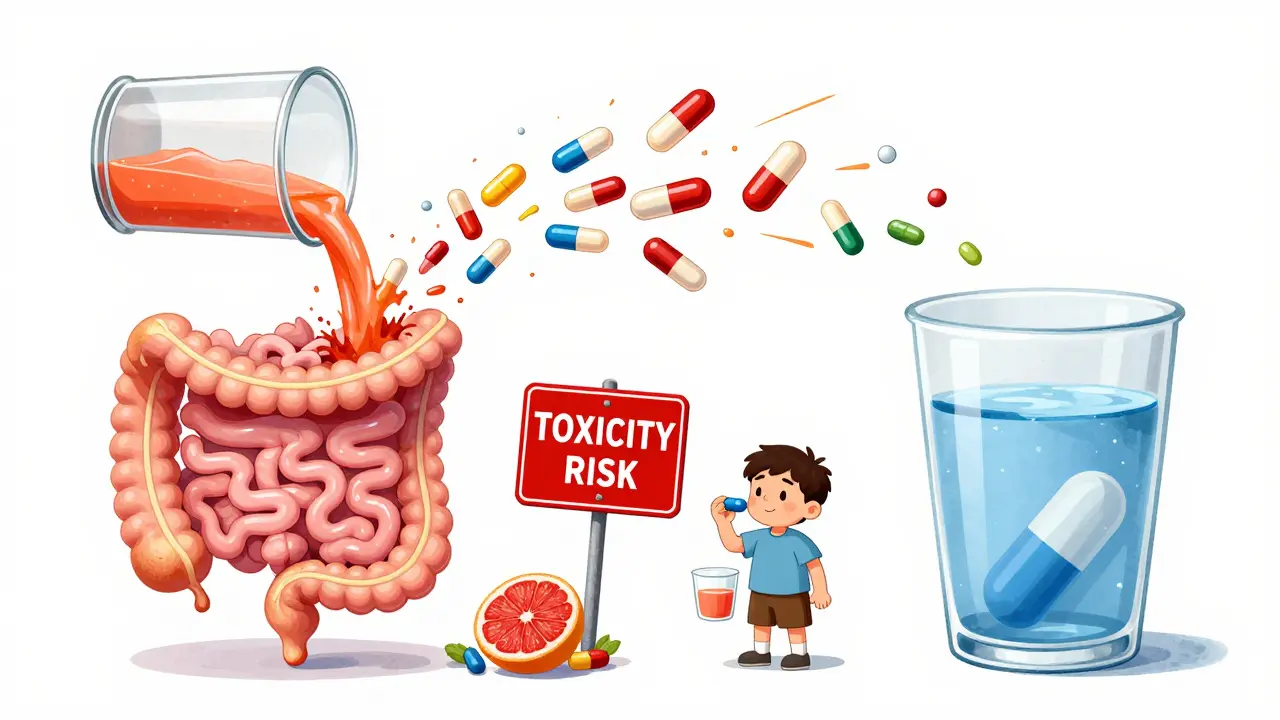
What About Grapefruit Juice? And Coffee?
Grapefruit juice isn’t just a breakfast staple-it’s a drug interaction wildcard. It blocks an enzyme called CYP3A4 in your gut, which normally breaks down certain medications. That means more drug enters your bloodstream. For drugs like saquinavir, that’s helpful. For statins like simvastatin or blood pressure meds like felodipine, it’s dangerous. It can lead to muscle damage, kidney failure, or dangerously low blood pressure. Coffee? It’s not always the enemy, but it can interfere. The caffeine and acids in coffee can reduce absorption of levothyroxine and some antibiotics. Even if you take your pill with water, drinking coffee 30 minutes later can still mess with it. If you’re on a strict empty-stomach regimen, wait at least an hour.Real People, Real Problems
It’s not just about knowing the rules. It’s about remembering them. A 2023 GoodRx survey of 5,000 patients found that 42% admitted to occasionally taking their meds wrong when it came to food. The worst offenders? People taking five or more medications. One man in Boston told his pharmacist he took his levothyroxine with his morning smoothie because he thought it was “healthy.” His TSH levels were off the charts. On Reddit’s r/Pharmacy, users shared that using phone alarms helped 68% of them remember food rules. One woman set three alarms: one for her antibiotic, one for her thyroid pill, and one for her NSAID. She said it felt like a full-time job-but it kept her out of the hospital. And the solutions are getting smarter. Pharmacists at Express Scripts started using color-coded labels in 2023: red for empty stomach, green for with food, yellow for high-fat meals. In a six-month pilot, adherence jumped 31%. Why? Because people didn’t have to read tiny print. They just saw the color.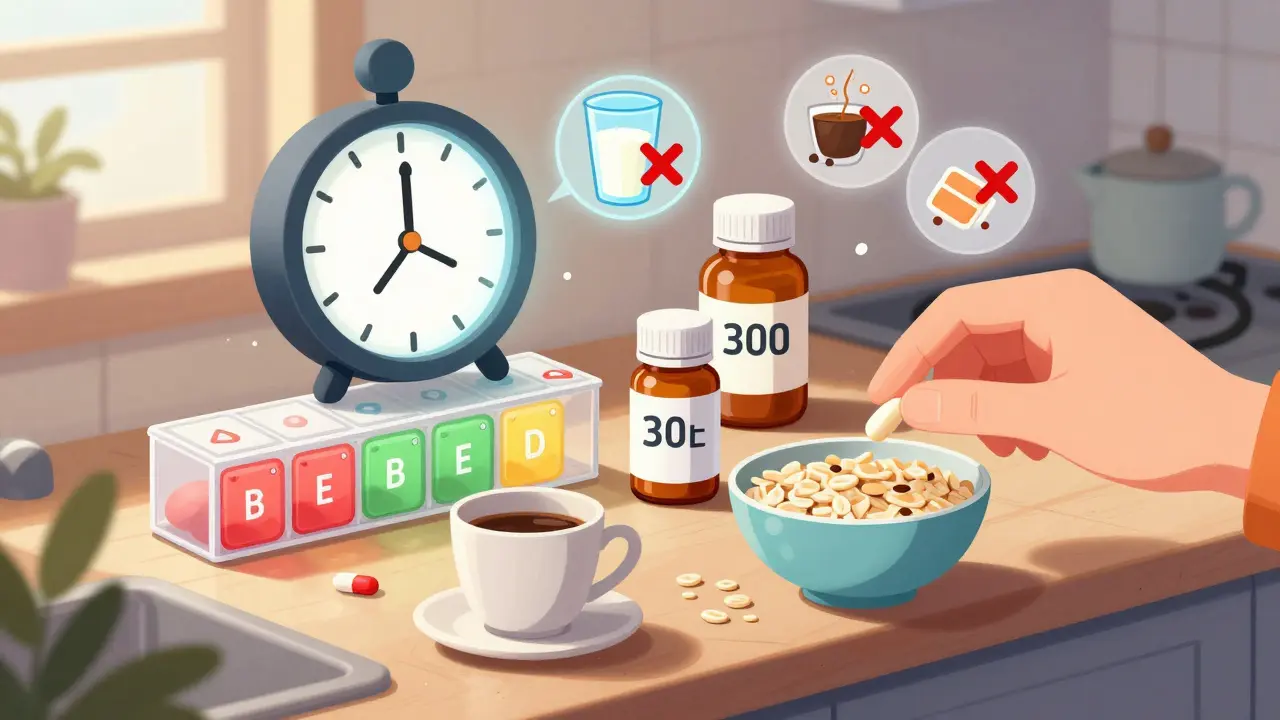
How to Get It Right Every Time
Here’s what actually works:- Read the label. Don’t assume. “With food” doesn’t mean “any food.” Some drugs need a full meal. Others just need a cracker.
- Ask your pharmacist. They’re trained to catch these details. Don’t just pick up the script and go.
- Use a pill organizer with time slots. Separate your morning meds from your evening ones. Label them with sticky notes: “Take with breakfast,” “Wait 1 hour after eating.”
- Set phone reminders. One hour before breakfast? Set a 6:30 a.m. alarm. Two hours after lunch? Set a 3 p.m. alarm.
- Keep a food-medication log. Write down what you ate and how you felt. Over time, you’ll spot patterns. Did your stomach hurt after taking ibuprofen with yogurt? Note it.
- Know your “buffer zone.” For empty-stomach meds, aim for 1 hour before or 2 hours after eating. For bisphosphonates, it’s 30 to 60 minutes. Don’t wing it.
Aysha Siera
January 16, 2026 AT 19:55The FDA doesn't want you to know this but food labels are rigged to make drugs seem safer than they are
They changed the rules in 2024 so they can keep selling you poison that only works if you eat the right kind of bread
Who benefits? Big Pharma and your grocery store
You think this is science? It's control
rachel bellet
January 17, 2026 AT 09:16Let’s deconstruct this with pharmacokinetic rigor. The CYP3A4 inhibition by grapefruit is well-documented, but the author conflates absorption kinetics with bioavailability. The 40% increase in saquinavir isn’t linear-it’s saturable, and the ceiling effect renders the clinical relevance marginal unless Cmax is the primary endpoint. Also, the NHS recommendation for NSAIDs is based on observational data with high confounding bias. The Inflammopharmacology meta-analysis you cite actually showed no statistically significant reduction in GI hemorrhage when adjusted for age and NSAID dose. You’re overestimating the clinical utility of food timing for non-therapeutic index drugs.
Selina Warren
January 17, 2026 AT 18:55STOP treating your body like a broken machine you can just plug in and forget.
Every pill you swallow is a conversation with your cells. If you’re taking levothyroxine with your coffee like it’s a damn snack, you’re not just wasting money-you’re disrespecting your own biology.
You think your thyroid doesn’t notice? It does. It screams. It tires. It fails.
Set the alarm. Write it down. Eat the damn cracker. Your future self will thank you.
This isn’t about rules-it’s about showing up for yourself when no one’s watching.
Be the person who does the boring thing right.
That’s where real power lives.
Robert Davis
January 18, 2026 AT 01:29Interesting article. I’ve been taking my doxycycline with yogurt for years because I read somewhere that probiotics help with gut health. I guess I’ve been doing it wrong. I don’t remember ever having an infection come back though. Maybe it’s placebo. Or maybe the body adapts. Or maybe the science is oversimplified. I’ll keep taking it with food until someone proves otherwise. I’m not rushing to change habits based on one article.
Eric Gebeke
January 19, 2026 AT 07:48People don’t take their meds right because they’re lazy. Not because they’re ignorant. They’re overwhelmed. They’re working two jobs. They’re raising kids. They’re on 8 different prescriptions and someone handed them a pamphlet with 12 tiny fonts and said ‘read this.’
Color-coded labels? That’s a bandaid. What we need is pharmacists in every pharmacy who actually talk to patients. Not just scan the script and hand over a bottle.
And stop blaming the patient. The system failed them first.
Jake Moore
January 20, 2026 AT 05:06Just want to add a real-world tip: if you’re on levothyroxine and you absolutely must have coffee in the morning, wait 60 minutes after taking it. Don’t just sip it 10 minutes later thinking it’s fine. The acids interfere even if you don’t eat. I used to be the guy who took it with my coffee-my TSH was 8.5. After switching to water + 1-hour wait, it dropped to 2.1 in 6 weeks. No joke. Your thyroid doesn’t care if you’re ‘in a rush.’ It just wants consistency. Do the thing.
Joni O
January 21, 2026 AT 17:32i just started taking amoxicillin and i kept forgetting to eat first so my stomach was wrecked
so i started putting a peanut butter cracker in my pocket and eating it right before the pill
it’s dumb but it works
also i set a reminder called ‘don’t be sick again’
thank you for the color coded idea!! i’m stealing that
Ryan Otto
January 23, 2026 AT 08:41The entire premise of this article is a product of pharmaceutical hegemony. The notion that food timing is a critical variable is a construct designed to perpetuate dependency on regulated pharmaceuticals. In traditional medicine systems, including Ayurveda and Traditional Chinese Medicine, the concept of ‘food-drug interaction’ is not treated as a binary condition but as a dynamic interplay of constitutional energetics. The FDA’s 2024 guidance is not progress-it is standardization of medical orthodoxy. The real breakthrough lies in personalized nutrigenomic profiling, which the article superficially alludes to but fails to endorse. Until then, this is merely pharmacological colonialism disguised as education.
Praseetha Pn
January 24, 2026 AT 15:48They don’t want you to know that food timing is just the tip of the iceberg
What about the plastics in your water bottle? The glyphosate in your bread? The EMFs from your phone when you take your pill?
Levothyroxine doesn’t just hate coffee-it hates everything modern
They made you dependent on a pill because they sold you the lie that your body can’t heal
That’s why they control the labels, the colors, the alarms
They need you to think you’re powerless
Wake up. Your body is smarter than your prescription.
christian Espinola
January 25, 2026 AT 02:30‘One man took levothyroxine with a smoothie’ - and this is presented as a shocking revelation? This is the baseline level of medical illiteracy in this country. The fact that 42% of patients admit to ‘occasionally’ ignoring dosing instructions is not a failure of patient education-it’s a failure of the entire healthcare delivery model. If you require a color-coded label to take a pill correctly, you shouldn’t be prescribed it. The system is broken. And you’re just rearranging deck chairs.
Chuck Dickson
January 25, 2026 AT 22:23Hey everyone - I’m a pharmacist and I’ve seen this a thousand times.
People think ‘take with food’ means ‘take with a big meal.’ No. For some meds, it’s just a cracker. For others, it’s a banana. For some, it’s a high-fat snack like peanut butter. It’s not about quantity - it’s about composition.
And yes - grapefruit juice is a silent killer with statins. I had a patient on simvastatin who drank a glass every morning. He ended up in the hospital with rhabdo. He didn’t know. No one told him.
So here’s the deal: If you’re on more than three meds, write down your schedule. Use a whiteboard. Put it on your fridge. Set alarms. Don’t be ashamed. We’ve all been there.
You’re not dumb. You’re just human.
And you’re not alone.