
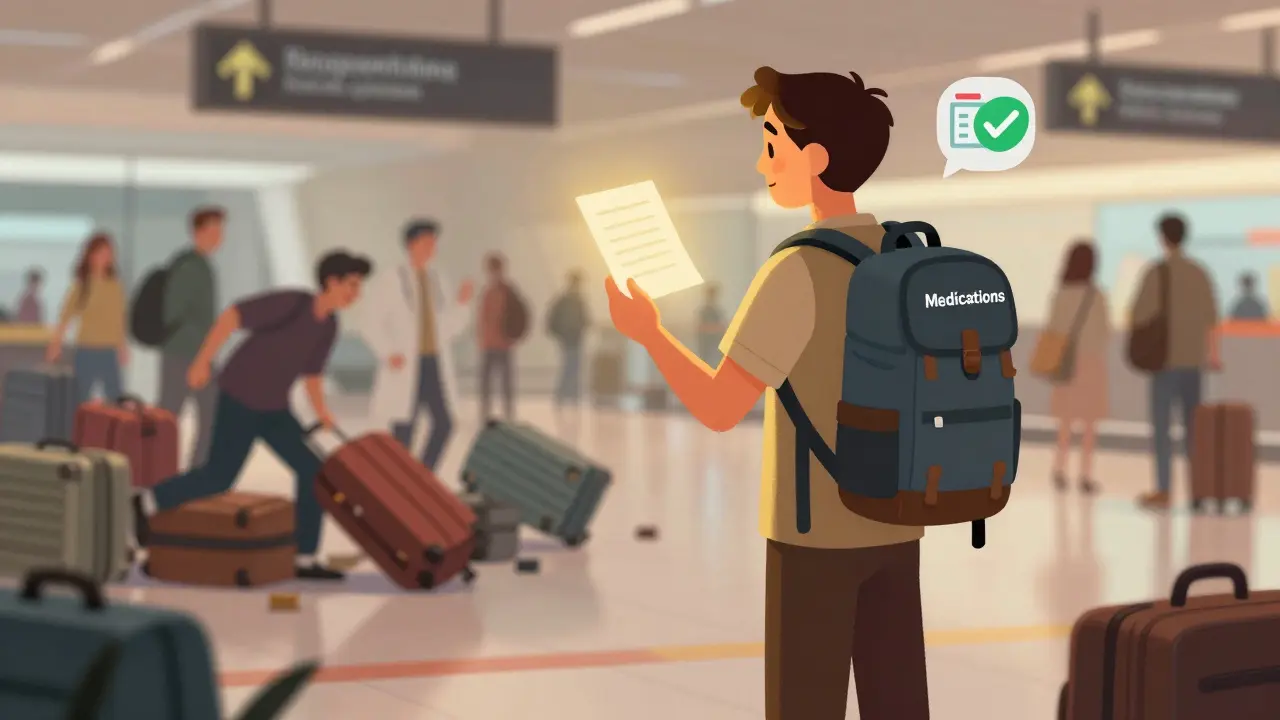
Running out of medication while traveling isn’t just inconvenient-it can be dangerous. Whether your bag got stolen, your suitcase was lost by the airline, or you simply miscounted your pills, running out of essential drugs overseas can turn a vacation into a medical emergency. The good news? You’re not alone, and there are clear steps to get back on track. But it’s not as simple as walking into a local pharmacy and asking for a refill. Different countries have different rules, and some medications simply can’t be replaced without the right paperwork.
Before You Leave: Pack Smart and Prepare Documentation
The best way to avoid a crisis is to plan ahead. The CDC and the International Society of Travel Medicine both agree: carry a letter from your doctor. This letter should list every medication you take, including the generic name, dosage, and reason for use. It should also include your doctor’s contact info. Keep a printed copy in your wallet and a digital copy saved on your phone. This one step alone can cut your replacement time by more than half.Always pack your meds in your carry-on. The International Air Transport Association (IATA) reports that 1 in 150 checked bags are mishandled. If your pills are in a checked bag that goes missing, you could be without medication for days. Carry at least a seven-day extra supply. For insulin, heart meds, or psychiatric drugs, this isn’t optional-it’s life-saving.
Keep all medications in their original bottles with pharmacy labels. Over 60% of countries require this for legal entry. Even if you’re not asked, having the label proves the medication is yours and not counterfeit. Skip the pill organizers for international travel. They look suspicious to customs officials and won’t hold up if questioned.
What to Do If Your Medication Is Lost or Stolen
Step 1: Stay calm. Panicking won’t help. Take a breath and focus on what you can control.Step 2: Contact your travel insurance provider. If you have comprehensive travel insurance (and you should), your plan likely includes 24/7 medical assistance. Companies like Allianz and MedAire have teams that can connect you with local doctors, verify your prescription, and even arrange for a new one. They’ve helped over 89% of clients get their meds within 12 hours.
Step 3: Call your prescribing doctor back home. If you’re on a chronic medication like blood pressure pills, diabetes insulin, or antidepressants, your doctor can often fax or email a new prescription to a pharmacy abroad. But here’s the catch: U.S. federal law doesn’t allow doctors to refill Schedule II controlled substances (like Adderall, OxyContin, or Vicodin) without an in-person visit-even if you’re overseas. The DEA strictly prohibits this. So if you’re on one of these, you’ll need to see a local doctor in person.
Step 4: File a police report if your meds were stolen. This isn’t just for insurance-it’s often required by airlines for baggage claims. The IATA requires theft reports within 21 days for any lost luggage claim. Even if you didn’t fly, local authorities may need to document the loss for your insurer.
Can You Just Walk Into a Pharmacy Abroad?
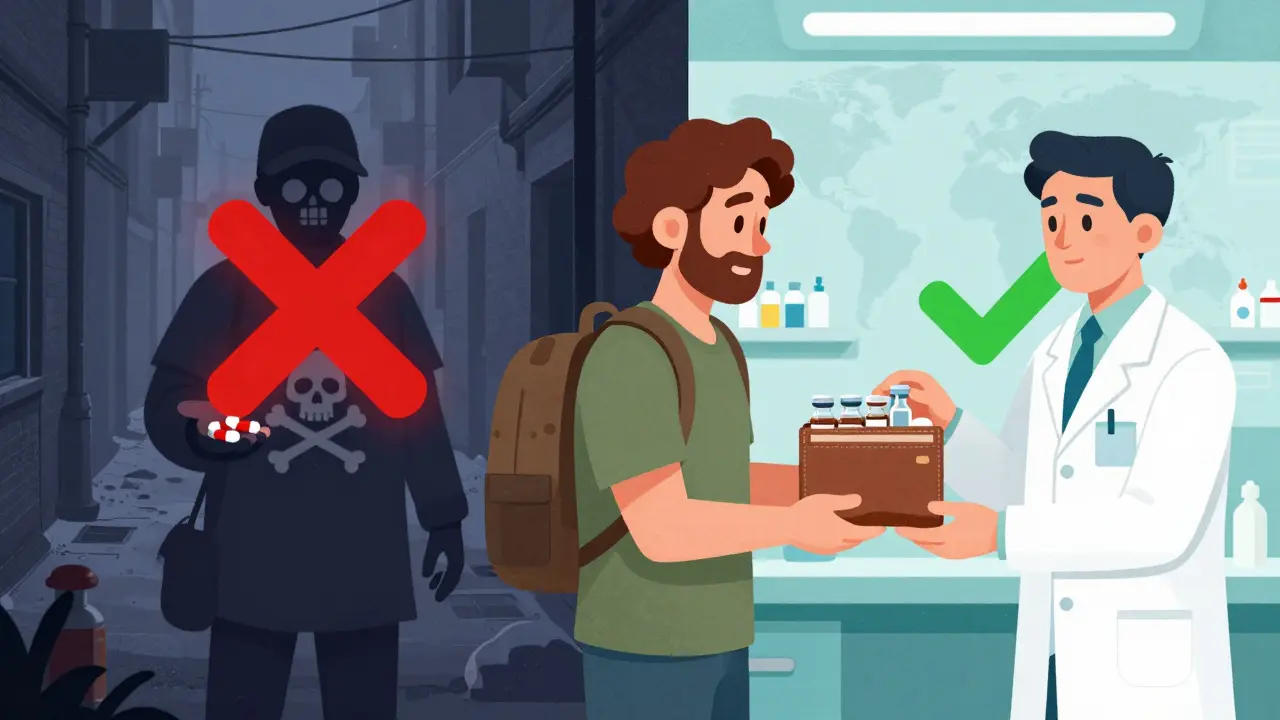
It’s tempting, but risky. Over 89% of countries won’t fill a U.S. prescription. That’s because drug regulations, brand names, and even active ingredients vary wildly. In the UK, codeine is sold over the counter. In the U.S., it’s a prescription. In Thailand, pseudoephedrine (common in cold meds) is tightly controlled under narcotics laws. A pharmacy in Bangkok might refuse to give you your American-brand asthma inhaler because it’s not approved there.And here’s the scary part: 10-30% of medications sold in parts of Southeast Asia and Africa are counterfeit, according to the World Health Organization. Fake pills can be filled with chalk, sugar, or worse-poison. Never buy medication from street vendors, unmarked clinics, or pharmacies without a visible license.
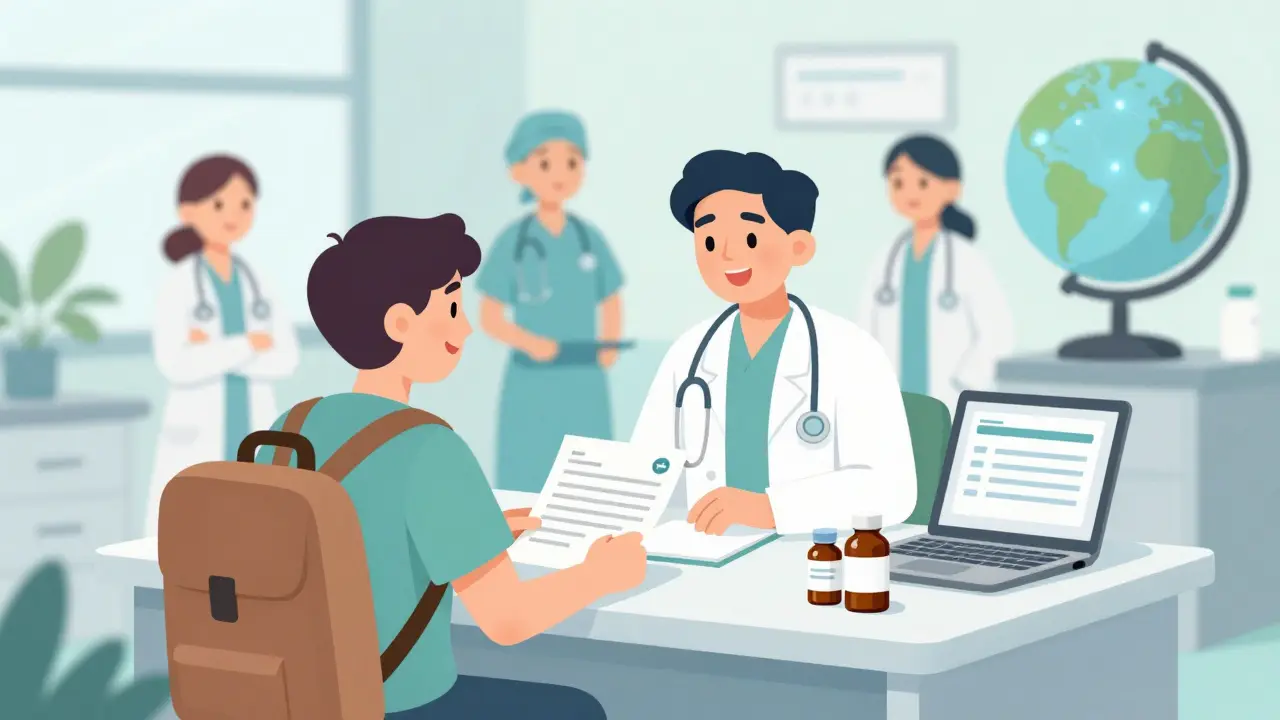
Your safest bet? Go through a licensed local clinic or hospital. Many countries have clinics that specialize in treating foreign travelers. These clinics are used to dealing with U.S. prescriptions and know how to navigate the system. They’ll check your doctor’s letter, verify your medical history, and prescribe an equivalent medication that’s legal and safe in their country.
Controlled Substances and the Hard Reality
If you take Adderall, Ritalin, Xanax, or opioids like Vicodin, you’re in a tougher spot. U.S. law doesn’t let doctors prescribe these remotely. And most countries won’t recognize U.S. prescriptions for these drugs at all. In places like Japan, Australia, or the UAE, even having these medications without a local prescription can land you in serious legal trouble.Your best move? Talk to your doctor before you leave. Ask if you can get a slightly higher supply than usual-maybe a 90-day supply instead of 30. Some doctors will do this for travelers. If you can’t, you may need to pause treatment or switch to an alternative medication before you go. Don’t risk it. If you need to stop your medication suddenly (like an antidepressant or seizure drug), it can be dangerous.
What If You Don’t Have Travel Insurance?
You’re not out of luck, but it’s harder. Without insurance, you’ll pay out of pocket. Costs vary wildly:- Western Europe: $75-$150 for a standard prescription
- Southeast Asia: $40-$90 (but watch for fake meds)
- Latin America: $120-$200
Use services like MyUSADr for non-controlled substances. It’s a telehealth platform that connects you with U.S.-licensed doctors who can e-prescribe medications (except controlled ones) to pharmacies in many countries. But remember: U.S. law still bans telehealth for Schedule II drugs, even for travelers.
For chronic conditions like diabetes or hypertension, go to a hospital emergency room. They’ll treat you, even if you can’t pay right away. Many hospitals in Europe and Latin America have international patient services that can help you get your meds at a lower cost.
Temperature-Sensitive Medications: A Hidden Risk
Insulin, some biologics, and certain antibiotics need to stay cool. If your meds were in a checked bag that sat in a hot cargo hold for hours, they might be ruined-even if the bottle looks fine. The International Diabetes Federation found that 41% of travelers with insulin reported reduced effectiveness after exposure to high heat.Carry a small insulated cooler with ice packs in your carry-on. You can buy travel-sized cooling wallets online. If your meds get too hot, don’t use them. Ask for a replacement immediately.
Real-World Examples: What Works
A traveler in Berlin lost her diabetes insulin. She had her doctor’s letter, her original prescription, and her insulin in a cooling wallet. She went to a local hospital, showed her documents, and got a new prescription within 4 hours. No problem.Another traveler in Bangkok lost her Adderall. She didn’t have documentation. She tried three pharmacies. All refused. She ended up going to a private clinic, paying $180 out of pocket, and getting a local stimulant that worked-but it wasn’t the same. She had side effects for two weeks.
The difference? Preparation.
Final Tips: Don’t Wait Until It’s Too Late
- Always carry a printed copy of your prescriptions and doctor’s letter.
- Use a travel insurance plan that includes medication replacement (68% of comprehensive plans do).
- Research your destination’s drug laws before you go. The CDC’s Yellow Book 2024 has country-specific guidelines.
- Never rely on digital prescriptions alone-paper is still king.
- For controlled substances, plan ahead. Ask your doctor for a larger supply before you leave.
If you follow these steps, you’re not just reducing risk-you’re giving yourself peace of mind. Travel is supposed to be freeing, not stressful. With the right prep, losing your meds won’t ruin your trip. It’ll just be a minor hiccup you handled like a pro.
Timothy Olcott
March 19, 2026 AT 21:46Desiree LaPointe
March 20, 2026 AT 04:02Newsflash: Travel isn’t a vacation from responsibility. If you can’t manage a 90-day supply of controlled substances before leaving, you shouldn’t be allowed to board a plane. Your ‘minor hiccup’ is someone else’s public health nightmare.
Jackie Tucker
March 21, 2026 AT 02:50It’s not about legality-it’s about absurdity. The same governments that ban your meds will happily sell you a $150 vial of ‘Thai Viagra’ with no label and a QR code that leads to a Facebook group.
And yet, we’re supposed to trust the ‘licensed clinics’? Please. Most are just pharmacies with a laminated sign and a guy who speaks three words of English. The real solution? Global harmonization of drug regulations. Or at least, a global app that tells you what’s legal before you land. But no. We’d rather have people panic in Bangkok.
Thomas Jensen
March 21, 2026 AT 13:06Now he’s got a criminal record and a PTSD episode. This article? It’s not advice. It’s a lifeline. And the fact that so many people don’t even know this exists? That’s the real tragedy.
Why isn’t this mandatory reading before international flights? Why aren’t airlines required to hand this out at check-in? We warn people about water safety, scams, and sunburn-but not drug laws? That’s negligence.
matthew runcie
March 22, 2026 AT 00:02Just carry the letter. Keep it in your wallet. Bring extra pills. Don’t overthink it.
Peace of mind is worth the 10 minutes it takes to prep.
shannon kozee
March 23, 2026 AT 11:23Original bottles? Yes.
Doctor’s letter? Non-negotiable.
Travel insurance that covers meds? Get it.
Simple. Done.
trudale hampton
March 24, 2026 AT 09:04It’s not magic. It’s just knowing what to do.
Thanks for the clear guide. This should be in every travel guide.
Shaun Wakashige
March 24, 2026 AT 15:33