

When you switch health plans, your prescription drugs might suddenly cost more - even if they’re the same generic medication you’ve been taking for years. That’s because generic drug coverage isn’t the same across plans. One plan might charge you $3 for your blood pressure pill. Another might charge $40. And you won’t know until you’ve already enrolled.
Why Generic Drug Coverage Matters More Than You Think
Most people assume that if a drug is generic, it’s cheap everywhere. That’s not true. Generic drugs make up 90% of all prescriptions filled in the U.S., but they account for only 23% of total drug spending. That’s because insurance plans control how much you pay through something called a formulary - a list of covered drugs divided into tiers. Tier 1 is where you want your generics to be. These are the most affordable drugs, usually with copays between $3 and $20. But not all plans treat generics the same. Some require you to hit your full medical deductible before you pay anything for prescriptions. Others waive the deductible for Tier 1 generics and give you a flat $20 copay instead. That difference can save you over $1,500 a year if you take multiple medications.How Formularies Work - And Why They’re Confusing
Formularies are broken into tiers. Most plans use 3 to 5 tiers:- Tier 1: Preferred generics - lowest cost, usually $3-$20 copay
- Tier 2: Non-preferred generics or brand-name drugs - $30-$60 copay
- Tier 3: Higher-cost brand-name drugs - $70-$100 copay
- Tier 4-5: Specialty drugs - coinsurance (20-30% of cost), often $200+
Plan Types and How They Affect Your Costs
Different types of health plans handle generics differently:- Marketplace Silver SPD Plans: These are the best for generic users. They waive your deductible for Tier 1 generics and charge a fixed $20 copay. In 2023, KFF found these plans saved low-income users an average of $1,200 a year.
- High-Deductible Health Plans (HDHPs): These plans often require you to pay your full deductible - for both medical care and prescriptions - before coverage kicks in. That means if your deductible is $3,000 and you take three generics a month, you could pay $180 out of pocket before your $20 copay even starts.
- Medicare Part D: Most have a $505 deductible in 2023, but many plans waive it for Tier 1 generics. Copays are usually $0-$10. But watch out: some Medicare Advantage plans put generics in Tier 2, charging $20-$40.
- Employer Plans: Vary wildly. Some charge $5 for generics before deductible. Others charge $10 after. Always check the formulary.

State Rules Can Make or Break Your Costs
Where you live changes everything. California requires a $85 deductible for prescriptions before coverage starts, then charges 20% coinsurance up to $250 per year. New York, on the other hand, waives deductibles for generics entirely and caps copays at $75 for specialty drugs. In D.C., there’s a separate $350 outpatient drug deductible - separate from your medical deductible. That means if you’re switching plans and moving states, you can’t just compare plan names. You have to check state-level rules too. A plan that looks great in Texas might be terrible in California because of how the state regulates pharmacy costs.What You Must Check Before Switching
Don’t rely on summaries. Don’t trust the plan’s website homepage. You need to dig into the full formulary. Here’s what to do:- Get the complete formulary list - not just the tier chart. Look for your exact drug name and manufacturer.
- Verify the formulation - is it immediate release or extended release? Is it 500mg or 1000mg? Plans often cover one version but not another.
- Check your pharmacy network - your local CVS might be preferred, but the one down the street isn’t. Non-preferred pharmacies can charge 3-4 times more for the same generic.
- Calculate your annual cost - multiply your monthly copay by 12. Then add any deductible you’d have to meet first. Don’t forget mail-order discounts - some plans charge less if you order a 90-day supply.
Real Stories: What Goes Wrong
Reddit users reported 147 cases in 2023 where their generic drug suddenly cost more after switching plans. In 63% of those cases, it wasn’t because the drug changed - it was because the plan switched manufacturers. For example, one person’s levothyroxine (a thyroid med) was $0 under Plan A. Under Plan B, it became a Tier 2 drug with 25% coinsurance - jumping from $0 to $45 a month. Another user switched to a new employer plan and assumed their $5 generic copay would stay the same. Turns out, the new plan didn’t cover the exact brand of metformin they were taking. They had to pay $75 out of pocket for a month until they got a new prescription. These aren’t rare mistakes. The American Pharmacists Association found 68% of people switching plans don’t check if their specific generic version is covered.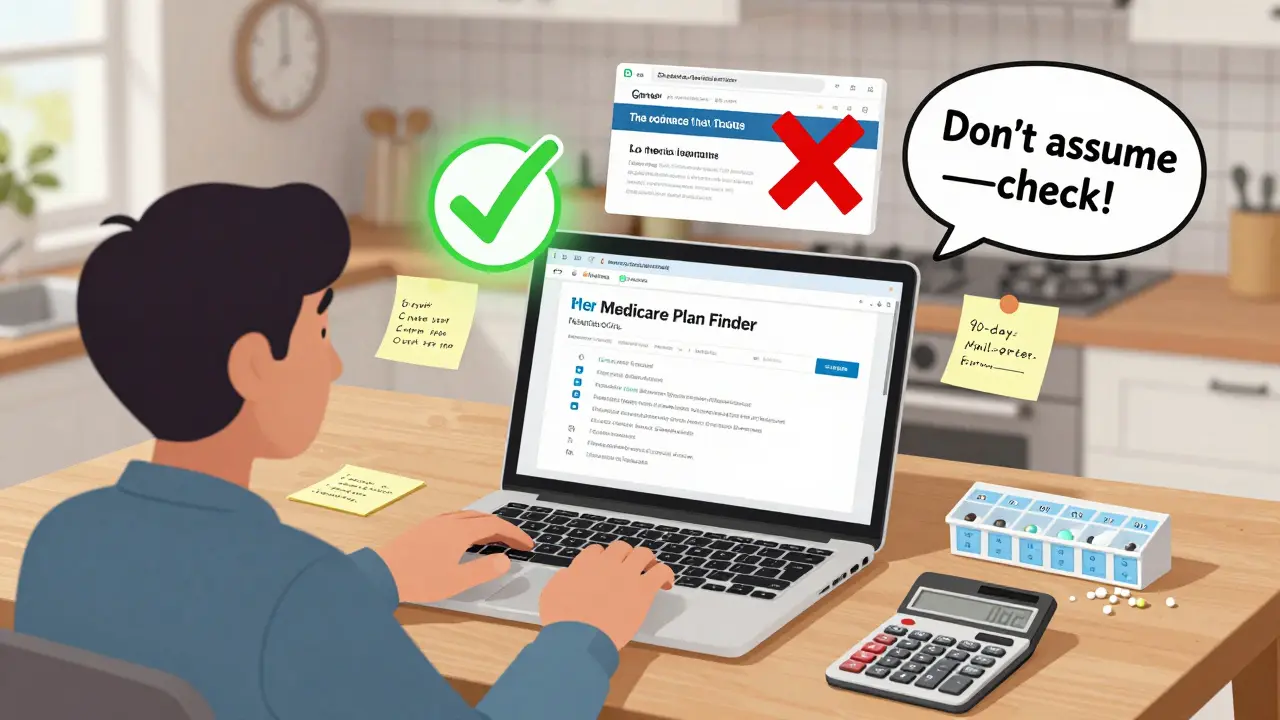
Tools That Actually Work
Use these tools to compare plans accurately:- Medicare Plan Finder - lets you enter your drugs and see exact costs across all Part D plans. Used by 4.2 million people in 2022.
- Healthcare.gov Plan Selector - filters marketplace plans by drug coverage. Only use the tool that lets you input your exact medications.
- Insurer-specific formulary search tools - UnitedHealthcare, Blue Cross, and others have their own drug lookup tools. They’re 96% accurate - much better than third-party sites.
What’s Changing in 2025
New rules are coming. Starting in 2025, Medicare Part D will cap out-of-pocket drug costs at $2,000 per year. That’s huge - but it doesn’t help if your generic isn’t covered at all. Also, more states are adopting Silver SPD plans. In 2024, 32 states will offer them - up from 24 in 2023. These plans are becoming the gold standard for generic drug users. Meanwhile, AI tools like CMS’s new “Medicare Plan Scout” are helping people pick the right plan. In pilot testing, it cut enrollment errors by 44%.The Bottom Line
Switching health plans isn’t just about premiums. If you take any regular medications - even cheap generics - your out-of-pocket costs can explode if you don’t check the formulary. The difference between a $3 and a $40 copay isn’t just money. It’s whether you fill your prescription at all. Take 30 minutes before open enrollment. List your drugs. Check the formulary. Compare pharmacy networks. Calculate your total cost. You might save $800 a year - or more.Don’t assume your drug is covered. Don’t assume it’s cheap. And don’t wait until you’re at the pharmacy counter to find out you’re paying triple.
Do all health plans cover the same generic drugs?
No. Each plan creates its own formulary based on negotiations with drugmakers and pharmacy benefit managers. Two plans can cover the same generic drug but place it on different tiers - meaning one charges $3 and the other charges $40. Even the manufacturer matters. Some plans cover metformin made by Company A but not Company B, even though both are FDA-approved generics.
What’s the difference between a deductible and a copay for generics?
A deductible is the amount you pay before your insurance starts covering drugs. A copay is a fixed fee you pay each time you fill a prescription. In some plans, you must meet your deductible before any generic drug is covered. In others - especially Silver SPD plans - you pay a flat $20 copay for Tier 1 generics even if you haven’t met your deductible. That’s a major savings for people who take daily medications.
Can I switch to a new plan mid-year to get better generic coverage?
Generally, no. You can only switch during Open Enrollment (November-December for most plans) or if you qualify for a Special Enrollment Period - like losing other coverage, moving, or having a baby. You can’t switch just because your drug costs went up. Plan changes only happen once a year unless you meet a qualifying life event.
Why does my generic drug cost more on one plan even though it’s the same medicine?
Because insurance plans don’t cover all versions of a generic equally. Even if two drugs have the same active ingredient, they can be made by different manufacturers. Plans often choose one version based on rebate deals - not effectiveness. So your levothyroxine from Manufacturer X might be Tier 1, but the same drug from Manufacturer Y is Tier 2. Always check the manufacturer name on the formulary.
Are mail-order pharmacies better for generic drugs?
Often yes. Many plans offer lower copays for 90-day supplies ordered through mail-order pharmacies. For example, a $20 copay for a 30-day supply might drop to $15 for a 90-day supply. But make sure the mail-order pharmacy is in your plan’s network. Using an out-of-network mail-order service can cost 3-4 times more.
What if my drug gets removed from the formulary after I switch?
Plans can change their formularies during the year, but they must notify you in advance. If your drug is removed, you may be able to get a temporary exception or switch to a similar drug. Always ask your doctor about therapeutic alternatives - sometimes another generic version works just as well and is covered.
How do I know if a plan is good for my specific medications?
Use the plan’s official formulary search tool and enter each drug by name and dosage. Don’t rely on summaries or customer service reps. Check the tier, copay, deductible rules, and pharmacy network. Then calculate your total annual cost: (copay × 12) + (deductible amount if applicable). Compare that across all your options. The lowest premium isn’t always the cheapest if your drugs are expensive.
Spencer Garcia
December 23, 2025 AT 04:18Just checked my plan’s formulary last week-my metformin jumped from Tier 1 to Tier 2. $3 to $35. No warning. I called customer service and they said it was a ‘formulary update’-like that’s normal. Took me 45 minutes to get a therapist-approved exception. Don’t trust the website. Call them. Ask for the PDF.
Delilah Rose
December 24, 2025 AT 15:10I used to think generics were all the same until my dad’s thyroid med went from $0 to $80 a month after switching plans. Turns out, the new plan covered the generic from one manufacturer but not the exact one he’d been on for 8 years-even though both were FDA-approved. He had to switch brands, and his TSH levels went haywire for three months. Now I print out the full formulary, highlight every drug, and compare side-by-side. It’s tedious, but it’s cheaper than a trip to the ER. Also, mail-order for 90-day supplies saved us $200 a year. Worth the wait.
Bret Freeman
December 26, 2025 AT 05:41THIS IS WHY AMERICA IS BROKE. Insurance companies don’t care if you live or die-they care about rebate deals with Big Pharma. They’ll swap your $3 generic for a $40 version just because the manufacturer gave them a kickback. And you think you’re getting ‘affordable care’? Ha. They don’t even tell you until you’re at the counter. I’ve had my blood pressure med changed twice in two years. Twice. I had to go to three pharmacies before I found one that stocked the old version. This isn’t healthcare. It’s a rigged casino.
bharath vinay
December 26, 2025 AT 19:49They’re hiding the truth. Formularies are designed to push you toward expensive drugs so insurers can profit from rebates. The FDA doesn’t regulate which generic version gets covered. It’s all corporate greed masked as ‘cost containment.’ You think you’re saving money? You’re being manipulated. And don’t get me started on mail-order pharmacies-they’re data harvesting fronts that track your prescriptions for third-party advertisers.
Aurora Daisy
December 27, 2025 AT 16:06Oh wow, you actually checked your formulary? How quaint. In the UK, we just get the bloody medicine and don’t have to fill out 17 forms to get a $3 pill. But hey, at least you’re not paying $200 for insulin like Americans. Progress, I guess.
Austin LeBlanc
December 29, 2025 AT 11:14Why are you wasting time on this? Just get a high-deductible plan and HSA. You’ll save on premiums and you can use the HSA to pay for your meds tax-free. Problem solved. Stop overcomplicating it. Also, if you’re on metformin, you’re probably overweight anyway. Maybe lose 20 pounds and stop needing the pills.
Gray Dedoiko
December 30, 2025 AT 03:09I had the same issue with my levothyroxine. My new plan covered a different brand and I felt awful for weeks. I called my doctor and asked if there was a therapeutic alternative. She said yes, but I had to get prior authorization. Took 3 days. Worth it. I also asked my pharmacist to check if the manufacturer changed-turns out, the old one was made in India, the new one in Germany. Same active ingredient, but my body reacted differently. Don’t assume it’s ‘the same.’
John Pearce CP
December 31, 2025 AT 08:48It is a fundamental failure of the American healthcare system that citizens must become pharmaceutical compliance analysts just to afford basic medication. The formulary system is a labyrinth designed by lobbyists, not physicians. The fact that a $0.10 generic pill can be priced at $40 based on corporate rebate agreements is a moral outrage. This is not capitalism. This is corporate feudalism. And the government’s silence is complicity.
Pankaj Chaudhary IPS
January 2, 2026 AT 03:50As a public health professional, I commend this article. The key insight is that generic equivalence ≠ generic coverage. In India, we have a National List of Essential Medicines that standardizes access-but even there, private insurers create tiered systems. The solution lies in transparency: every plan should be required to publish formularies in machine-readable format, with manufacturer details and tier logic. Patients should not be forced into guesswork. Empowerment through data is the only ethical path forward.
niharika hardikar
January 3, 2026 AT 19:56Given the prevailing regulatory architecture within the U.S. pharmaceutical benefit management (PBM) ecosystem, it is empirically evident that formulary tiering is not predicated on pharmacoeconomic efficiency but rather on contractually negotiated rebates that incentivize suboptimal therapeutic substitution. Consequently, patient out-of-pocket expenditures are systematically inflated due to the absence of mandatory formulary transparency protocols. The 73% reduction in unexpected costs, as cited from CMS data, underscores the imperative for patient-driven formulary audits prior to plan enrollment-a non-negotiable fiduciary duty.