

When your body goes into anaphylaxis, every second counts. Swelling in your throat. Trouble breathing. A sudden drop in blood pressure. These aren’t just scary symptoms-they’re life-threatening. And the only thing that can stop it fast enough is epinephrine. If you or someone you care about has a severe allergy, knowing how to use an epinephrine auto-injector isn’t optional. It’s survival.
What Happens During Anaphylaxis?
Anaphylaxis isn’t just a bad allergic reaction. It’s a full-body emergency. Your immune system overreacts to something like peanuts, bee stings, shellfish, or even certain medications. Within minutes, your airways tighten, your blood pressure plummets, and your heart struggles to pump. Without treatment, death can happen in under an hour. In some cases, it’s faster.Antihistamines like Benadryl? They don’t cut it. They might help with a rash or itchy skin, but they won’t open your airway or raise your blood pressure. Only epinephrine does that. And the faster you give it, the better your chances. Studies show giving epinephrine within 5 to 15 minutes of symptoms starting cuts the risk of dying by 75%.
How Epinephrine Auto-Injectors Work
These devices are simple by design: one click, one shot. Inside is a tiny needle and a pre-measured dose of epinephrine-either 0.15 mg for kids between 33 and 66 pounds, or 0.3 mg for anyone over that weight. When you activate it, the spring-loaded needle shoots out and delivers the medicine directly into your thigh muscle. It’s meant to work through clothing, so you don’t need to strip down in a panic.The medicine works fast. It tightens blood vessels to bring your pressure back up. It relaxes the muscles around your airways so you can breathe. It helps your heart keep pumping. Side effects like a racing heart, shaking, or feeling anxious? They’re normal. They’re also temporary-usually gone in 20 to 30 minutes. And they’re a million times better than the alternative.
Which Devices Are Available?
You’ll likely see one of four devices in the U.S.:- EpiPen-The most common. Comes in two strengths. Has a bright orange tip that covers the needle. You press it firmly against the thigh until you hear a click.
- Auvi-Q-Smaller, rectangular, and talks to you. It gives step-by-step voice instructions. Great if you’re scared or panicking. It also retracts the needle after use.
- Adrenaclick-Cheaper, but you have to remove two caps and press a button to activate. More steps mean more room for error.
- Neffy-New in 2023. A nasal spray. No needle. But you have to aim it right and squeeze hard. If you don’t get the spray deep enough, it won’t work.
EpiPen still dominates the market, used in over 85% of cases. But Auvi-Q’s voice guidance has been shown to improve correct use by nearly 25% compared to EpiPen in real-world emergencies. If you’re nervous about using it, or if you’re training someone who freezes under stress, Auvi-Q might be the better fit.
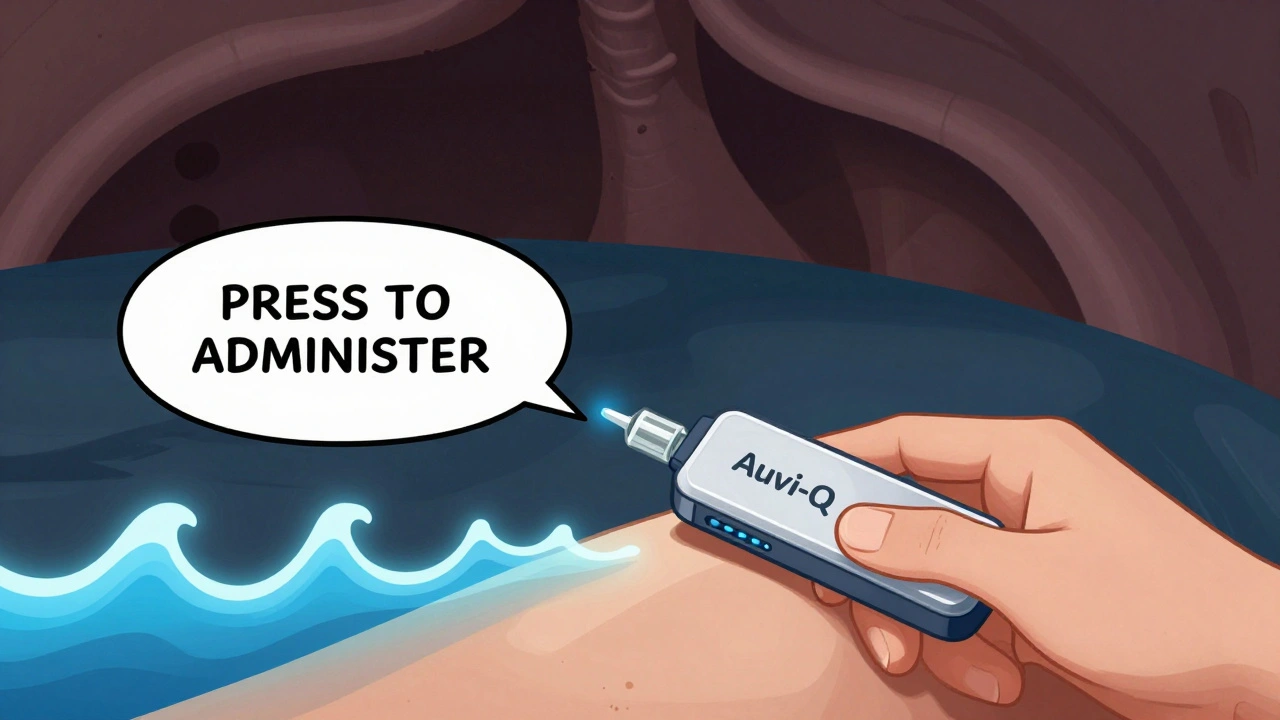
Step-by-Step: How to Use Your Auto-Injector
Follow these steps exactly. Don’t skip anything. Don’t guess.- Recognize the signs. Look for trouble breathing, swelling of the lips or tongue, hives, dizziness, vomiting, or a feeling that something’s terribly wrong. If you’re unsure, give it anyway. Better safe than sorry.
- Call 911. Right now. Don’t wait. Even if you feel better after the shot, you still need emergency care. Anaphylaxis can come back-sometimes hours later.
- Remove the safety cap. For EpiPen or Adrenaclick, pull off the blue (or gray) safety release. For Auvi-Q, pull the red tab. For Neffy, remove the cap and hold the spray upright.
- Place it on the outer thigh. This is key. Not your arm. Not your stomach. Not your butt. The outer thigh, halfway between hip and knee. You can inject through jeans, leggings, or shorts. No need to undress.
- Press hard and hold. Slam the device into the thigh with enough force to trigger the needle. Hold it there for 3 full seconds. For EpiPen and Adrenaclick, you’ll hear a click and feel a push. For Auvi-Q, it will tell you to hold. For Neffy, squeeze the bottle firmly until it beeps.
- Remove and massage. Take it away. Rub the injection site for 10 seconds. This helps the medicine absorb faster.
- Stay down. Lie flat if you can. If you’re dizzy, sit with your legs stretched out. Never stand up. Standing can make your blood pressure drop even more.
- Use a second dose if needed. If symptoms don’t improve-or get worse-after 5 to 10 minutes, give another shot. Always carry two. You might need both.
Common Mistakes (And How to Avoid Them)
Even people who’ve trained with these devices mess up. Here’s what goes wrong most often:- Not removing the safety cap. 58% of training failures happen here. Always check before you act.
- Injecting in the wrong spot. The thigh is the only reliable place. Injecting into the arm or belly means slower absorption.
- Not holding long enough. You need 3 seconds. Most people hold for 1 or 2. That’s not enough. Wait for the device to finish its job.
- Waiting too long to use it. People try antihistamines first. Or wait to see if it gets worse. Don’t. Epinephrine works best when given early.
- Forgetting the second dose. Half of all deaths from anaphylaxis happen because only one dose was given. Keep the second one ready.
Practice with a trainer device. Many pharmacies give out free plastic ones that don’t have medicine. Use them once a month. Practice on a pillow or a friend’s leg. Make it routine.
Storage and Expiration
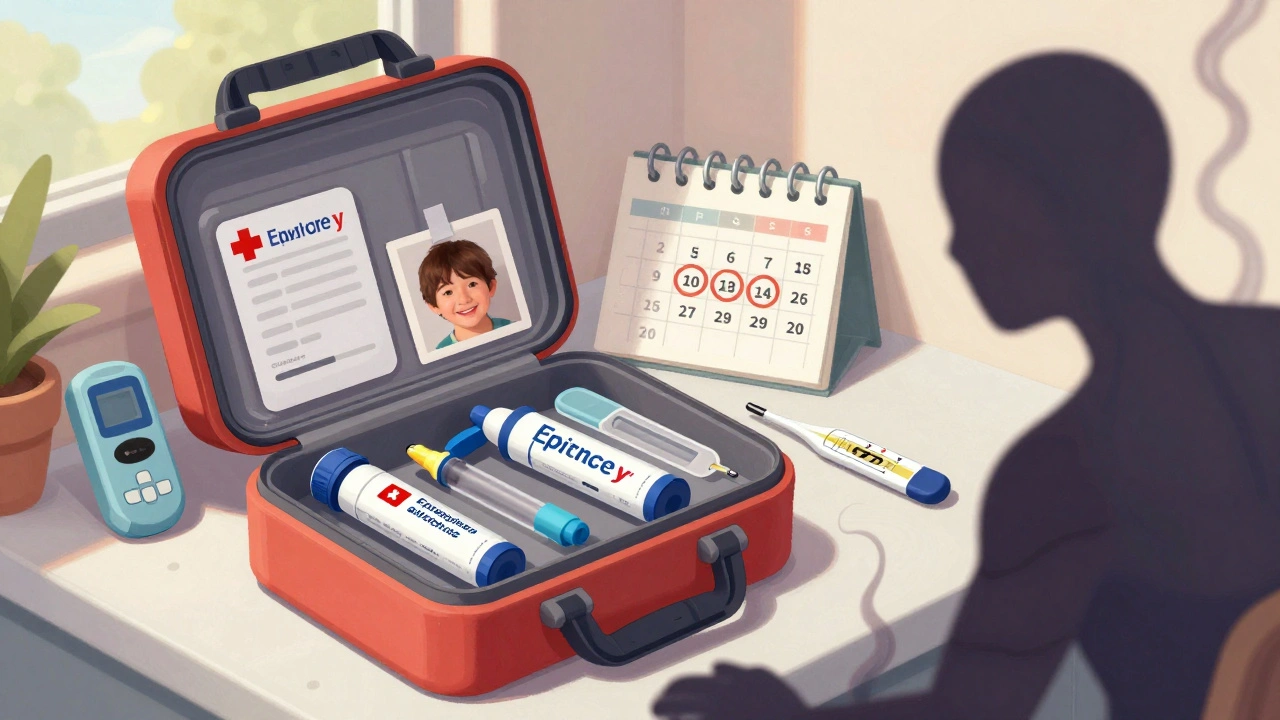
Don’t leave your injector in the car. Don’t put it in the fridge. Don’t keep it in a hot bathroom. Epinephrine breaks down if it gets too hot or too cold. Keep it between 59°F and 86°F-room temperature is fine.Check the expiration date every time you refill your prescription. Most last 18 months. But if the liquid inside looks brown or cloudy, toss it. Even if it hasn’t expired.
Keep one at home. One at work. One in your bag. One at your kid’s school. If you’re traveling, carry two. Always.
What to Do After the Injection
Even if you feel fine after the shot, you still need to go to the ER. Anaphylaxis can rebound. That’s called a biphasic reaction. It happens in up to 20% of cases, sometimes hours later. Emergency staff will monitor your breathing, blood pressure, and heart rate for several hours.Bring your used injector with you. The hospital will need to know what you took and when. If you have a second dose, hand it over too. They might give you steroids or antihistamines to prevent a second wave-but those don’t replace epinephrine.
Training and Preparation
If you’re a parent, teacher, or caregiver, you need to know how to use this device. Schools in 47 states are required to have epinephrine on hand. But only 28 states require staff to be trained. Don’t assume someone else knows what to do.Ask your allergist for a training session. Watch videos from the Allergy & Asthma Network or the Asthma and Allergy Foundation of America. Practice with a trainer device. Teach your kids how to tell someone if they’re having a reaction.
And if you’re ever unsure-give the shot. The side effects are temporary. The consequences of waiting? They’re permanent.
Final Thought: Don’t Wait for Perfection
There’s no perfect time to use an epinephrine auto-injector. There’s only the right time-and that’s now. If you’re hesitating because you’re scared you’ll do it wrong, remember this: you don’t have to be perfect. You just have to be brave enough to act.One woman in Boston told me her 8-year-old had a peanut reaction at school. She didn’t know how to use the EpiPen. She panicked. But she remembered the orange tip. She pressed it. Held it. Called 911. Her daughter is alive today because she didn’t wait for a perfect plan. She did what she could, when she could.
That’s all you need to do.
Stephanie Fiero
December 4, 2025 AT 14:58Just used my EpiPen last month after a shrimp accident at a wedding-felt like my throat was closing and my hands went numb. Didn’t think twice. Pressed. Held. Called 911. I’m alive because I didn’t wait for someone to tell me I was doing it right. You don’t need to be a doctor-you just need to be brave. Keep two in your purse. Always.
Laura Saye
December 5, 2025 AT 21:49There’s something deeply human about how this post frames epinephrine not as a medical device but as an act of radical self-preservation. We’re conditioned to avoid pain, to delay action, to seek permission-but in anaphylaxis, the only permission that matters is the one you give yourself. The trembling, the fear, the hesitation-they’re all part of being alive. But so is pressing that injector into your thigh. It’s not about medicine. It’s about choosing to keep breathing.
sean whitfield
December 6, 2025 AT 19:46Wow. So the government pays for this thing but doesn’t teach you how to use it? Shocking. Next they’ll tell us to use a fire extinguisher without training. I mean, come on. If you can’t figure out a needle in 3 seconds, maybe you shouldn’t have allergies. Just sayin’.
James Moore
December 7, 2025 AT 23:55Let me tell you something, folks-this isn’t just about medicine, it’s about American resilience. We’ve got the best medical tech on the planet, and yet people still fumble with it because they’re too busy worrying about being ‘politically correct’ instead of being prepared. In my day, we didn’t wait for voice-guided devices-we learned to act. We didn’t have Auvi-Qs, we had grit. And grit doesn’t need instructions. It just does what’s necessary. If you’re too scared to press a button, maybe you shouldn’t be near food. Period.
Kylee Gregory
December 8, 2025 AT 05:52I appreciate how this post avoids fear-mongering and focuses on clarity. It’s rare to see medical advice that doesn’t assume the reader is already a trained professional. I’ve watched friends freeze during emergencies-not because they didn’t care, but because they were overwhelmed. The step-by-step breakdown here? That’s the kind of thing that saves lives. Simple. Direct. No fluff. I’ve shared it with my entire family.
Lucy Kavanagh
December 8, 2025 AT 22:56Did you know the EpiPen is actually patented by a pharmaceutical company that lobbies to keep prices high? And that the ‘voice-guided’ Auvi-Q was pulled from the market for ‘manufacturing issues’-but only after they made billions? Coincidence? I don’t think so. The FDA lets them sell overpriced devices while ignoring cheaper alternatives like Adrenaclick. And don’t get me started on Neffy-it’s just a spray, but they’re pushing it like it’s magic. They want you dependent. Always carry two. Always question why.
Chris Brown
December 10, 2025 AT 21:54It is, without question, a moral failing of modern society that individuals are expected to self-administer life-saving pharmaceuticals without formal certification. The fact that a child can be given an EpiPen at school while the staff remains untrained is not merely negligent-it is an institutional betrayal of the social contract. One does not entrust life-or-death procedures to amateurs because convenience outweighs competence. This is not empowerment. It is abdication.
Krishan Patel
December 11, 2025 AT 23:01Everyone talks about epinephrine like it’s a miracle drug. But let’s be honest-it’s just a synthetic version of adrenaline. Your body makes it naturally. So why are we paying $600 for a plastic tube that does the same thing? In India, we use injectable epinephrine from vials-cheaper, faster, and you can dose it properly. These auto-injectors are just corporate toys. Buy the vial, learn to draw it up, carry a syringe. It’s not harder than making coffee. Stop letting companies profit off your fear.
Carole Nkosi
December 13, 2025 AT 12:08You think this is about allergies? No. This is about control. Who gets to decide what’s dangerous? Who gets to sell you the solution? The same people who told you vaccines were safe, then changed the ingredients. The same people who told you masks worked, then said they didn’t. Epinephrine is just another tool to make you dependent on their system. You don’t need a device. You need awareness. You need to avoid the triggers. That’s the real answer. And they don’t want you to hear that.
Philip Kristy Wijaya
December 14, 2025 AT 20:27Let me offer a counterpoint to this emotional propaganda. The notion that epinephrine is the only option is dangerously reductive. Many anaphylactic reactions resolve spontaneously. The overprescription of auto-injectors has created a culture of hypervigilance that pathologizes normal immune responses. Why are we medicating fear instead of educating tolerance? Why are schools required to stock these devices but not to teach immunology? The real crisis isn’t the allergy-it’s the medical industrial complex’s profit-driven narrative that turns children into walking emergency kits
Jennifer Patrician
December 16, 2025 AT 11:47Wait-so the guy who wrote this is telling us to press a device into our thigh and then lie down? What if you’re driving? What if you’re alone? What if you’re in a public restroom? They don’t tell you that after the shot, you might collapse and break your skull on the tile. And the ‘second dose’? That’s just a way to get you to buy two. They know you’ll panic and use one too early. Then you’re stuck buying another. This whole thing is a money scheme wrapped in fear. I’ve got a better idea: carry Benadryl and pray.