

Every year, people take expired medications without realizing the risks. You might find an old bottle of antibiotics in a medicine cabinet, or a bottle of pain relievers past its printed date. You think, It’s probably still fine. But here’s the truth: expired drugs don’t just lose potency-they can change in ways that make them dangerous. And you don’t need a lab to spot the warning signs. You just need to know what to look for: color, odor, and texture.
What Happens When Medications Expire?
Expiration dates aren’t arbitrary. They’re based on strict stability testing required by the FDA. Manufacturers test drugs under different temperatures, humidity levels, and light conditions to see how long they stay safe and effective. After that date, chemical breakdowns begin. Some pills turn brittle. Some liquids cloud up. Some creams separate into oily layers. These aren’t just cosmetic changes-they’re signs of degradation.
According to NASA’s 2011 stability study, discoloration was the most common change in expired drugs, appearing in 68.3% of tested samples. Tetracycline antibiotics, for example, turn yellow to brown as they break down. That’s not normal aging-it’s a chemical reaction that can reduce effectiveness or even create toxins.
Color Changes: The Most Visible Red Flag
Look closely at your pills, capsules, and liquids. A white tablet that’s now speckled with brown spots? That’s a problem. Clear liquid medicine that’s turned cloudy or yellow? Don’t use it.
Some drugs naturally change color over time. Nitroglycerin, for example, can turn from clear to pale yellow as it degrades. But if it turns dark brown or has visible particles floating in it, that’s beyond normal aging. The same goes for hydrocortisone cream-if it was smooth and off-white and now looks streaked with gray or has dark patches, it’s likely degraded.
Studies show that human eyes miss subtle color changes 35% of the time. That’s why experts recommend comparing your medication to a reference image. The FDA’s Drug Expiration Database has photos of common degradation patterns. If your pill looks different from the reference, assume it’s unsafe.
Odor: When Medicine Smells Wrong
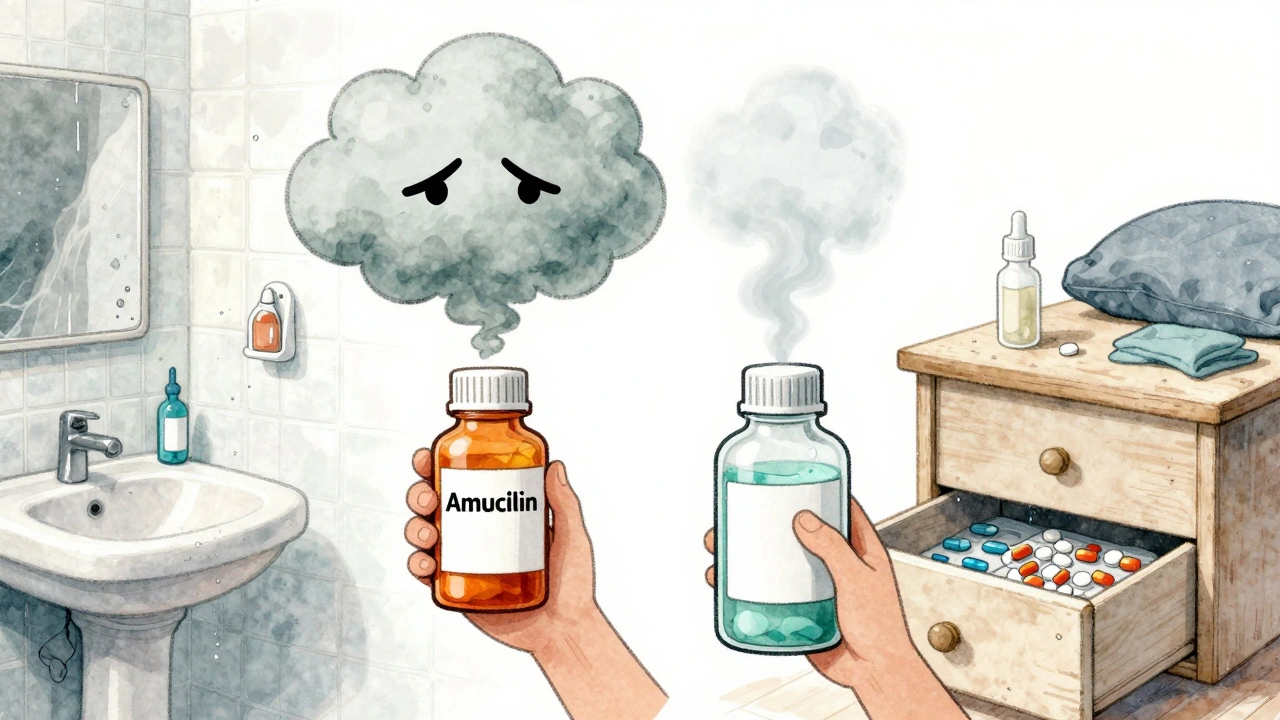
Medications are formulated to be odorless or have a faint, consistent smell. If your bottle of amoxicillin suddenly smells sour, musty, or like vinegar, that’s not normal. That’s moisture getting in-and moisture triggers bacterial growth and chemical breakdown.
Hygroscopic drugs like amoxicillin and doxycycline absorb water from the air. When that happens, the powder inside capsules can clump, harden, or ferment. You might not see it, but you’ll smell it. A strong, unpleasant odor in any oral medication is a clear signal to throw it away.
Even topical products like antibiotic ointments can go bad this way. If mupirocin cream smells rancid, don’t apply it to a wound. You’re not just risking infection-you could be introducing harmful microbes into your skin.
Texture: The Silent Danger
Texture changes are often the most overlooked. A tablet that crumbles in your fingers? A capsule that feels sticky or soft? A cream that’s separated into oily and watery layers? These aren’t just inconvenient-they’re dangerous.
Solid dosage forms like tablets and capsules are designed to dissolve at a specific rate. If they’ve hardened or become brittle, they won’t break down properly in your stomach. That means you’re not getting the full dose. On the flip side, if a tablet is soft or sticky, it may have absorbed moisture, which can cause active ingredients to degrade faster.
Semisolid products like creams and ointments are especially vulnerable. Look for "oil-off" or "water-off"-when the product splits into layers. Clotrimazole cream that’s now runny on top and thick on the bottom? That’s phase separation. It means the emulsion has broken down. The active ingredient may no longer be evenly distributed. You could be applying a dose that’s too weak-or too strong.
Liquids are just as risky. If you see floating particles, cloudiness, or sediment that won’t shake out, stop using it. The USP standard allows no more than 6,000 particles larger than 10 micrometers per container. You can’t see those with your eyes, but you can see clumps. If you can, it’s already way past safe.
What to Do When You Spot a Problem
If you notice any of these changes, don’t guess. Don’t take a chance. Dispose of the medication properly.
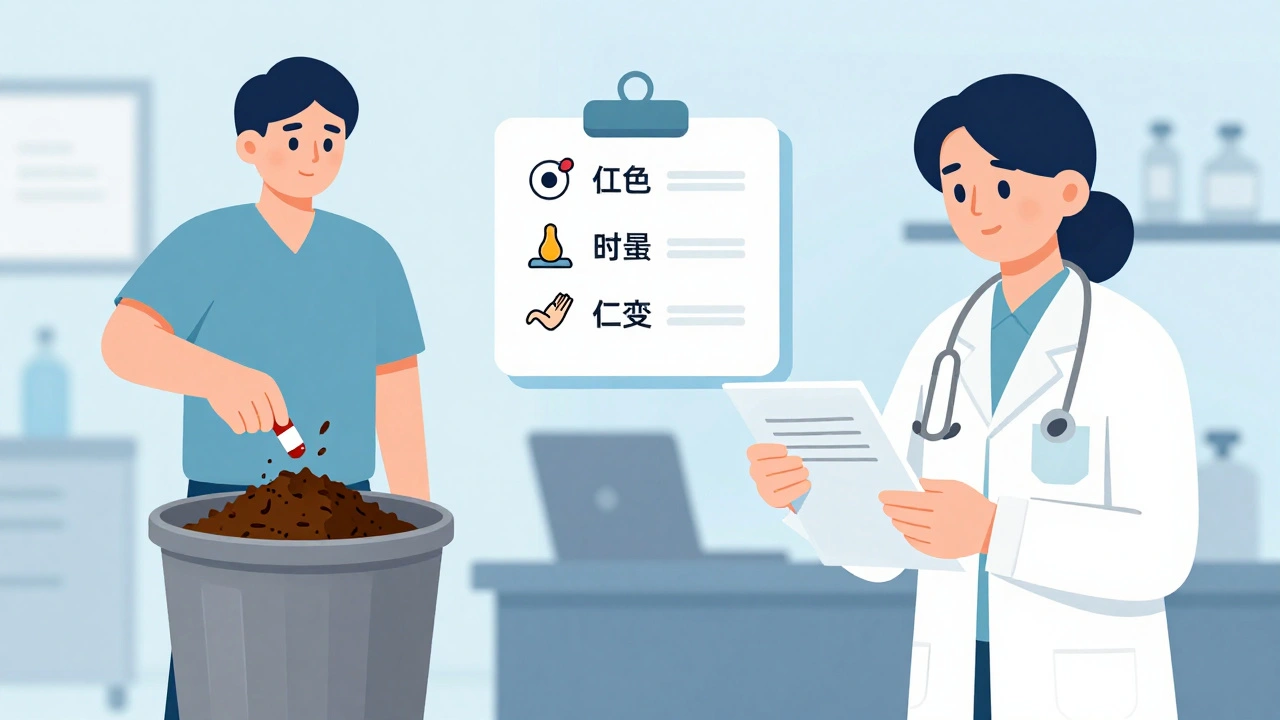
Most pharmacies offer take-back programs. If yours doesn’t, the FDA recommends mixing pills with coffee grounds or cat litter, sealing them in a plastic bag, and throwing them in the trash. Never flush them unless the label says to-many drugs pollute water supplies.
For creams and liquids, seal the container tightly and discard it with household waste. Never pour liquid meds down the sink.
And here’s the key: always document what you saw. Write down the drug name, expiration date, and exact change-"light brown discoloration on tablet edges," "cream separated into oily layer," "strong vinegar smell." This helps pharmacists and regulators track patterns and improve safety.
When Visual Checks Aren’t Enough
Here’s the hard truth: not all dangerous changes are visible. Some drugs, like PMZ (phenytoin), can lose potency without any color or texture change. That’s why professional labs use instruments-spectrophotometers, pH meters, and Raman scanners-to test for chemical integrity.
But for most people, those tools aren’t available. That’s why visual inspection remains the first and most practical line of defense. The WHO says simple visual checks are the most accessible way to spot degraded medicines, especially in low-resource areas.
Still, if you’re managing medications for someone with a chronic condition-like epilepsy, heart disease, or diabetes-don’t rely on sight alone. Talk to your pharmacist. Ask if the drug is one that degrades without visible signs. Ask if there’s a test strip or a lab option to check potency.
Prevention: How to Keep Medications Safe Longer
The best way to avoid expired drugs with changes is to prevent degradation in the first place.
- Store pills in a cool, dry place-like a bedroom drawer, not the bathroom.
- Avoid keeping medicines in cars or near windows. Heat and sunlight accelerate breakdown.
- Keep bottles tightly closed. Even a slightly loose cap lets in moisture.
- Use the original packaging. Blister packs protect better than pill organizers.
- Check expiration dates every 3 months. Set a calendar reminder.
At research facilities like the University of Wisconsin’s RARC, staff use a colored dot system to track expiration dates. Each year gets a color. The month is written in the center. They check every drug monthly. You don’t need a lab to do this. Just grab a marker and a sticker. Write the expiration date on the bottle cap. It’s simple. It works.
Final Reality Check
Some people swear they’ve taken expired meds for years and felt fine. Maybe they have. But that doesn’t mean it’s safe. One person’s "fine" is another person’s hospital visit. In 2019, a hospital kept using expired morphine sulfate that had developed crystals. They thought it was normal. Fourteen patients had adverse reactions.
Pharmaceuticals aren’t like milk. You can’t always smell or taste when they’ve gone bad. But you can see, feel, and notice when they’ve changed. And if you do, you have one responsibility: stop using them.
Your health isn’t worth the gamble. When in doubt, throw it out. And next time you buy a new prescription, ask your pharmacist: "Is there anything I should watch for if this expires?" That simple question could save your life.
Can expired drugs become toxic?
Yes, some expired drugs can break down into toxic compounds. Tetracycline antibiotics, for example, can degrade into substances that damage the kidneys. While this is rare, it’s well-documented. Other drugs may not become toxic but lose potency, which can lead to treatment failure-like an antibiotic not killing an infection, leading to worse illness.
Is it safe to use expired insulin or epinephrine?
No. These are life-saving medications. Insulin can lose potency without visible changes, and epinephrine auto-injectors degrade quickly after expiration-even if they look fine. Using expired insulin or epinephrine can be life-threatening. Always replace them on time.
What if my pill looks fine but is past the expiration date?
It’s still risky. Some drugs degrade chemically without changing color, smell, or texture. For non-critical meds like antihistamines or pain relievers, the risk may be low-but potency drops over time. For anything treating a serious condition (blood pressure, seizures, heart disease), don’t take it past the date. When in doubt, consult your pharmacist.
Can I trust the expiration date on over-the-counter drugs?
Yes, if stored properly. OTC drugs are tested just like prescriptions. But if you’ve kept them in a hot bathroom or a sunny car, they may degrade faster. Always check for signs of damage-color, smell, texture-even if the date hasn’t passed.
How do I know if a liquid medication has bacterial contamination?
You can’t see bacteria, but you can see signs they’re growing. Cloudiness, floating particles, unusual sediment, or a foul odor are red flags. If the liquid was clear and now looks murky or has bits floating in it, discard it. The USP limits microbial growth to 100 CFU/mL for non-sterile products-anything beyond that is unsafe.
Do refrigerated meds expire faster if left out?
Yes. Medications that require refrigeration, like certain antibiotics, insulin, or eye drops, degrade much faster when exposed to room temperature. Leaving them out for more than 24 hours can compromise safety. Always follow storage instructions on the label.
Rebecca M.
December 3, 2025 AT 10:37So let me get this straight-we’re supposed to trust our eyes over FDA labs? 😏 My grandma took her blood pressure med for 3 years past expiry and still outlived her cat. Guess who’s the real expert here?
Roger Leiton
December 3, 2025 AT 22:40Bro this is 🔥 real talk. I checked my old amoxicillin last week-smelled like sour milk and the capsules were sticky as hell. Threw it out immediately. Also, side note: storing meds in the bathroom is basically a science experiment in mold growth 🤢💧
Jay Everett
December 5, 2025 AT 19:18Man, I used to be one of those people who thought "it’s probably still good"-until my buddy took expired insulin and ended up in the ER. 🚨 The scary part? No color change. No smell. Just… dead potency. That’s when I started labeling every bottle with a Sharpie and a color code. Red = 2024, Blue = 2025. Simple. Effective. Life-saving. 💡💊
Steve World Shopping
December 6, 2025 AT 20:05The degradation kinetics of pharmaceutical formulations are non-linear and highly dependent on Arrhenius-based thermal degradation pathways. Discoloration exceeding ΔE > 15 in CIELAB space is a statistically significant indicator of hydrolytic decomposition, particularly in beta-lactam antibiotics. The 68.3% figure cited from NASA is corroborated by the 2017 WHO Pharmacovigilance Report on substandard antimicrobials in low-resource settings. You’re not "just looking"-you’re performing rudimentary quality control. Fail to do so, and you’re complicit in therapeutic failure.
Laura Baur
December 8, 2025 AT 15:19It’s fascinating how society has normalized the idea that expiration dates are mere suggestions, as if pharmaceuticals were artisanal bread instead of chemically engineered interventions designed to modulate physiological pathways. We live in a culture that equates convenience with wisdom, and yet, we’re shocked when the body rebels. The fact that people still keep pills in their bathrooms-steam, heat, humidity-isn’t negligence; it’s a metaphor for how we treat our own health: casually, carelessly, and with a profound disregard for consequence. You wouldn’t leave a child in a hot car, but you’ll leave epinephrine in a drawer above the shower? The cognitive dissonance is breathtaking.
Steve Enck
December 9, 2025 AT 18:45While the article presents a compelling argument grounded in empirical data, it fails to address the systemic socioeconomic determinants that compel individuals to consume expired pharmaceuticals. In underserved communities, access to affordable medications is a structural issue-not a personal failure. To assert that "when in doubt, throw it out" is to ignore the reality that for many, "throwing it out" means foregoing treatment entirely. The moral imperative must shift from individual vigilance to policy reform: universal access, subsidized replacements, and pharmacy-led expiration tracking programs.
मनोज कुमार
December 10, 2025 AT 17:20Too much talk. If it looks weird or smells bad, trash it. No need for NASA or WHO. Simple. Done. 🤷♂️
Joel Deang
December 12, 2025 AT 10:18OMG i just checked my hydrocortisone and it’s got like… gray streaks?? 😱 i thought it was just old but now i’m scared. i’ve been using it for my eczema for 2 years. gonna run to the pharmacy tomorrow. ty for the wake up call!! 🙏❤️
Jack Dao
December 13, 2025 AT 18:45Of course you people are freaking out about color changes. Meanwhile, half the country is still taking expired Adderall like it’s candy. If you’re using expired meds for non-life-threatening stuff, you’re already gambling. At least be honest about it. This isn’t science-it’s just you being lazy and hoping for the best. And yes, I’m judging you. 🤨