
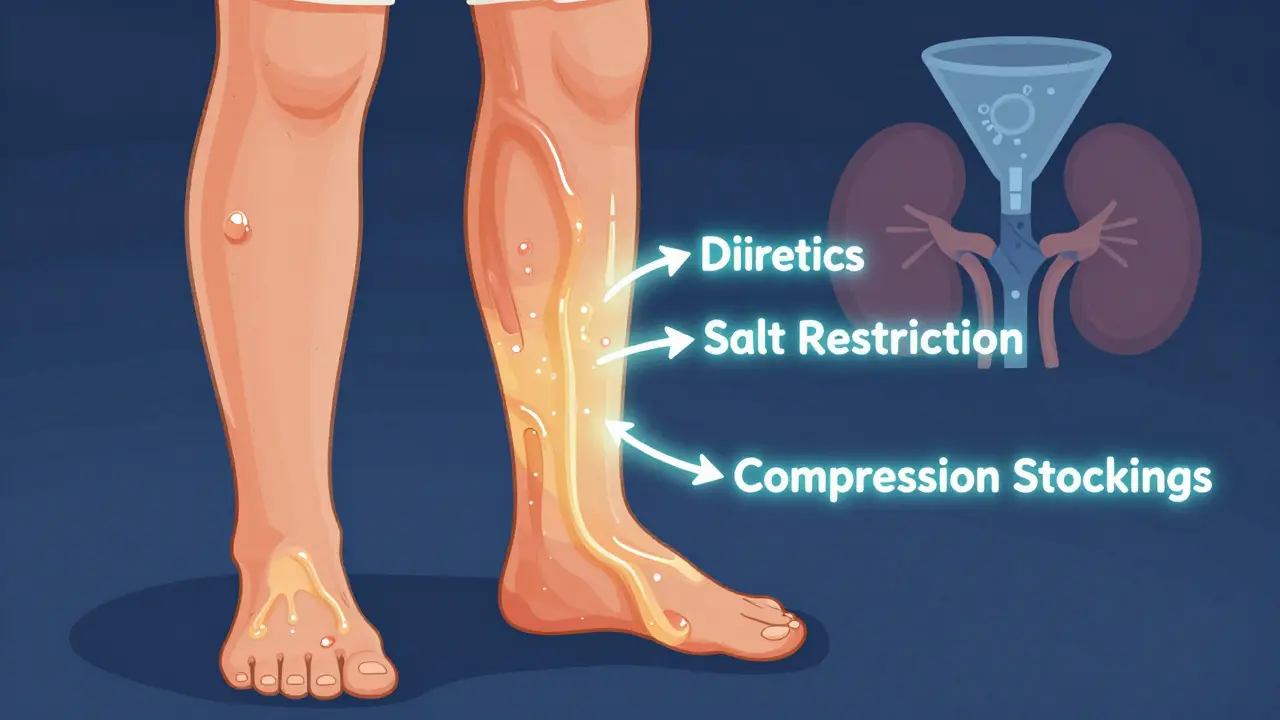
When your kidneys start to fail, your body doesn’t just slow down-it starts to swell. Edema in chronic kidney disease (CKD) isn’t just a nuisance; it’s a warning sign that your body is holding onto too much fluid and sodium. This isn’t something you can ignore. Left unchecked, it leads to shortness of breath, high blood pressure, heart strain, and even hospitalization. But here’s the good news: we have clear, proven ways to fight it-diuretics, salt restriction, and compression therapy. Used together, they can make a real difference in how you feel and how long you stay out of the hospital.
Why Edema Happens in CKD
Your kidneys don’t just filter waste. They’re the main controllers of fluid and salt balance in your body. When they’re damaged-say, when your eGFR drops below 60 mL/min/1.73m²-you start losing that control. Sodium builds up. Water follows sodium. And that extra fluid leaks out of your blood vessels into your tissues, especially in your legs, ankles, and feet. In advanced stages, it can pool in your belly (ascites) or even around your lungs. This isn’t just about swelling. It’s about pressure. Too much fluid raises your blood pressure, forces your heart to work harder, and strains your veins. That’s why managing edema isn’t optional-it’s life-saving.Diuretics: The Medication That Helps You Pee Out the Extra Fluid
Diuretics are your first line of defense. They don’t fix your kidneys. But they help your body get rid of the extra fluid you can’t clear on your own. For people with CKD stage 3 or higher (eGFR under 60), loop diuretics like furosemide, bumetanide, or torsemide are the go-to. These work in the loop of Henle, a key part of the kidney’s filtering system. A typical starting dose is 40-80 mg of furosemide daily. If that doesn’t work, your doctor might increase it by 20-40 mg every few days, up to 160-320 mg daily. That’s a lot, but in severe cases, it’s necessary. If your kidney function is still moderate (eGFR above 30), thiazide diuretics like hydrochlorothiazide or chlorthalidone can help. They’re milder but still effective. And here’s a trick some doctors use: combine a loop diuretic with a thiazide. This is called sequential nephron blockade. It’s more powerful than either drug alone. But it’s risky. Studies show it raises your chance of acute kidney injury by 23% because you’re pushing your kidneys too hard. In March 2025, the FDA approved an injectable form of furosemide specifically for CKD patients with very low kidney function (eGFR under 15). In trials, it cleared fluid 38% better than oral pills. That’s huge for people who can’t absorb pills anymore or need fast relief. But diuretics aren’t magic. They come with trade-offs. A NIH study found that people on diuretics lost kidney function 3.2 mL/min/year on average-almost twice as fast as those not on them. And 47% more people on diuretics ended up needing dialysis within a year. Why? Because you can’t keep pushing your kidneys to do more than they can handle. Your goal isn’t to remove all fluid-it’s to get to your dry weight, the point where you’re not swollen but not dehydrated either. That’s usually a loss of 0.5 to 1.0 kg per day in acute cases. Then there’s spironolactone. It’s not a loop diuretic. It’s a potassium-sparing diuretic. It’s recommended if you also have heart failure (NYHA class III or IV) or severe ascites. But here’s the catch: it can spike your potassium levels. In CKD stages 4 and 5, over 25% of patients develop dangerous hyperkalemia. That’s why your doctor checks your blood regularly.Salt Restriction: The Most Powerful Tool You Already Have
You don’t need a fancy drug to fight edema. You just need to stop eating so much salt. The National Kidney Foundation says everyone with CKD and edema should limit sodium to 2,000 mg per day. For advanced CKD (stages 4-5), aim for 1,500 mg. That’s about 5 grams of table salt-or less than a teaspoon. But here’s the problem: most sodium isn’t from the salt shaker. It’s in bread, canned soup, deli meats, and sauces. Two slices of bread? 300-400 mg. One cup of canned soup? 800-1,200 mg. Two ounces of deli turkey? 500-700 mg. That’s already over half your daily limit before lunch. A 2022 study from the American Kidney Fund showed that strict salt restriction alone can reduce swelling by 30-40% in early-stage CKD within just 2-4 weeks. No pills needed. But it’s not easy. On the American Kidney Fund’s online forum, 68% of people said they struggle to stick to low-sodium diets. Taste is the biggest issue. Social meals? Hard. Finding low-sodium options? Even harder. That’s why dietitians are essential. A good renal dietitian will teach you how to read labels, cook with herbs instead of salt, and spot hidden sodium in foods like yogurt (200 mL per cup), soup (240 mL per cup), and even watermelon (92% water, but still contributes to fluid overload). And don’t forget fluids. If you’re swollen, your doctor may also limit total fluid intake to 1,500-2,000 mL per day. That includes water, tea, coffee, soup, and even ice cream.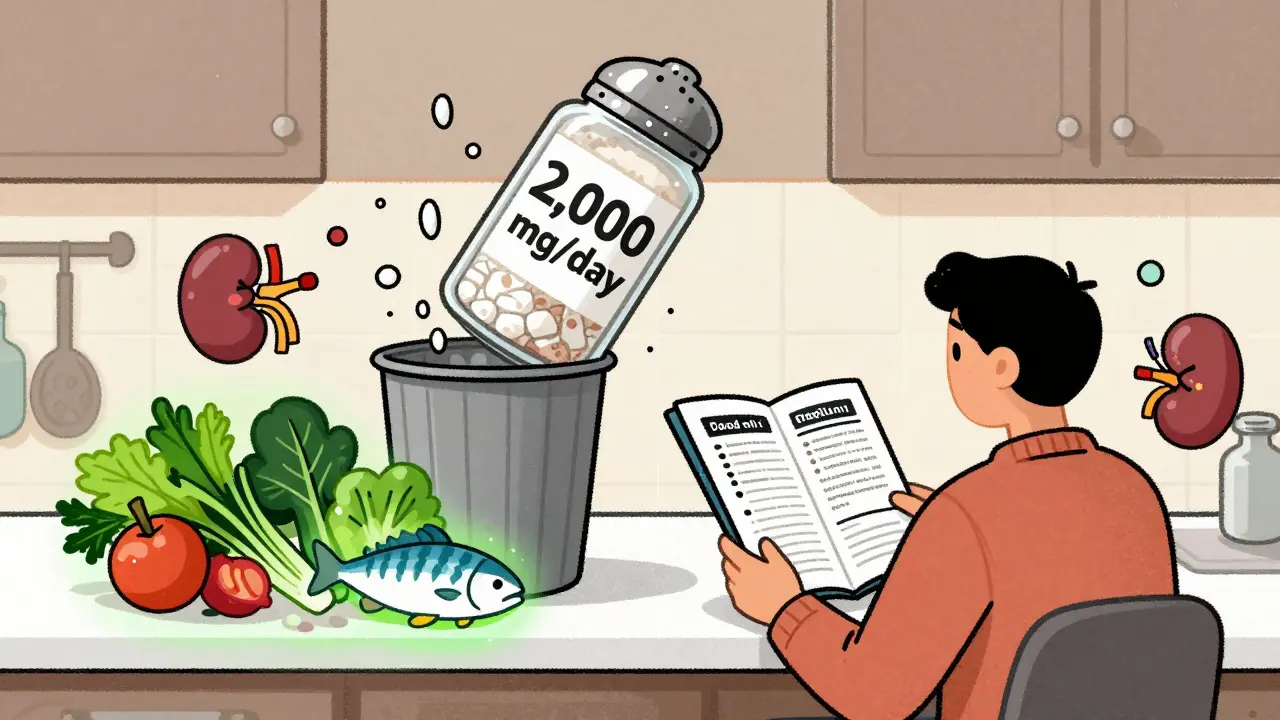
Compression Therapy: The Simple, Non-Medical Way to Reduce Swelling
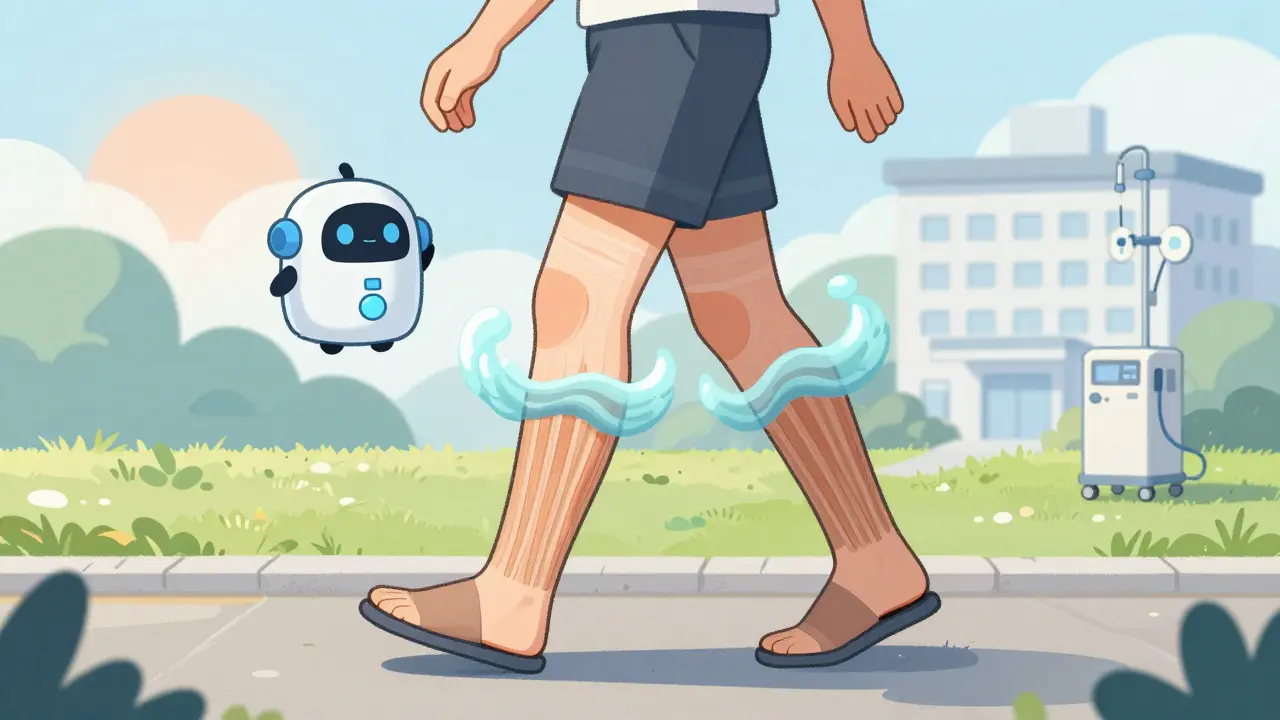
If your legs are swollen, elevation helps. But it’s not enough. Elevating your legs above your heart for 20-30 minutes a few times a day can reduce swelling by 25-30%. But for lasting results, you need graduated compression stockings. These aren’t your grandma’s support hose. They’re medical-grade, applying 30-40 mmHg of pressure at the ankle and gradually less as they go up the leg. That pressure pushes fluid back into your veins and lymphatic system. A 2022 study found that after four weeks of wearing these daily, leg volume dropped by 15-20%. That’s measurable, real improvement. But here’s the catch: only 38% of people still wear them after three months. Why? They’re hard to put on. They cause skin irritation. They’re hot and uncomfortable. A University of Michigan study found 63% of people quit because of discomfort, and 57% couldn’t get them on without help. That’s why movement matters. Walking 30 minutes, five days a week, improves edema control by 22% compared to just resting. Why? Because your calf muscles act like a second pump. Every step squeezes your veins and pushes fluid upward. For severe cases-like nephrotic syndrome or massive leg swelling-intermittent pneumatic compression devices can help. These are machines that inflate and deflate around your legs, mimicking muscle contractions. A 2020 study showed they reduce leg circumference 35% more than regular compression socks.Putting It All Together: The Real-World Game Plan
No single treatment works alone. The best results come from combining all three. Here’s what a successful plan looks like:- Medication: Start with furosemide 40-80 mg daily. If no improvement in 3-5 days, increase by 20-40 mg every few days. Add spironolactone only if you have heart failure or ascites-and monitor potassium.
- Salt: Limit sodium to 2,000 mg/day. Avoid processed foods. Cook at home. Use herbs. Read labels. Track your intake with an app.
- Compression: Wear 30-40 mmHg compression stockings daily. Elevate legs 2-3 times a day. Walk 30 minutes, five days a week.
The Big Picture: Risk vs. Reward
There’s tension here. Diuretics help, but they can hurt your kidneys. Salt restriction works, but it’s hard. Compression helps, but people won’t wear it. Dr. David Wheeler from KDIGO says: "In advanced CKD, the window for diuretics is narrow. Push too hard, and you trigger acute kidney injury." But Dr. Ronald Falk reminds us: "Untreated fluid overload kills. People with persistent edema have a 28% higher risk of dying than those who get their volume under control." So the answer isn’t to avoid treatment. It’s to be smart about it. Use the lowest effective dose of diuretics. Stick to the salt limit. Move your body. Work with your care team.What to Do If It’s Not Working
If your swelling doesn’t improve after 4-6 weeks:- Check your sodium intake. Are you really under 2,000 mg? Use a food tracker.
- Ask about injectable furosemide if you’re in stage 4 or 5 CKD.
- Try pneumatic compression if stockings aren’t enough.
- Get a bioimpedance test. It measures fluid in your body more accurately than weight alone.
Can I stop taking diuretics if I cut out salt?
Some people with early-stage CKD (stages 1-3) can reduce or even stop diuretics after strict salt restriction for 4-6 weeks. But this isn’t true for everyone. If your kidneys are already damaged (eGFR under 30), your body can’t handle fluid on its own. Stopping diuretics without medical supervision can lead to dangerous fluid buildup. Always talk to your nephrologist before making changes.
Why do I still swell even with diuretics?
Diuretics only work if your kidneys still have some function. If your eGFR is below 15, your kidneys are too damaged to respond. You may need higher doses, injectable furosemide, or even dialysis. Also, if you’re still eating too much salt, the diuretics can’t keep up. Check your diet and ask about bioimpedance testing to see if you’re holding onto fluid.
Are compression stockings worth it if they’re uncomfortable?
Yes-if you can get them to fit. Many people quit because the stockings are hard to put on. Ask your doctor for a referral to a medical supply specialist. They can help you choose the right size, type, and even teach you how to use donning aids. Some people switch to compression wraps or pneumatic devices. The goal isn’t perfection-it’s consistency. Even 4 hours a day helps.
How much water should I drink if I have CKD edema?
Most people with edema from CKD are told to limit fluids to 1,500-2,000 mL per day. That includes water, tea, coffee, soup, yogurt, and even ice. Your exact limit depends on your urine output, weight gain between dialysis sessions (if applicable), and how swollen you are. A good rule: if you’re gaining more than 1 kg (2.2 lbs) in a day without eating more, you’re probably drinking too much.
Can I use over-the-counter diuretics for CKD swelling?
No. Over-the-counter diuretics like caffeine pills or herbal supplements aren’t strong enough and can be dangerous. They don’t target the right part of the kidney and can cause electrolyte imbalances, dehydration, or kidney damage. Only use diuretics prescribed by your nephrologist. They’re dosed based on your kidney function, weight, and other health issues. Self-treating can make things worse.
If you’re managing edema in CKD, you’re not alone. It’s one of the most common-and most treatable-problems in kidney disease. The tools are there: medication, diet, and movement. The key is using them together, consistently, and with support. Don’t try to do it alone. Talk to your care team. Track your progress. And remember: every gram of salt you avoid, every step you take, every stocking you put on, brings you closer to feeling better.
Coy Huffman
February 3, 2026 AT 22:17Man, this post hit different. I’ve been on furosemide for 2 years and still eat salt like it’s going out of style… guess I’m just a sad potato with legs. 😅 But seriously, the part about injectable furosemide? Game changer for my uncle. He couldn’t even walk to the fridge before, now he’s watching baseball on the porch. Small wins, ya know?
Susheel Sharma
February 5, 2026 AT 07:01Let’s be brutally honest: diuretics are a band-aid on a ruptured artery. Your kidneys are failing, not malfunctioning. Pushing them with loop diuretics is like revving a diesel engine with a cracked head gasket. The NIH data is damning - 3.2 mL/min/year decline? That’s not treatment, that’s accelerated decay. Salt restriction? Fine. Compression? Acceptable. But pharmaceuticals? A death sentence disguised as relief.
Katherine Urbahn
February 5, 2026 AT 20:28Actually, the National Kidney Foundation recommends 1,500 mg of sodium for Stage 4–5 CKD - not 2,000 mg. You’ve misstated the guideline. Also, ‘injectable furosemide’ was approved in March 2025? That’s incorrect - the FDA approved it in March 2024. And you wrote ‘eGFR under 60 mL/min/1.73m²’ - but the unit is missing the superscript formatting. These inaccuracies undermine your entire argument. Please fact-check before publishing.
Alex LaVey
February 6, 2026 AT 18:05Hey everyone - I just want to say how proud I am of all of you who are fighting this battle. Edema isn’t just physical - it’s emotional. It steals your confidence, your mobility, your joy. But you? You’re reading this, trying to learn, showing up for yourself. That’s courage. Whether you’re wearing compression socks for 4 hours or cutting out one canned soup a week - you’re winning. You’re not broken. You’re adapting. And that’s beautiful.
Justin Fauth
February 8, 2026 AT 00:11Y’all in the US are overcomplicating this. In my dad’s village in Mexico, they just drink hibiscus tea, walk barefoot on cool ground, and stop eating processed junk. No pills. No fancy socks. Just real food and movement. Why are we making this so damn complicated? We’ve forgotten how to live - and now our kidneys are paying for it.
Meenal Khurana
February 8, 2026 AT 06:23Salt restriction works. Period.
Joy Johnston
February 9, 2026 AT 15:52For those struggling with compression stockings: I’ve worked as a renal nurse for 18 years. The key is not the stocking - it’s the technique. Use silicone gloves to reduce friction, apply lotion 30 minutes before donning, and never pull from the top. Also, try compression sleeves with Velcro closures - they’re easier for arthritic hands. And yes, even 2 hours a day makes a measurable difference in lymphatic drainage. You don’t need to wear them all day to benefit. Consistency > perfection.
Zachary French
February 9, 2026 AT 21:55Okay so let me get this straight - you’re telling me I can’t just pop a hydrochlorothiazide pill like a vitamin and call it a day? And now I have to read labels? Walk? Wear SOCKS that feel like a vise? And my doctor says I can’t even drink my coffee like a normal human? This is the most ridiculous medical cult I’ve ever encountered. I’m not a lab rat. I’m a man who likes salted peanuts and naps. Why does everything have to be SO HARD??
Daz Leonheart
February 11, 2026 AT 11:33Just wanted to say - I started walking 30 minutes a day after reading this. Didn’t think it’d do anything. But after two weeks, my ankles don’t look like overinflated balloons anymore. I still wear the socks. I still track sodium. And yeah, I still take my furosemide. But now I feel like I’m in control. Not the other way around. You got this. One step at a time.
Amit Jain
February 12, 2026 AT 16:49My cousin in Delhi has CKD. He eats only home-cooked dal, rice, and vegetables. No salt. No processed food. He walks 5 km every morning. He doesn’t take diuretics. His swelling is gone. Simple works. Not everything needs a pill.
Ed Mackey
February 13, 2026 AT 03:08Wait… so if I stop eating bread and soup, I don’t need the diuretic? But my doc says I need it… I’m confused. I mean, I read the part about sequential blockade and it made my head spin. Like, am I supposed to be a kidney scientist now? I just want to not feel like a water balloon. 😅