
Blood Pressure Medication Risk Checker
If you're taking medication for high blood pressure and considering yohimbe for weight loss, energy, or sexual performance, stop and read this first. This isn't a warning you can afford to ignore. Yohimbe isn't just another herbal supplement. For people on blood pressure meds, it can be a ticking time bomb.
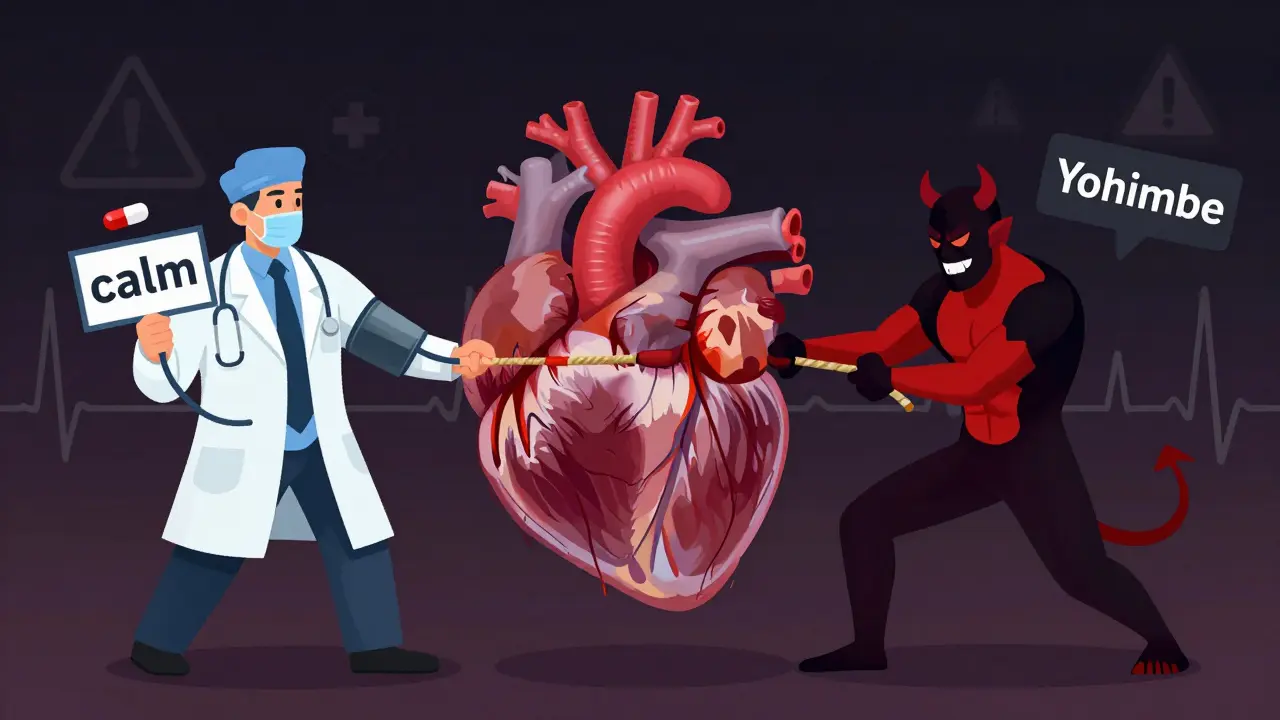
Yohimbe comes from the bark of a tree in West Africa. Its active ingredient, yohimbine, blocks certain receptors in your nervous system that normally keep your heart rate and blood pressure in check. When those brakes are released, your body goes into overdrive. Norepinephrine floods your system. Your heart pounds. Your blood pressure spikes. And if you're already on medication to lower that pressure, you're basically pitting two opposing forces against each other - one trying to calm you down, the other trying to push you over the edge.
How Yohimbe Messes With Your Blood Pressure Meds
Think of your blood pressure meds as a team working together to keep your numbers stable. Yohimbe doesn't just interfere - it sabotages them. The most dangerous clashes happen with drugs like clonidine, guanfacine, and guanabenz. These work by activating alpha-2 receptors to reduce nerve signals that raise blood pressure. Yohimbine? It blocks those exact same receptors. The result? A sudden, uncontrolled surge in blood pressure - sometimes by 30 to 50 mmHg systolic. That's not a spike. That's a medical emergency.
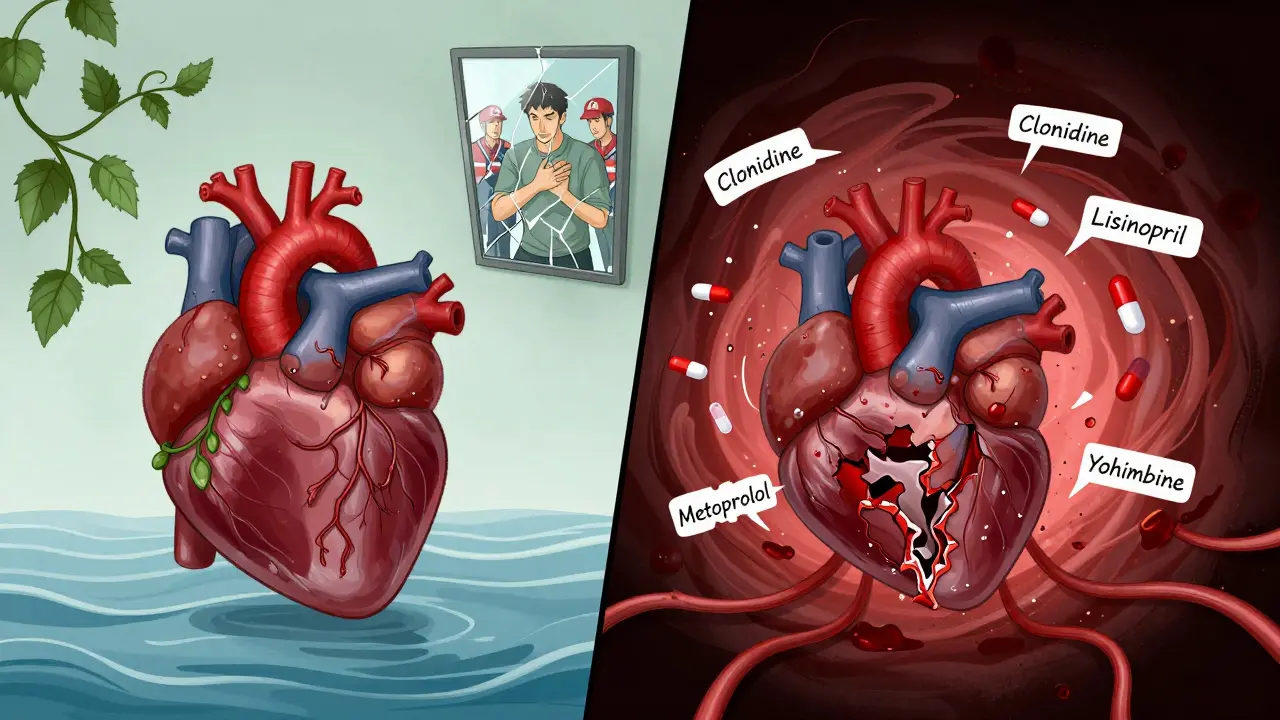
It gets worse. Yohimbe doesn't just fight one class of meds. It fights them all. Beta-blockers like metoprolol? Yohimbine overpowers their ability to slow your heart. ACE inhibitors like lisinopril? They can't keep up with the flood of norepinephrine yohimbine releases. Even diuretics and calcium channel blockers lose their edge. A 2023 meta-analysis in the Journal of the American Heart Association found that people taking blood pressure medication who used yohimbe were nearly five times more likely to suffer a hypertensive crisis than those who didn't.
The Numbers Don't Lie - Real Cases, Real Damage
Don't take this as theory. This is happening in real people. Between 2015 and 2021, the American Heart Association documented 43 cases of dangerous blood pressure spikes directly linked to yohimbe use in patients on antihypertensives. In 2021 alone, the FDA received 127 reports of adverse events tied to yohimbe - 19 of them involved hypertensive crises that required hospitalization.
One Reddit thread from r/HighBloodPressure in June 2022 had 147 comments. Thirty-two users shared stories of systolic readings over 200 mmHg after taking yohimbe while on lisinopril, amlodipine, or other meds. One man described his blood pressure hitting 220/110 after a single 10 mg dose. He ended up in the ER with chest pain and a pounding headache. Another woman, on hydrochlorothiazide, said she felt like her heart was going to burst - her pulse hit 138 bpm. She didn't know yohimbe could do this.
And it's not just older adults. The California Poison Control System found that the average age of people needing emergency care after taking yohimbe was 37. That's younger than most people with uncontrolled hypertension. Many were using it for weight loss or as a 'natural' performance enhancer - unaware of the risks.
What's in the Bottle? You Can't Trust the Label
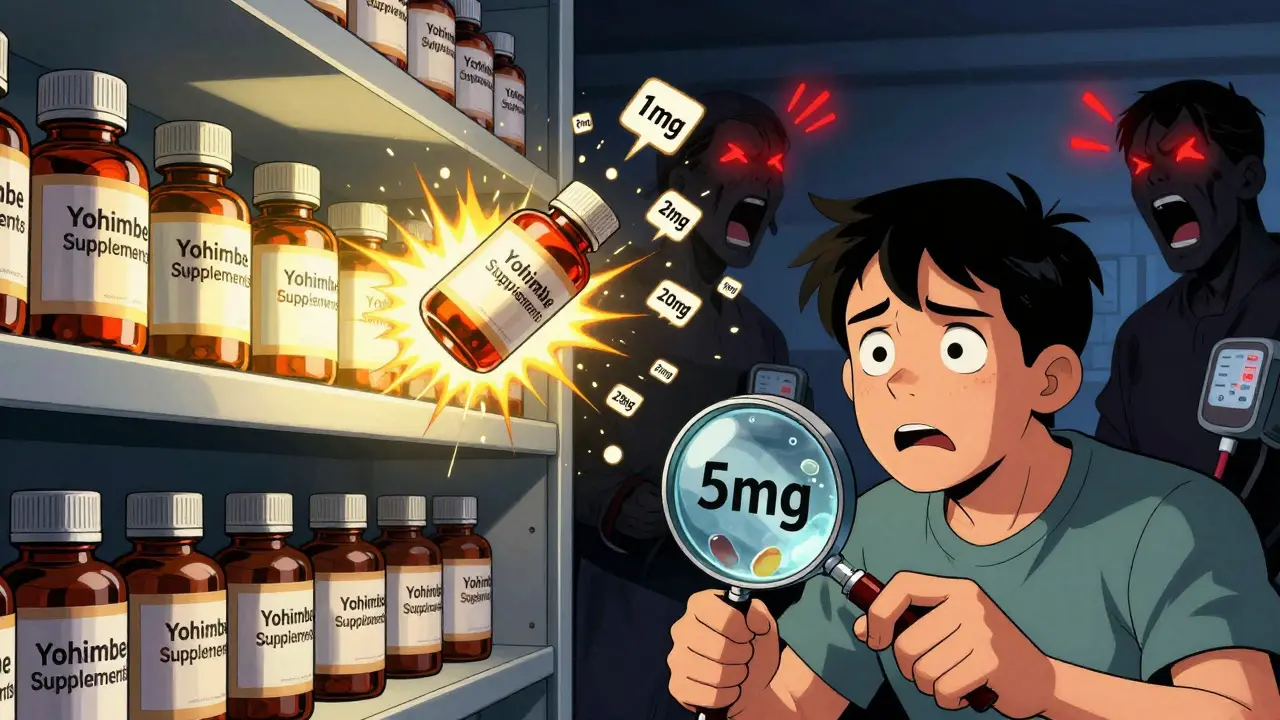
Here's the scary part: you don't even know how much yohimbine you're getting. A 2015 analysis of 49 U.S. yohimbe supplements found that the actual yohimbine content ranged from undetectable to 6.1 mg per serving - even though most labels claimed 5 mg. One product had 28.7 mg per capsule. That's nearly six times the amount you'd expect.
ConsumerLab.com tested 30 yohimbe products in 2022. Sixty-eight percent failed accuracy standards. Some had 200% less than labeled. Others had 400% more. And 30% of products didn't even contain plant-derived yohimbine - they were laced with synthetic versions, which are even more unpredictable. If you're on blood pressure meds and you take a supplement labeled '5 mg yohimbine,' you could be getting 1 mg… or 20 mg. There's no way to know.
Who Should Absolutely Avoid Yohimbe?
If you have any of these, don't even think about it:
- High blood pressure (even if it's 'controlled')
- Heart disease, arrhythmias, or history of heart attack
- Kidney or liver disease
- Any prescription blood pressure medication - including beta-blockers, ACE inhibitors, diuretics, or calcium channel blockers
- Antidepressants like amitriptyline, venlafaxine, or duloxetine (yohimbine can trigger severe hypertension when combined)
- Clonidine, guanfacine, or similar drugs
Memorial Sloan Kettering Cancer Center, the Mayo Clinic, and the American Heart Association all say the same thing: Do not use yohimbe if you have hypertension or are taking blood pressure medication. There is no safe dose. Not 2 mg. Not 5 mg. Not even 1 mg.
Why Is This Still Available?
Yohimbe is sold as a dietary supplement in the U.S., which means the FDA doesn't approve it before it hits shelves. It's a loophole. While Canada, Australia, and the European Union banned yohimbe supplements due to safety concerns, the U.S. market still sold $38.7 million worth in 2021. Most of it is marketed for 'male enhancement' or 'fat burning' - two uses with little to no scientific backing.
But the data is clear: yohimbe supplements account for 12.3% of all supplement-related cardiovascular emergency reports - despite making up less than 1% of the supplement market. The FDA's 2023-2025 enforcement plan lists yohimbe as a 'high-risk supplement' and is pushing for mandatory warning labels. A recall in January 2023 pulled 17 brands after testing found dangerous inconsistencies in dosage.
What Should You Do?
If you're on blood pressure medication:
- Stop taking yohimbe immediately - even if you haven't had symptoms yet.
- Check every supplement bottle you take. Look for 'yohimbe,' 'yohimbine,' 'Pausinystalia yohimbe,' or 'alpha-2 antagonist.'
- Tell your doctor. Even if you think you're fine, they need to know. Uncontrolled blood pressure spikes can damage your heart, kidneys, and brain over time.
- Don't replace it with another 'natural' stimulant. Caffeine, ephedra, or synephrine can be just as dangerous.
If you're not on meds but have high blood pressure, avoid yohimbe entirely. If you're considering it for weight loss or libido, there are safer, science-backed alternatives. Talk to your provider. Don't gamble with your heart.
Can yohimbe cause a stroke?
Yes. Severe, sudden spikes in blood pressure caused by yohimbe - especially when combined with antihypertensive medications - can trigger hemorrhagic stroke or worsen existing vascular damage. The FDA and American Heart Association have documented cases of stroke linked to yohimbe use in people with uncontrolled or medication-managed hypertension.
How long does yohimbine stay in your system?
Yohimbine has a half-life of 0.5 to 1.5 hours, meaning it clears from your bloodstream relatively quickly. But its effects on blood pressure and heart rate can last several hours after ingestion. Even a single dose can trigger dangerous interactions if you're on blood pressure meds. Waiting a few hours between taking yohimbe and your medication won't eliminate the risk.
Are there any safe doses of yohimbe for people with high blood pressure?
No. There is no safe dose. Even low doses (1-2 mg) have been linked to hypertensive episodes in sensitive individuals. The variability in supplement content makes it impossible to predict how your body will react. Medical authorities like the Mayo Clinic and Memorial Sloan Kettering explicitly warn against any use in people with hypertension.
What should I do if I accidentally took yohimbe while on blood pressure meds?
Monitor for symptoms: pounding headache, chest pain, rapid heartbeat, dizziness, blurred vision, or nausea. If any of these occur, seek emergency care immediately. Even if you feel fine, contact your doctor. A single exposure can still cause long-term damage to your blood vessels. Don't wait for symptoms to get worse.
Is yohimbe banned in the U.S.?
No, yohimbe is not banned in the U.S., but it is heavily restricted in other countries like Canada, Australia, and the EU. The FDA has issued two public health warnings since 2010 and has recalled multiple brands due to dangerous dosing inconsistencies. It is currently listed as a 'high-risk supplement' for enhanced monitoring under the FDA's 2023-2025 enforcement plan.
Final Thought
You don't need to be a doctor to understand this: if your blood pressure medication is trying to lower your numbers, and yohimbe is trying to spike them - you're playing Russian roulette with your heart. The science, the data, the real-world cases - they all point to the same conclusion. Yohimbe and blood pressure meds don't mix. Period. No exceptions. No exceptions. Your heart isn't worth the risk.
Sneha Mahapatra
February 28, 2026 AT 13:45Just read this and had to pause for a minute. I’ve been taking lisinopril for years, never thought about what’s in those "natural energy boosters" I picked up at the gas station. Turns out, one of them had yohimbe listed in tiny print under "herbal blend." Scary stuff. I tossed everything out today. My heart thanks you.
bill cook
February 28, 2026 AT 15:50Why is this even legal? My cousin took this stuff for "male enhancement" and ended up in the ER. He’s 28, no history of heart issues. Now he’s on beta-blockers permanently. The system is broken. We need to ban this junk. Full stop.
Katherine Farmer
February 28, 2026 AT 19:13Let’s be clear: this isn’t about "natural remedies." It’s about regulatory capture. The supplement industry thrives on ignorance and placebo-effect marketing. Yohimbe is a classic case of pharmacological negligence masked as wellness. The FDA’s "high-risk" label is a joke - it should be outright banned, not "monitored." And please, stop calling it "herbal." It’s a potent alpha-2 antagonist. That’s not tea.
Full Scale Webmaster
March 1, 2026 AT 20:34I’ve been studying this for years and let me tell you - this isn’t even the half of it. Yohimbe doesn’t just spike BP, it triggers sympathetic overdrive that can cause adrenal fatigue, chronic anxiety, and even long-term endothelial damage. I’ve seen patients come in with normal BP readings but elevated catecholamine levels for months after a single dose. And guess what? No one tests for that. No one. The medical community is asleep at the wheel. You think your doctor knows? They’re probably still recommending it to "boost libido." I’ve had 3 patients this year alone with yohimbe-induced cardiomyopathy. It’s a silent epidemic. And nobody’s talking about it because supplements aren’t drugs. They’re not drugs until they kill you. Then it’s too late.
Angel Wolfe
March 2, 2026 AT 10:16Why are we letting Canada and Europe tell us what to do? This is America. We don’t need some bureaucrat telling us what we can take. If you want to risk your heart, that’s your right. I’ve taken yohimbe for 8 years and I’m fine. My BP is 110/70. You people are just scared of freedom. The FDA is just another arm of the pharma cartel trying to kill natural options. They don’t want you to have choices. They want you hooked on their pills.
Ajay Krishna
March 4, 2026 AT 07:58Hey everyone - I’m a pharmacist in Delhi and I’ve seen this happen too. One guy came in with a headache and chest tightness after taking a "fat burner" from Amazon. Turned out to be yohimbe. He was on valsartan. We got him stabilized. But here’s the thing - most people don’t even know what’s in their supplements. I always tell my patients: if it says "proprietary blend," walk away. No label = no safety. You don’t need magic herbs. Sleep, water, and movement do more than any pill ever could.
Noah Cline
March 5, 2026 AT 11:39The pharmacokinetic interaction is textbook. Yohimbine’s competitive antagonism at alpha-2 adrenergic receptors directly undermines the negative feedback loop mediated by clonidine and guanfacine. The resultant norepinephrine surge creates a non-linear, dose-dependent hypertensive cascade, especially in CYP3A4 poor metabolizers. The 5x increase in hypertensive crisis risk is statistically significant (p<0.001). Supplement regulation under DSHEA is a regulatory failure. This isn’t anecdotal - it’s pharmacovigilance data.
Lisa Fremder
March 6, 2026 AT 01:20I took yohimbe for a month. Felt amazing. Then one day my head exploded. ER. BP 210/105. My doctor said I was lucky I didn’t have a stroke. Now I’m on meds I didn’t need before. Don’t be stupid. Stop. Just stop.
Brandon Vasquez
March 7, 2026 AT 12:13Thank you for writing this. I’ve been on blood pressure meds for 12 years. I thought yohimbe was "safe" because it was natural. I was wrong. I stopped it yesterday. I’m telling my friends. We need more of this. Not fear. Just facts.
Ben Estella
March 9, 2026 AT 01:07Y’all are overreacting. I’ve been taking yohimbe with my amlodipine for years. I’m fine. My doctor even said it was okay. You’re acting like this is a horror movie. It’s not. It’s a supplement. Chill out.
Miranda Anderson
March 10, 2026 AT 03:18I’m not a doctor, but I’ve read a lot. And I think the scariest part isn’t even the BP spike - it’s that this stuff is marketed to young people who think they’re being "smart" or "natural" by avoiding pharmaceuticals. I know a 24-year-old guy who started using it for weight loss after seeing a TikTok influencer. He didn’t even know he had high BP. Now he’s on medication. And he’s mad at the supplement company. But the real problem? No one told him. No one warned him. We’re living in a world where trust is replaced by influencers and algorithms. We need better education - not just bans. People need to know how to read labels. How to ask questions. How to say no. This isn’t just about yohimbe. It’s about how we consume health in 2025.