
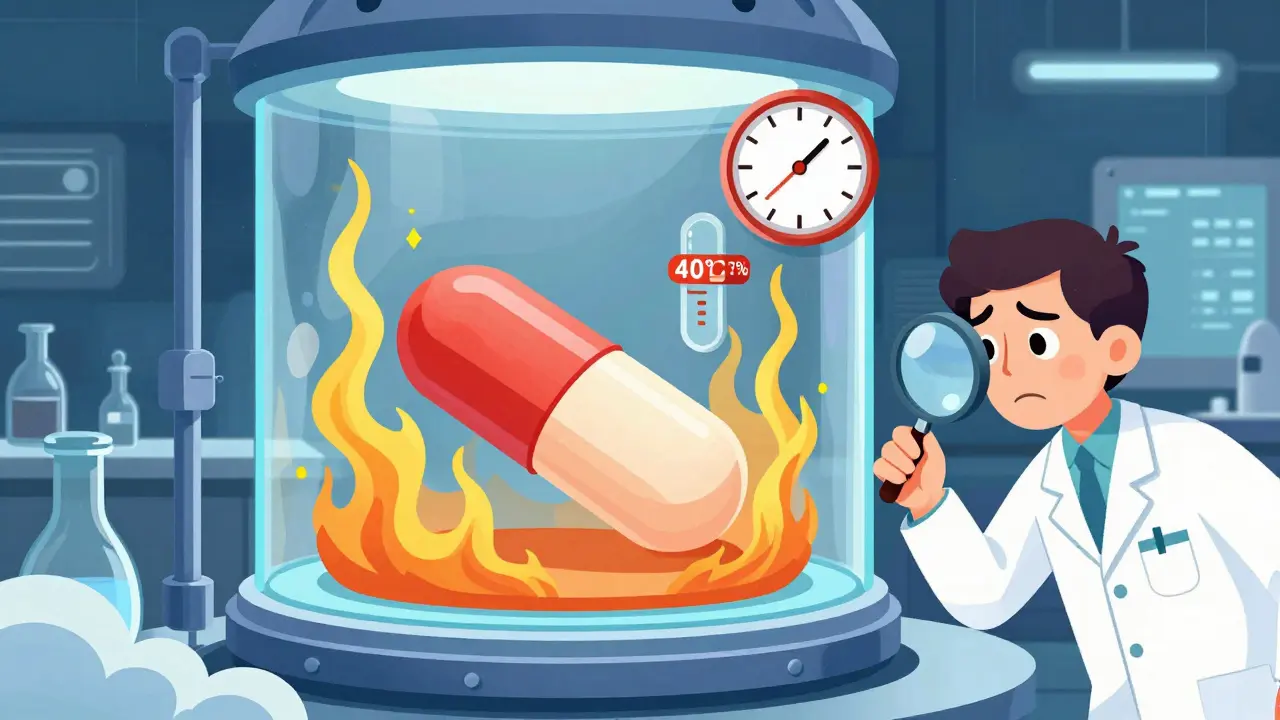
When you take a pill, you expect it to work the same way today as it did when it was manufactured-even if it’s been sitting on a shelf for a year. That’s not luck. It’s the result of strict stability testing requirements that control exactly how drugs are stored and monitored over time. These tests aren’t optional. They’re legally required, and getting them wrong can lead to recalls, regulatory penalties, or worse-patients receiving ineffective or harmful medication.
Why Temperature and Time Matter in Drug Stability
Drugs aren’t static. They degrade. Heat, moisture, and light break down active ingredients. A painkiller might lose potency. An antibiotic could become toxic. Stability testing answers one simple question: How long can this drug stay safe and effective under real-world conditions? The answer isn’t guesswork. It’s based on decades of science and global agreements. The International Council for Harmonisation (ICH), formed in 1990 by regulators from the U.S., Europe, and Japan, created the gold standard: ICH Q1A(R2). This guideline, finalized in 2003, is still in use today. The FDA, EMA, Health Canada, and others all follow it. If your drug doesn’t meet these standards, you won’t get approval to sell it anywhere major.Three Core Testing Conditions: Accelerated, Long-Term, and Intermediate
Stability testing isn’t one test. It’s three layers, each with exact temperature and humidity settings.- Accelerated testing is the stress test. It runs at 40°C ± 2°C and 75% RH ± 5% RH for six months. This isn’t meant to reflect normal storage-it’s meant to simulate worst-case scenarios like a warehouse in summer or a shipment stuck in a hot truck. If the drug breaks down here, it’s a red flag. This test helps predict how the drug will behave over years in just months.
- Long-term testing is the real-world clock. It runs at either 25°C ± 2°C / 60% RH ± 5% RH or 30°C ± 2°C / 65% RH ± 5% RH, depending on where the drug will be sold. This data builds the shelf life. The FDA requires at least 12 months of data before approval. The EMA lets companies submit with 6 months if they’re planning to add more later. Either way, you’re looking at a minimum of 12 to 36 months of monitoring.
- Intermediate testing is the backup. It runs at 30°C ± 2°C / 65% RH ± 5% RH for six months, but only if the long-term test is done at 25°C and the accelerated test shows signs of degradation. It’s a safety net to catch problems that might slip through.
What About Refrigerated or Frozen Drugs?
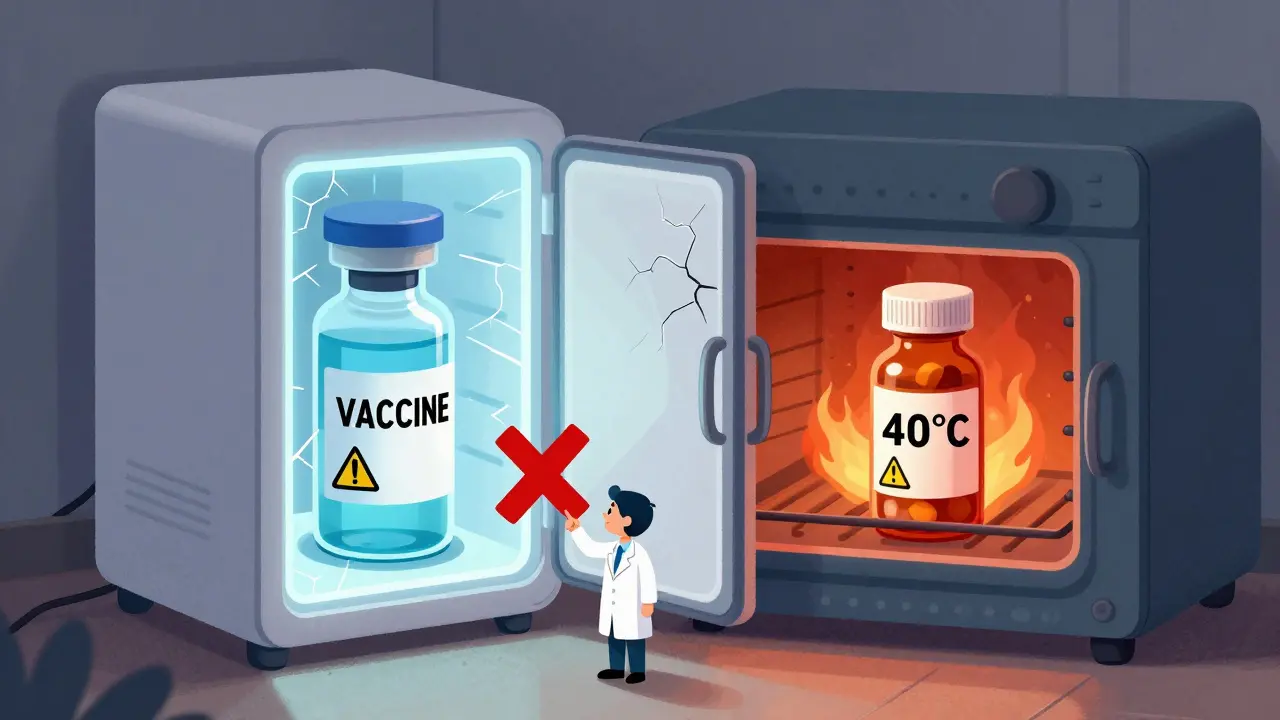
Not all drugs are stored at room temperature. Insulin, vaccines, and many biologics need cold chains. For these, the rules change.- Long-term storage: 5°C ± 3°C for at least 12 months.
- Accelerated testing: 25°C ± 2°C / 60% RH ± 5% RH for 6 months-not the 40°C used for regular pills.
Global Zones and Regional Differences
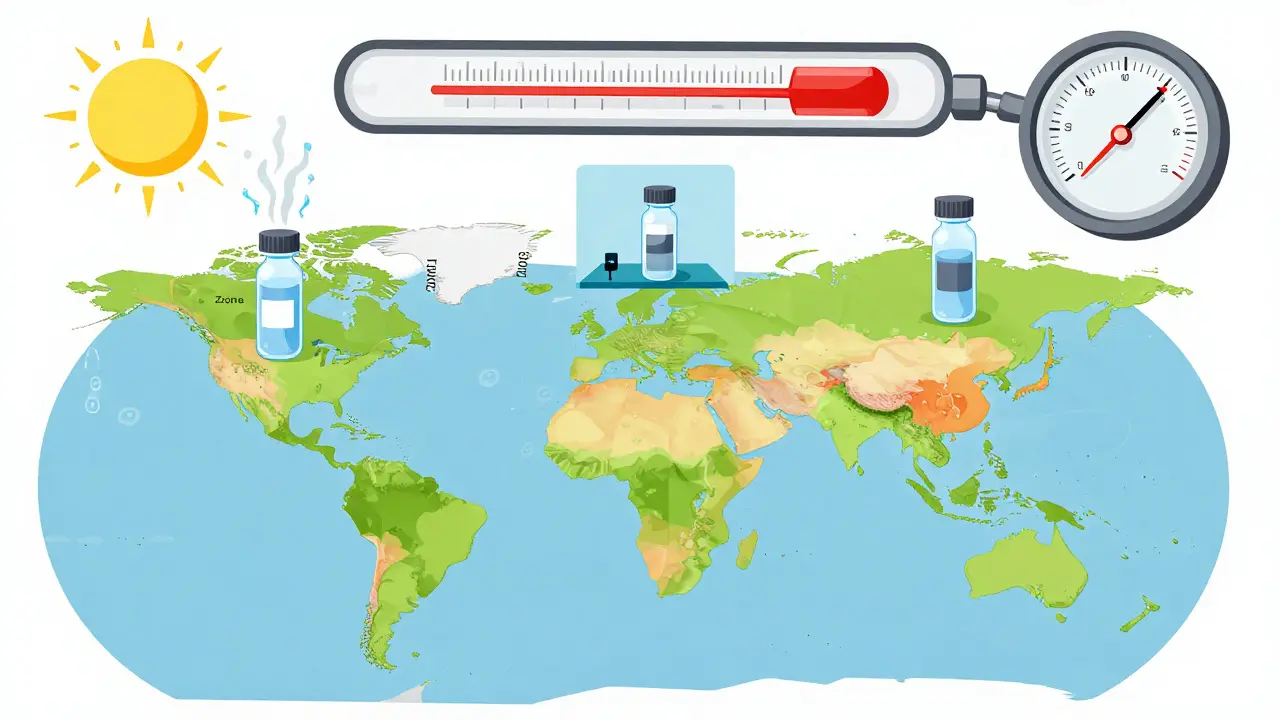
The world isn’t one climate. ICH Q1A(R2) accounts for this with five climatic zones:- Zone I (Temperate): 21°C / 45% RH
- Zone II (Mediterranean/Subtropical): 25°C / 60% RH
- Zone III (Hot-Dry): 30°C / 35% RH
- Zone IVa (Hot-Humid/Tropical): 30°C / 65% RH
- Zone IVb (Hot/Higher Humidity): 30°C / 75% RH
How Often Do You Test? The Timing Schedule
Testing isn’t a one-time check. It’s a schedule:- 0 months (baseline)
- 3 months
- 6 months
- 9 months
- 12 months
- 18 months
- 24 months
- 36 months (for products with 3-year shelf life)
Chambers Must Be Perfect-Or the Whole Test Fails
You can’t just put a box of pills in a closet and call it a stability chamber. These are precision instruments. Temperature must stay within ±0.5°C. Humidity must stay within ±2% RH. If the temperature spikes to 42°C during a 40°C test? The entire six-month run is invalid. You start over. Companies spend tens of thousands of dollars on chambers with dual-loop controls, redundant cooling systems, and real-time monitoring. One lab in Boston had to replace three chambers in 2023 after humidity drifted to ±8%-way over the ±2% limit. That cost them $180,000 and delayed a generic drug launch by eight months.What Counts as a “Significant Change”?
This is where things get messy. ICH Q1A(R2) says a drug has failed if:- Assay changes by more than 5%
- Any impurity exceeds its specification limit
- Physical properties change (color, texture, dissolution rate)
Real-World Failures and Recalls
This isn’t theoretical. In 2021, Teva recalled 150,000 vials of Copaxone® because stability testing at 40°C revealed protein aggregation that wasn’t caught in earlier tests. The drug was meant for multiple sclerosis patients-people who rely on consistent dosing. The FDA issued a Form 483, a formal warning. Merck’s Keytruda® had a similar near-miss. Intermediate testing at 30°C/65% RH caught a polymorphic transition-a hidden structural change in the drug’s crystal form-that could have affected how well the body absorbed it. They fixed it before launch. That’s the value of testing: preventing disasters before they reach patients.What’s Changing? The Future of Stability Testing
The ICH Q1A(R2) rules are 20 years old. They were made for pills and capsules. Today, we have mRNA vaccines, antibody-drug conjugates, and nanoparticle therapies. These don’t degrade the same way. Freeze-thaw cycles ruin them. Humidity cycling causes collapse. The old 40°C/75% RH test doesn’t predict their failure. The FDA is running pilot programs using real-time monitoring (PAT) to cut testing time. Some companies are using predictive models-running tests at 50°C to 80°C to forecast degradation. One study showed these models could cut testing time by 9-12 months. But regulators are skeptical. The EMA rejected eight model-based submissions in 2022-2023 because they didn’t trust the math. The AAPS says 62% of solid drug failures come from humidity cycling, not constant humidity. That means we’re testing the wrong thing. The next version of ICH Q1A might require dynamic humidity testing-mimicking real-world shifts in temperature and moisture.How to Get Started
If you’re new to stability testing:- Start with ICH Q1A(R2). Read it. Underline the numbers.
- Map your product to the right climatic zone.
- Qualify your chambers: IQ, OQ, PQ-follow ASTM E1993-19.
- Design your protocol: define test points, acceptance criteria, and what “significant change” means for your product.
- Run the long-term study first. Accelerated is predictive, but long-term is the law.
- Document everything. Your dossier will be 450-600 pages. No shortcuts.
Final Thought: Stability Testing Is the Silent Guardian
No one sees it. No one praises it. But if you’ve ever taken a drug that worked exactly as it should, even after months on the shelf-you’ve benefited from this system. It’s not perfect. It’s slow. It’s expensive. But it’s the only thing standing between you and a bottle of medicine that no longer does what it promises.What are the standard temperature and humidity conditions for long-term stability testing?
The ICH Q1A(R2) standard allows two options: 25°C ± 2°C / 60% RH ± 5% RH or 30°C ± 2°C / 65% RH ± 5% RH. The choice depends on the target market’s climate zone. For example, drugs sold in tropical regions (Zone IVa) must be tested at 30°C/65% RH. The FDA requires at least 12 months of data at these conditions before approving a product.
Why is accelerated testing done at 40°C and 75% RH?
The 40°C/75% RH condition was chosen to simulate extreme but realistic environmental stress-like a drug package exposed to hot warehouse conditions or a shipment delayed in transit. It’s not meant to reflect normal storage. This accelerated condition helps predict how a drug will degrade over years in just six months. Studies show it correlates to about 24 months of real-time stability for 85% of small-molecule drugs.
Do refrigerated drugs follow the same stability rules?
No. Refrigerated products, like insulin or vaccines, are tested at 5°C ± 3°C for long-term storage. Their accelerated test is at 25°C ± 2°C / 60% RH ± 5% RH-not 40°C. This is because freezing and thawing, not heat, are the main risks for biologics. Testing them at 40°C would destroy them without providing useful data.
What happens if a stability test fails?
If a drug shows significant degradation-like a potency drop over 5%, new impurities, or physical changes-the product cannot be approved or must be recalled. In 2022, the FDA issued 27 warning letters citing stability testing failures. Companies face delays, lost revenue, and reputational damage. In extreme cases, like Teva’s 2021 Copaxone recall, entire batches are pulled from shelves.
How long does a full stability study take?
A full long-term study for a 2-year shelf life takes 24 months. For a 3-year shelf life, it takes 36 months. Accelerated testing takes 6 months. But because testing starts at the same time as manufacturing, companies often begin stability studies early in development. Still, the waiting period for final data often delays product launches by 6-12 months.
Are there alternatives to physical stability testing?
Some companies use predictive modeling-running tests at higher temperatures (50-80°C) to forecast degradation faster. The FDA is testing real-time monitoring (PAT) for continuous manufacturing. But regulators still require physical data. In 2022-2023, the EMA rejected eight submissions that relied only on models. For now, physical testing is mandatory. Models may reduce testing in the future, but they’re not a replacement yet.
gary ysturiz
January 11, 2026 AT 02:08Just read this whole thing and honestly? This is the quiet hero work that keeps us all safe. No fanfare, no headlines, just scientists in labs making sure your ibuprofen doesn't turn into poison. Respect.
Anyone else think we should pay these folks more? They're literally guarding our health while we complain about pill prices.
jordan shiyangeni
January 12, 2026 AT 18:58Let me be clear-this entire system is a bureaucratic nightmare built on 20-year-old science that ignores modern drug delivery systems. The fact that we’re still using 40°C/75% RH for mRNA vaccines is criminal. It’s like testing a submarine with a garden hose. The FDA and EMA are clinging to ICH Q1A(R2) like a security blanket while patients suffer because companies can’t innovate under these archaic rules. This isn’t science-it’s regulatory dogma dressed up in lab coats. And don’t even get me started on the $180,000 chambers. We’re spending millions to measure what we already know. It’s corruption by compliance.
Abner San Diego
January 13, 2026 AT 13:50Ugh. Another overlong post about paperwork. We get it. Pills need to not expire. But why does this take 3 years to test? Why can’t we just use AI or something? I’m tired of hearing about humidity chambers. This is why pharma is so expensive-because nobody’s cutting the fat. We’re paying for 6-month tests that could be done in 3 if we stopped being so scared of change. America’s health shouldn’t be held hostage by ASTM E1993-19.
Eileen Reilly
January 14, 2026 AT 23:53ok but like… why do we even have to test at 30°C/65% RH if my drug is gonna sit in my fridge? i mean, i live in florida and my meds still work… why are we spending so much on these chambers?? also, who even checks this stuff?? 🤔
Monica Puglia
January 15, 2026 AT 12:36Love how you broke this down 🙌
So many people don’t realize how much care goes into every pill they take. It’s not magic-it’s science, patience, and a ton of very boring lab work.
Shoutout to the stability analysts who never get thanked. You’re the reason your grandma’s blood pressure med still works after 2 years on the shelf. 💙
Cecelia Alta
January 16, 2026 AT 21:03Okay, so let me get this straight-some guy in a lab in Boston spent $180K because the humidity drifted to ±8%? And that delayed a generic drug launch for EIGHT MONTHS? And you’re telling me this is normal? 😭
Meanwhile, I pay $400 for my insulin and the company says ‘market forces.’
Who’s really protecting patients here? The people running the chambers? Or the CEOs who profit from the delays?
This isn’t science. It’s a money laundering scheme with a lab coat.
steve ker
January 18, 2026 AT 04:59George Bridges
January 18, 2026 AT 19:26Just wanted to say thank you for writing this. I work in global supply chain for a small biotech and this is the reality we live in every day.
It’s not sexy, but it’s vital. I’ve seen what happens when a batch fails because someone skipped intermediate testing. It’s not just paperwork-it’s people’s lives.
Also, props to the lab techs who log every sample at 2 a.m. on a Saturday. We don’t talk about them enough.
Faith Wright
January 19, 2026 AT 10:27Wow. So we spend years testing drugs so they don’t expire… but people still buy them from shady websites that ship from India in 100°F warehouses?
Isn’t the real problem that we don’t regulate the *distribution*, not just the *manufacture*?
Also, can we talk about how ridiculous it is that a 4.8% potency drop gets rejected in the US but passed in Canada? Like… what even is science if it’s not consistent?
Also also, who’s paying for all these chambers? The patient? Again.
Rebekah Cobbson
January 21, 2026 AT 01:35If you’re new to stability testing, start here. This post is gold.
One tip I wish someone told me: don’t wait until Phase 3 to start your long-term study. I did. Lost 11 months.
And yes, document everything-even the weird stuff. The regulator who asks about that one weird color change in Month 9? They’ll be the one who approves your drug.
You’re not just following rules. You’re building trust.
And yes, it’s boring. But someone’s got to do it.