
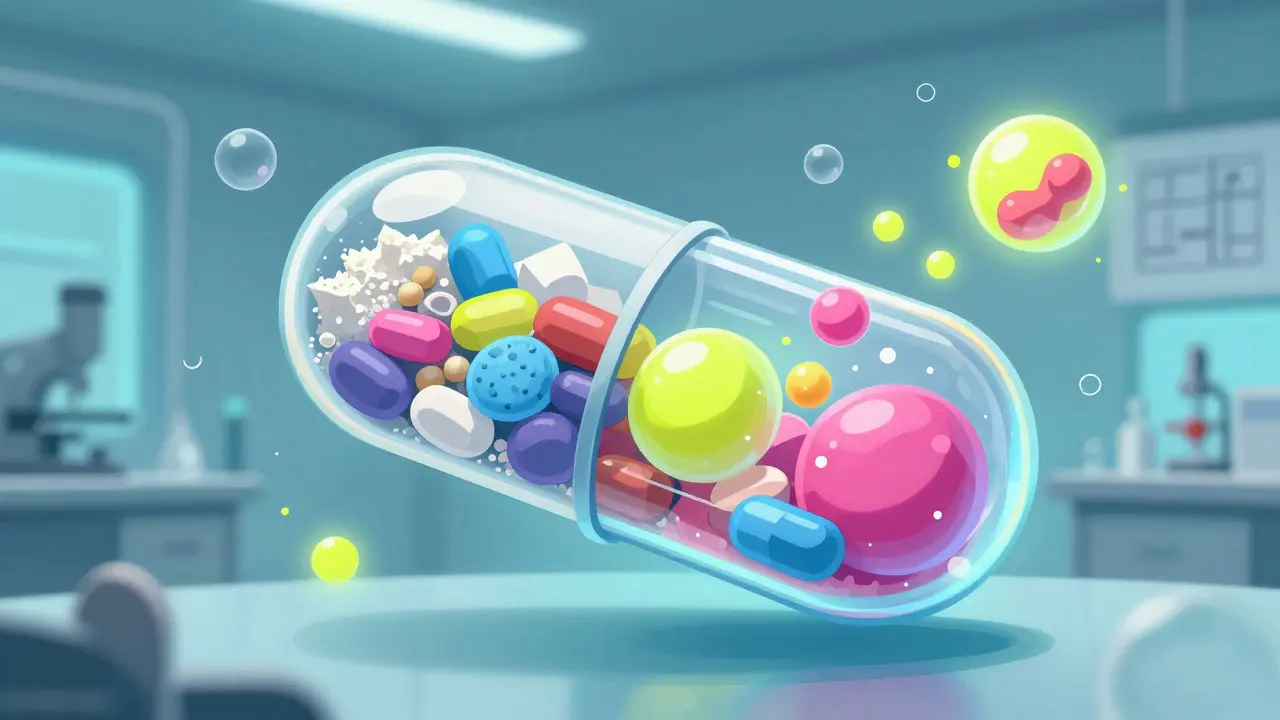
When you take a pill, you think you’re getting just the medicine. But that pill is mostly inactive ingredients-stuff that doesn’t treat your condition, but holds the drug together, helps it dissolve, or makes it taste less awful. These are called excipients. And while they’ve been called ‘inactive’ for decades, new science says that’s not always true. Some of them might be quietly changing how your drug works-or even causing side effects you never expected.
What Are Excipients, Really?
Excipients are everything in your pill that isn’t the active drug. Think fillers like lactose or microcrystalline cellulose, binders like polyvinylpyrrolidone, lubricants like magnesium stearate, or even food dyes like tartrazine. In an oral tablet, excipients make up 60% to 99% of the total weight. They’re not optional. Without them, pills would crumble, wouldn’t dissolve properly, or could be toxic if the active ingredient was too concentrated.
The FDA lists around 1,500 approved excipients across all drug types-oral, injectable, eye drops, you name it. Each drug usually contains 5 to 15 of them. The agency tracks them in its Inactive Ingredient Database (IID), updated every quarter. For decades, regulators assumed these ingredients were harmless bystanders. But that’s changing.
The ‘Inactive’ Label Is Outdated
A landmark 2020 study in Science turned the old thinking upside down. Researchers tested 314 common excipients against 44 biological targets-things like enzymes, receptors, and ion channels in the human body. They found that 38 of them, including ones you’ve probably taken, showed biological activity. Some even reached concentrations in the body that matched the levels shown to trigger effects in lab tests.
Take aspartame, the artificial sweetener used in some chewable pills. It blocked the glucagon receptor at just 8.5 micromolar. That’s a concentration you can actually reach after swallowing a tablet. Sodium benzoate, a preservative, inhibited monoamine oxidase B-a target linked to Parkinson’s-at 320 nanomolar. Propylene glycol, found in liquid medications and even some tablets, hit 210 nanomolar against monoamine oxidase A. These aren’t random chemicals. They’re in your medicine cabinet right now.
Dr. Giovanni Traverso, lead author of that study, put it bluntly: “The blanket classification of excipients as ‘inactive’ is scientifically inaccurate for a meaningful subset of these compounds.” The FDA’s own guidance from 2022 acknowledged this, admitting that “the assumption of inertness for excipients may not hold for all compounds at all concentrations.”
Why Does This Matter for Safety and Efficacy?
If an excipient interacts with a biological target, it could:
- Change how fast your drug gets absorbed
- Interfere with your body’s natural enzymes
- Trigger allergic reactions in sensitive people
- Alter how your liver metabolizes the drug
Take the 2018 recall of 14 generic valsartan products. It wasn’t the active ingredient that failed-it was a new solvent used in manufacturing. That solvent created NDMA, a known carcinogen, which contaminated the entire batch. The excipient change wasn’t just a tweak. It led to a public health risk.
Another example: Aurobindo’s 2020 attempt to make a generic version of Entresto (sacubitril/valsartan) got rejected because they swapped magnesium stearate for sodium stearyl fumarate. The FDA’s tests showed a 15% difference in how fast the drug released in the gut. That’s enough to affect how well the medicine works-especially for a heart failure drug where timing matters.
On the flip side, Teva’s 2021 generic of Jardiance replaced sodium starch glycolate with croscarmellose sodium as a disintegrant. The bioequivalence data showed nearly identical absorption rates: 374 vs. 368 ng/mL for peak concentration, and 4,215 vs. 4,187 ng·h/mL for total exposure. That’s a success story-but only because they did the work to prove it.
Regulations Are a Patchwork
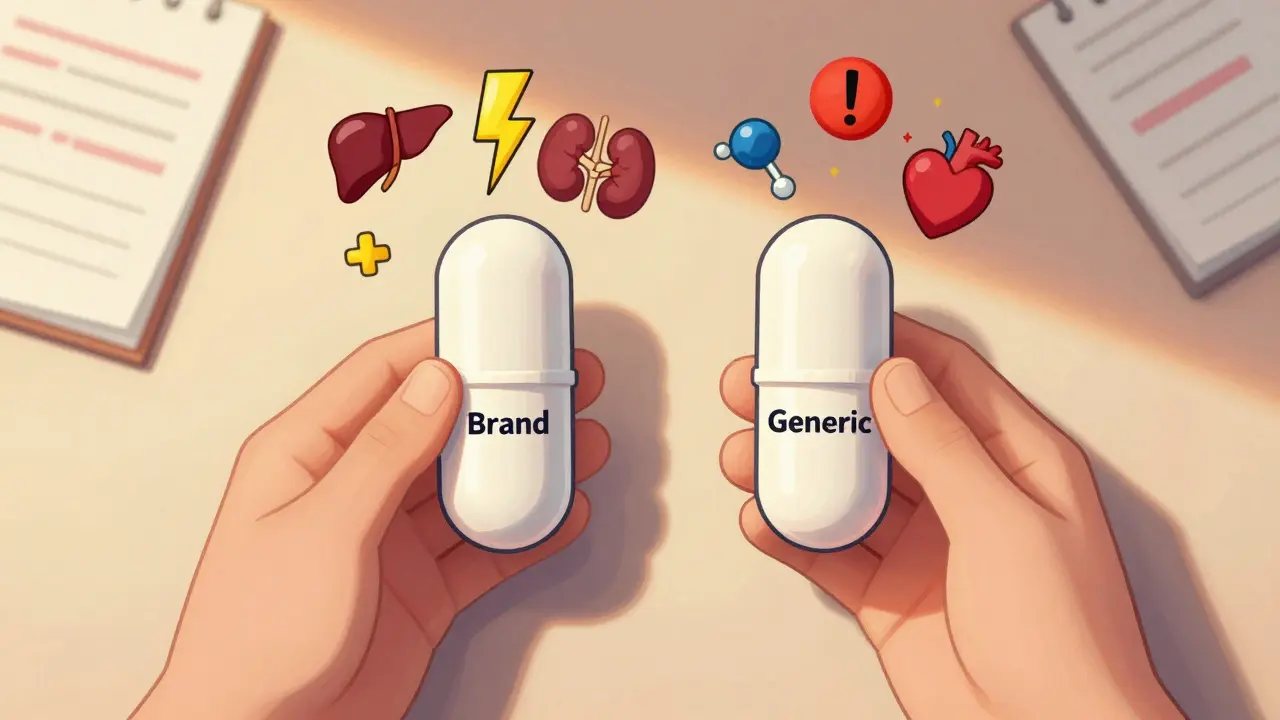
The rules for excipients aren’t the same for every drug. For injectables, eye drops, and ear drops, the FDA demands exact matches to the original brand drug’s ingredients-same type, same amount. That’s called Q1/Q2 sameness. But for most oral pills, manufacturers can swap excipients as long as they prove it doesn’t hurt safety or effectiveness.
That’s where things get messy. The FDA allows generic makers to use different excipients to cut costs or use more available materials. But proving safety isn’t cheap. On average, companies spend $1.2 million and 18 months justifying a new excipient. Most rely on the FDA’s database to show the ingredient has been used safely before. If it’s new? They need toxicology studies or pharmacokinetic bridging data.
The European Medicines Agency (EMA) is similar but requires a detailed Quality Overall Summary explaining any differences. Meanwhile, biologics-like insulin or cancer drugs-are under even tighter scrutiny. Even small excipient changes can trigger immunogenicity studies because the body might react to new additives as foreign.
Who’s at Risk?
Most people won’t notice anything. But some groups are more vulnerable:
- People with allergies: Lactose, gluten, or dyes like tartrazine can trigger reactions.
- Patients with kidney or liver disease: Their bodies can’t clear excipients like propylene glycol or polysorbate 80 as efficiently.
- Children and the elderly: Smaller bodies, slower metabolism, higher sensitivity.
- Those on multiple medications: Excipients can interact with other drugs’ absorption or metabolism.
The FDA’s Adverse Event Reporting System (FAERS) shows only 0.03% of side effects are definitively tied to excipients. But that number is likely low. Many doctors don’t suspect excipients. Patients don’t know to report them. And without specific testing, it’s hard to prove causation.
What’s Changing in 2025?
The FDA is finally catching up. In December 2023, they launched a pilot program requiring extra safety data for 12 high-risk excipients in orally disintegrating tablets-like aspartame and saccharin-after reports of rare hypersensitivity reactions. They’re also building a computational model to predict which excipients might interact with biological targets, based on the 2020 Science study.
By 2025, the FDA may require all new excipients to be screened against a panel of 50 high-risk biological targets. That could add $500,000 to $1 million to the cost of developing each new generic drug. It’s expensive-but necessary. The global excipients market is growing fast, hitting $7.8 billion in 2022 and expected to reach $11.3 billion by 2028. More complex drugs-extended-release pills, combination therapies, smart delivery systems-are using novel excipients every day.
Industry groups like PhRMA argue that decades of safe use should be enough. But experts like Dr. Jane Axelrad, former FDA deputy director for generic drugs, say the system is outdated. “It works for traditional pills,” she wrote in JAMA in 2023, “but not for the new wave of complex generics.”
What Should You Do?
Here’s what you can actually do:
- If you have allergies, check the pill’s inactive ingredients list. It’s on the FDA’s website and often on the pharmacy label.
- If you notice new side effects after switching to a generic, tell your doctor. It might not be the drug-it could be the filler.
- Ask your pharmacist: “Is this generic identical in excipients to the brand?” They can look it up in the FDA’s database.
- Don’t assume all generics are the same. Two generics of the same drug can have different fillers-and different effects.
The bottom line: Excipients aren’t just filler. They’re part of the medicine. And if you’re taking a drug long-term, especially for a chronic condition, it’s worth knowing what else is in that pill.
Are inactive ingredients really harmless?
No, not always. While most excipients are safe at approved levels, research shows some-like aspartame, sodium benzoate, and propylene glycol-can interact with biological targets in the body. These interactions may affect drug absorption, trigger reactions in sensitive people, or interfere with metabolism. The term ‘inactive’ is outdated for a subset of these ingredients.
Can switching to a generic drug cause side effects?
Yes. Even if the active ingredient is the same, different excipients can change how quickly the drug dissolves or is absorbed. For example, replacing magnesium stearate with sodium stearyl fumarate in a heart failure drug led to a 15% difference in release rate, causing a generic application to be rejected. Patients reporting new side effects after switching generics should report it to their doctor.
How do I find out what’s in my medication?
Check the drug’s prescribing information on the FDA’s website or ask your pharmacist for the full list of inactive ingredients. Brand-name drugs list them on the label, and generics must list them too. The FDA’s Inactive Ingredient Database also allows you to search by ingredient or drug name.
Why do generic drugs use different excipients?
Manufacturers use different excipients to reduce costs, improve stability, or use more readily available materials. The FDA allows this as long as the change doesn’t affect safety or efficacy. But proving that requires testing-and many companies skip thorough studies, leading to rejected applications or recalls.
Are there excipients I should avoid?
If you have allergies, avoid known triggers like lactose, gluten, or food dyes (e.g., tartrazine). People with kidney or liver disease should be cautious with excipients like propylene glycol or polysorbate 80, which can accumulate. For most people, approved excipients at standard doses are safe-but if you experience unexplained reactions, investigate the ingredients.
What’s Next?
The future of drug safety won’t just be about the active ingredient anymore. It’ll be about the whole pill-the fillers, the coatings, the sweeteners, the preservatives. As drug delivery gets more advanced, excipients will become more sophisticated. And the regulatory system has to catch up.
Right now, we’re at a turning point. The science is clear: excipients aren’t always inert. The question isn’t whether they matter-it’s how fast we’ll start treating them like part of the medicine.
Christine Joy Chicano
January 7, 2026 AT 18:37Did you know that propylene glycol in your liquid Tylenol can inhibit MAO-A at concentrations you actually reach after swallowing it? This isn't sci-fi-it's 2020 Science journal data. The FDA's 'inactive' label is a relic from the 1970s when we thought pills were just drug + sugar. Turns out, sugar might be actively messing with your neurotransmitters.
And don't get me started on aspartame in chewables. That stuff blocks glucagon receptors. If you're prediabetic and taking daily meds with it, you're basically giving your pancreas a subtle nudge toward dysfunction. No one talks about this because it's not profitable to.
Excipients aren't filler. They're pharmacologically active bystanders with a lobbying budget.
Kyle King
January 8, 2026 AT 19:40Of course they’re not inert. Big Pharma doesn’t want you to know that your pills contain carcinogenic solvents, neurotoxic sweeteners, and GMO-derived fillers. The FDA’s database? A joke. They approve stuff based on ‘historical use’-like if it was in a 1950s aspirin, it’s fine now. Meanwhile, your thyroid is slowly being poisoned by sodium benzoate in your antidepressant.
They’re testing new excipients on you. You’re the lab rat. Wake up.
Adam Gainski
January 10, 2026 AT 05:30There’s real science here, but the fear-mongering misses the point. Most people aren’t going to react to excipients at approved doses. The real issue is inconsistent manufacturing standards between generics. That 15% absorption difference in Entresto? That’s not because magnesium stearate is evil-it’s because the company skipped proper bioequivalence testing.
Regulators need better tools, not panic. We already have computational models that can predict interactions. Let’s use them instead of demonizing every filler.
Also, if you’re allergic to lactose, check the label. It’s literally right there. No conspiracy needed.
Elen Pihlap
January 12, 2026 AT 01:17my doctor switched me to a generic and now i cry for no reason and my hands shake. i knew it. they’re poisoning us. i’m going to the FDA. someone help me.
why won’t anyone listen??
Poppy Newman
January 13, 2026 AT 16:31mind = blown 🤯
so my morning ibuprofen has tartrazine? and that’s why i get migraines??
im checking every pill from now on. thank you for this.
Jessie Ann Lambrecht
January 15, 2026 AT 09:54Stop scrolling. Stop assuming. Start asking.
If you’re on long-term meds, go to the pharmacy and ask for the inactive ingredients list. Print it. Compare your brand to your generic. If your doctor doesn’t know the difference between croscarmellose sodium and sodium starch glycolate, find a new one.
This isn’t fear. It’s empowerment. You paid for your medicine. You deserve to know what’s in it. Not just the active part-the whole damn thing.
And yes, two generics of the same drug can behave differently. That’s not a glitch. It’s the system. Fix it by being informed.
Vince Nairn
January 16, 2026 AT 17:25so let me get this straight… the stuff that makes pills not taste like chalk is now a bioactive compound that might be messing with my brain?
so… my Adderall is basically a cocktail of chemicals i didn’t sign up for?
well. that explains why i’ve been having existential dread since 2021.
pass the popcorn. or whatever filler is in it.
Kamlesh Chauhan
January 18, 2026 AT 15:13who cares
its just a pill
you take it or dont
why you so worried about sugar and dye
just take your meds and shut up
stop reading internet
go outside
steve rumsford
January 19, 2026 AT 14:18i took a generic for my blood pressure and felt like a zombie for three days. switched back to brand. felt like myself again. i thought it was stress. turns out it was the damn filler.
now i only buy brand. even if it costs 3x. worth it.
if your doctor says 'theyre the same' theyre lying. they dont know what's in it.
trust your body. not the label.
Andrew N
January 21, 2026 AT 03:02the 0.03% adverse event rate is misleading because it's self-reported and poorly coded. if you don't specifically code 'excipient reaction' it gets buried under 'unknown etiology'.
also, the FDA database includes ingredients used in topical creams and inhalers-those aren't relevant to oral tablets. cherry-picking data doesn't make a case.
the science is interesting but the implications are overstated. don't panic. just verify.
Emma Addison Thomas
January 22, 2026 AT 07:30In the UK, we’re starting to see more transparency. The MHRA now requires excipient labeling on all new prescriptions. It’s slow, but it’s happening.
I’ve had patients with celiac disease react to gluten-containing starches in generics. One woman had chronic fatigue for years-switched to a gluten-free generic, and her energy returned in weeks.
This isn’t paranoia. It’s precision medicine. We treat active ingredients with care. Why not the rest of the pill?
Anastasia Novak
January 23, 2026 AT 05:29Wow. You mean to tell me that after 70 years of pharmaceuticals, we’re only now realizing that the stuff holding the pill together might actually DO something?
How is this not a scandal? How is this not front-page news?
Big Pharma has been hiding behind the word 'inactive' like it’s a magic spell. And now you want us to believe they’re just 'catching up'? No. They’re being dragged kicking and screaming into the 21st century.
I’m not taking another pill without a PhD in excipient chemistry. And neither should you.
Jonathan Larson
January 25, 2026 AT 00:02There’s a deeper philosophical question here: If a substance is pharmacologically active but not intended as a therapeutic agent, is it still an excipient? Or is it an unintended drug?
Historically, medicine treated the body as a black box. We gave compounds and observed outcomes. We never asked what the carrier was doing.
Now, we’re forced to see the pill as a system-not just a delivery mechanism, but a complex micro-environment. This isn’t just regulatory reform. It’s a paradigm shift in how we understand pharmacology.
And it’s long overdue.
The real tragedy isn’t the lack of science-it’s the lack of humility. We thought we understood medicine. We were wrong.
Mina Murray
January 25, 2026 AT 12:41You all are missing the point. The real danger isn’t the excipients-it’s that regulators allow manufacturers to swap them without proving safety. That’s not oversight. That’s negligence. And it’s not just generics. Even brand-name companies do it when they reformulate.
They don’t test for interactions between multiple excipients. They test them one at a time. But you take 5-15 at once. What happens then? No one knows.
This isn’t about allergies or rare reactions. It’s about cumulative, synergistic toxicity. And we’re all just guinea pigs in a $11 billion experiment.
Adam Gainski
January 27, 2026 AT 02:59That’s exactly why the FDA’s new pilot program for 12 high-risk excipients is a step forward. Instead of banning things, they’re building predictive models based on actual biological targets. That’s smarter than blanket bans or fear.
And yes, synergies matter. But we’re not helpless. We’re just starting to understand the system. The next 5 years will be about mapping interactions, not just labeling them.
Progress isn’t pretty. But it’s happening.