
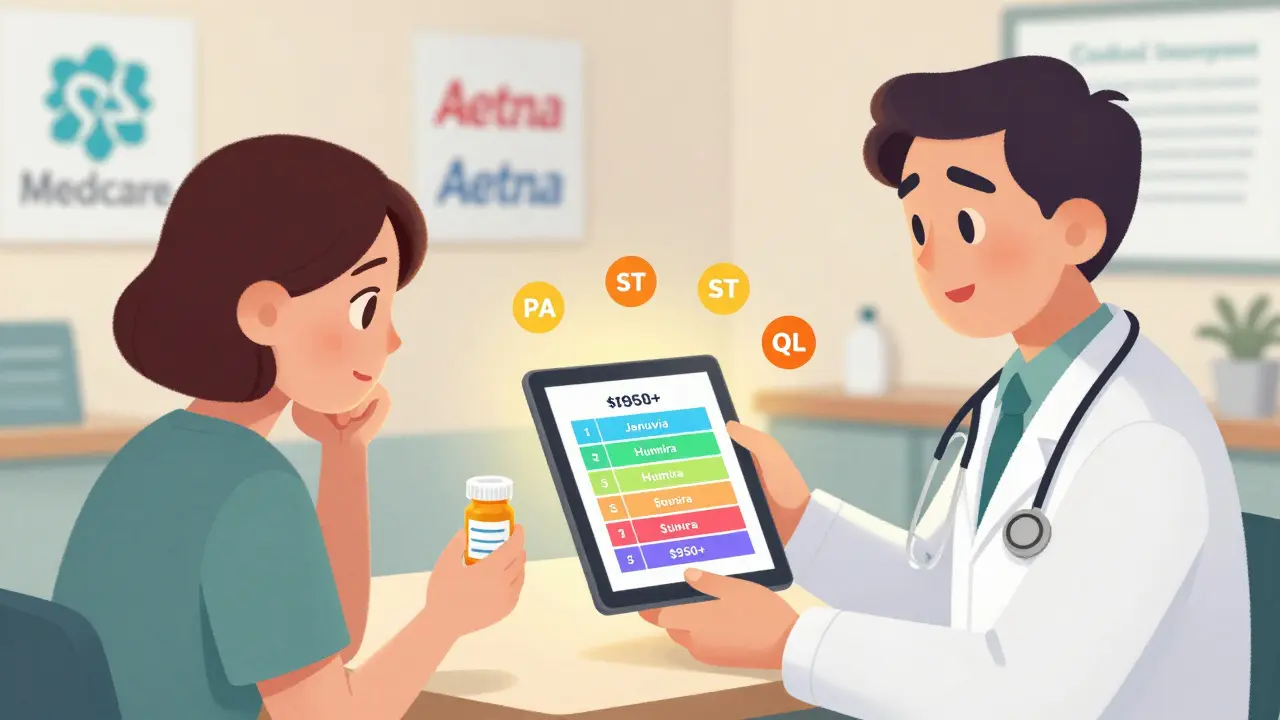
Before you write a prescription, you need to know if the drug is covered - and how much the patient will actually pay. It’s not just about what’s clinically right. It’s about what’s covered, what requires prior authorization, and whether the patient can afford it at the pharmacy counter. In 2026, with Medicare Part D covering over 50 million people and commercial insurers managing complex tiered formularies, skipping this step can mean a patient walks out with a script they can’t fill - or worse, ends up in the ER because they skipped doses to save money.
What Exactly Is a Formulary?
A formulary, also called a Preferred Drug List (PDL), is the official list of medications an insurance plan will pay for. It’s not random. Every drug on it has been reviewed by a committee of doctors and pharmacists who weigh clinical evidence, safety, and cost. These lists are updated regularly - sometimes monthly - and vary by plan, state, and type of insurance.Medicare Part D plans follow a standard five-tier structure:
- Tier 1: Preferred generics - often $1-$5 per prescription
- Tier 2: Other generics - usually $10-$20
- Tier 3: Preferred brand-name drugs - $40-$70
- Tier 4: Non-preferred brands - $80-$150+
- Tier 5: Specialty drugs - over $950/month, paid as a percentage (coinsurance)
But here’s the catch: what’s Tier 3 on one plan might be Tier 4 on another. Januvia, for example, is Tier 3 on one Medicare plan, Tier 4 on another, and requires step therapy on a third. That’s why checking before prescribing isn’t optional - it’s essential.
How to Find the Right Formulary
You don’t need to memorize every plan’s list. You need to know where to look - and how fast.Start with the insurer’s website. Most have a drug search tool. For Aetna, you enter the patient’s county and plan name. For UnitedHealthcare, you pick the commercial or Medicare plan from a dropdown. Excellus BCBS lets you download a full PDF of their 2024 formulary, updated in January, April, July, and October. Bookmark these pages. Set calendar reminders for quarterly updates.
For Medicare patients, use CMS’s Plan Finder tool. It covers 99.8% of Part D plans and shows tier levels, prior authorization rules, and even estimated out-of-pocket costs. It’s free, fast, and updated in real time.
Don’t rely on memory. Don’t ask the patient. Don’t guess based on last month’s prescription. Even if you’ve prescribed the same drug 50 times, the formulary could have changed. CMS requires insurers to give 60 days’ notice before removing a drug or raising costs - but that doesn’t mean patients or providers get a heads-up.
Decode the Codes: PA, ST, QL
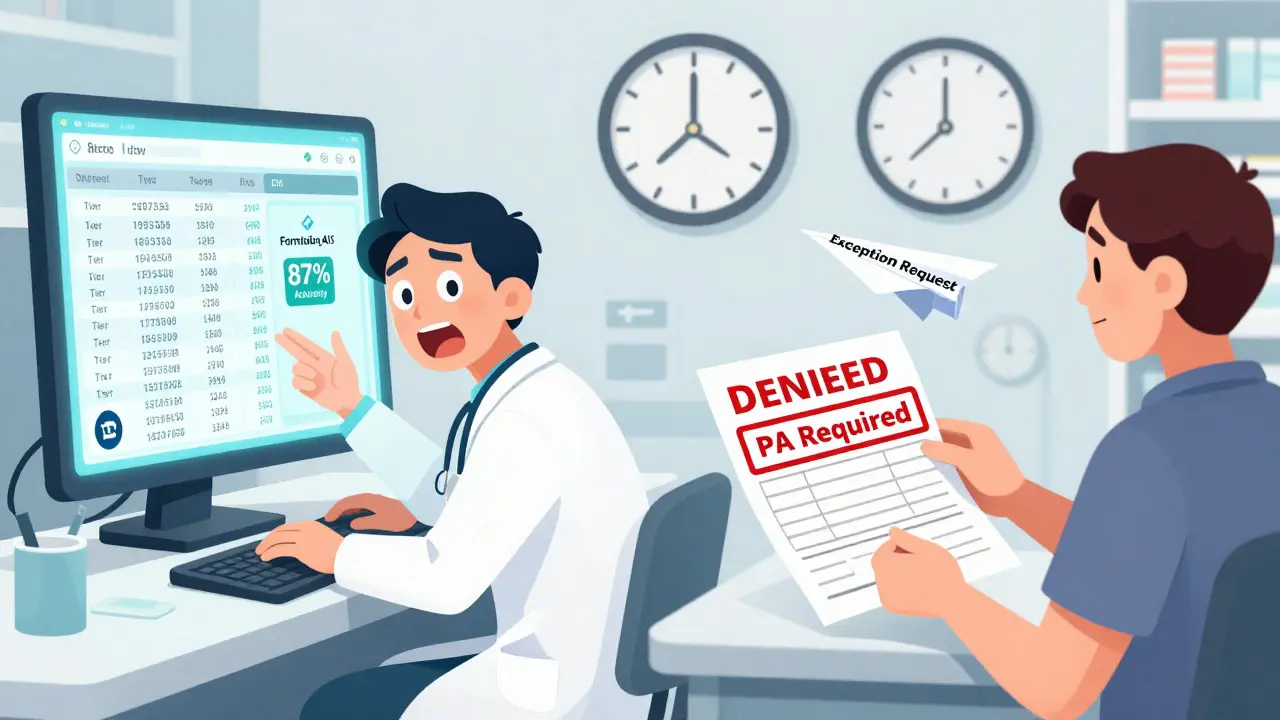
Every drug listing includes abbreviations you must understand:- PA = Prior Authorization - You need to call or submit paperwork before the plan will cover it. This can take 24-72 hours. For cancer drugs, delays over 48 hours happen in 32% of cases.
- ST = Step Therapy - The patient must try a cheaper drug first. Even if it didn’t work last time. Even if they’ve been on the same drug for years.
- QL = Quantity Limit - You can’t prescribe more than 30 tablets, or 90 days’ supply, without special approval.
One provider in Boston told me about a patient with rheumatoid arthritis. She’d been on Humira for five years. The new plan switched her to a cheaper biologic - step therapy. She had a flare-up within two weeks. By the time the PA was approved, she’d missed three weeks of work. That’s not clinical judgment. That’s administrative friction.
Medicare vs. Medicaid vs. Commercial Plans
Not all formularies are built the same.Medicare Part D has a federal standard: five tiers, mandatory exceptions process, and 60-day notice for changes. All plans must cover at least two drugs per therapeutic class.
Medicaid is state-run. Forty-two states use closed formularies - meaning if it’s not on the list, you need prior authorization just to ask for it. Minnesota’s DHS, for example, created a single PDL for all state program members after consulting their Drug Formulary Committee. That means if you treat Medicaid patients across multiple counties, you’re still working with one list - but it’s different from what you’d find in Texas or California.
Commercial plans like UnitedHealthcare or Cigna are all over the place. Some use four tiers. Some don’t have specialty tiers. Some require step therapy for insulin. Some don’t. And they update without warning. A 2024 MGMA survey found 68% of providers spend 10-20 minutes per patient just checking coverage. Primary care docs? Nearly 19 minutes. That’s 100+ hours a year per provider - just on formulary checks.
How EHR Tools Are Changing the Game
The good news? Technology is catching up.Northwestern Medicine cut prescription abandonment by 42% after adding Epic’s Formulary Check module to their EHR. Now, when a provider selects a drug, the system pulls real-time data: tier level, PA status, copay estimate - all without leaving the chart.
By January 2026, CMS will require all Medicare Part D plans to integrate Real-Time Benefit Tools (RTBT) directly into EHRs. That means the formulary info will appear as you type - no more switching tabs, no more calling the insurer. Right now, 68% of commercial plans already have this. Medicare is playing catch-up.
Even better: Epic’s new FormularyAI, launched in August 2024, predicts coverage likelihood with 87% accuracy by analyzing 10 million past prior authorization decisions. It doesn’t just tell you if a drug is covered - it tells you how likely it is to be approved, and how long it might take.
What to Do When the Drug Isn’t Covered
Sometimes, the best drug for the patient isn’t on the list. That’s when you need the exceptions process.Medicare Part D requires insurers to respond to prior authorization requests within 72 hours - or 24 hours if it’s an urgent case. You don’t need to be a lawyer to file one. Most insurers have a simple online form. Include:
- Why this drug is medically necessary
- Why alternatives failed or aren’t suitable
- Any supporting clinical notes or lab results
Don’t assume it’s denied. A 2024 AMA report found that 72% of prior authorization requests for cancer drugs are approved - if they’re complete. The ones that get denied? Usually because the provider didn’t include enough clinical detail.
Still stuck? Call the insurer’s provider hotline. 98% of Medicare Part D plans have one, staffed 24/7. Ask for the formulary team. They can often override a decision on the spot.
Why This Matters More Than Ever
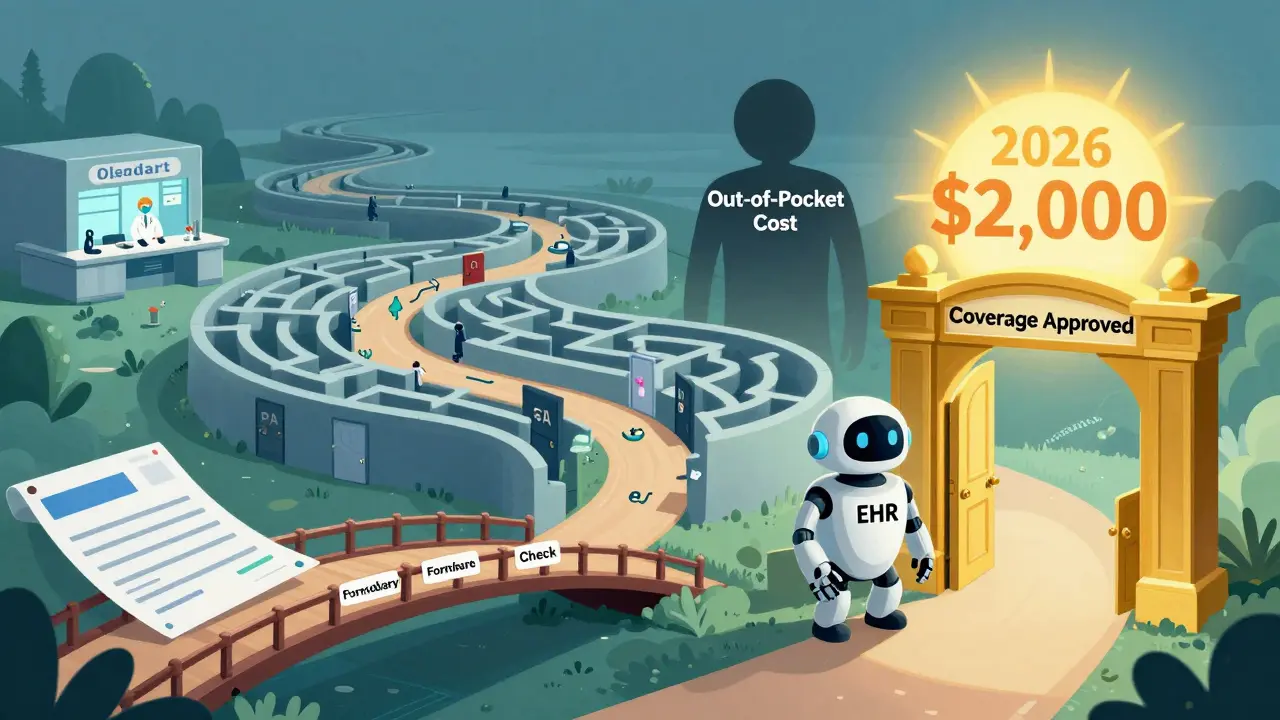
In 2025, Medicare Part D patients will hit a $2,000 annual out-of-pocket cap. That’s huge. But here’s the twist: insurers are already shifting drugs to lower tiers to manage costs. By January 2025, 73% of new Medicare formularies will move more brand-name drugs to Tier 3 or even Tier 2 to help patients hit that cap faster.Meanwhile, the Inflation Reduction Act is forcing formularies to change - not just to save money, but to save lives. A 2024 Avalere analysis found that when high-cost drugs are moved to lower tiers, adherence increases by 15-20%. That’s not just economics. That’s clinical outcomes.
But there’s a dark side. Dr. Aaron Kesselheim at Brigham and Women’s Hospital warns that overly restrictive formularies delay care. One patient in my practice waited 11 days for a PA on a diabetes drug. By then, her A1c hit 11.2. She ended up in the hospital. That’s not a fluke. It’s systemic.
Your Action Plan: 5 Steps Before You Prescribe
1. Know the plan. Is it Medicare Part D? Medicaid? Commercial? Each has a different list. 2. Check the formulary. Use CMS Plan Finder for Medicare. Go directly to the insurer’s website for commercial plans. Don’t use third-party apps - they’re often outdated. 3. Look for PA, ST, QL. If any of these are marked, prepare to act. Don’t assume the patient knows. 4. Use your EHR. If your system has a formulary checker, use it. If not, push for it. Your time is worth more than a 15-minute phone call. 5. Document the check. Add a note in the chart: “Formulary checked via CMS Plan Finder on 1/10/2026. Drug covered on Tier 3. No PA required.” That protects you and the patient.Prescribing isn’t just about diagnosis. It’s about access. A perfect drug is useless if the patient can’t get it. In 2026, checking formularies isn’t extra work - it’s part of the prescription.
What’s the difference between a formulary and a preferred drug list?
They’re the same thing. "Formulary" is the broader term used by insurers and Medicare. "Preferred Drug List" (PDL) is often used by Medicaid programs and state agencies. Both refer to the official list of covered medications and their cost-sharing rules.
Can I prescribe a drug not on the formulary?
Yes - but the patient will likely pay full price unless you get prior authorization. For Medicare and Medicaid, you can request an exception. For commercial plans, you may need to appeal or switch to a different drug. Always check the plan’s exceptions process before prescribing off-formulary.
How often do formularies change?
Medicare Part D plans must notify you 60 days before any negative change. Many insurers update quarterly - HealthPartners, for example, releases updates in January, April, July, and October. Commercial plans can change at any time. Always verify before prescribing, even if you prescribed the same drug last month.
Why does the same drug have different tiers on different plans?
Each insurer negotiates its own pricing and contracts with drug manufacturers. A drug might be cheaper for one plan due to a rebate, so they put it in a lower tier. Another plan might have no deal with the manufacturer, so they put it in a higher tier to discourage use. It’s not about clinical value - it’s about cost negotiations.
Is there a free tool I can use to check formularies?
Yes. CMS’s Plan Finder tool (medicare.gov/plan-compare) is free, official, and covers nearly all Medicare Part D plans. It shows tier levels, prior authorization rules, and estimated costs. For commercial plans, go directly to the insurer’s website - most offer free formulary search tools for providers.
What should I do if a patient can’t afford their medication even with coverage?
Ask about patient assistance programs. Most drugmakers offer discounts or free meds for low-income patients. Also check NeedyMeds.org or the Partnership for Prescription Assistance. Many pharmacies also have generic alternatives or 340B pricing for eligible patients. Never assume a patient will skip doses - offer help before they have to.
Daniel Pate
January 11, 2026 AT 20:35Formularies are a bureaucratic nightmare disguised as cost-control. I’ve had patients cry because their insulin went from $10 to $300 overnight - no warning, no exception granted. This isn’t healthcare. It’s a financial obstacle course with a stethoscope.
Jose Mecanico
January 12, 2026 AT 08:27Just added the CMS Plan Finder to my browser bookmarks. Took me 5 years to realize I shouldn’t trust my memory. Now I check before I even open the chart. Small change, huge impact.
Sonal Guha
January 12, 2026 AT 15:57Lawrence Jung
January 13, 2026 AT 20:25People act like this is new. It’s not. Insurance has always been a game of hide the ball. The only difference now is we have tools to see the ball. Doesn’t mean the rules changed.
Alice Elanora Shepherd
January 15, 2026 AT 05:42For anyone new to this: always document your formulary check - even if it’s just a note like ‘verified via Plan Finder, Tier 2, no PA’. It protects you, the patient, and your sanity. And yes, the 60-day notice rule is meaningless if no one reads the email.
Konika Choudhury
January 16, 2026 AT 11:25Darryl Perry
January 18, 2026 AT 07:51Windie Wilson
January 19, 2026 AT 01:53So let me get this straight… we’ve got AI predicting drug approvals, EHRs auto-checking tiers, and yet patients are still skipping doses because a $50 copay is ‘too much’? We’re not fixing healthcare. We’re just making the paperwork prettier.
Abner San Diego
January 19, 2026 AT 14:48Real talk: if your EHR doesn’t have RTBT by 2026, you’re not a provider - you’re a data entry clerk with a medical license. Stop pretending you’re saving time by not using tech. You’re just making the system worse.
Eileen Reilly
January 21, 2026 AT 09:09did u know some plans dont cover metformin anymore? i swear i saw it on a formulary once. now they want you to use some new brand name junk that costs 20x. wtf is this
Cecelia Alta
January 22, 2026 AT 22:05Let’s be real - this whole system is designed to make you feel guilty for wanting your patient to live. You check the formulary. You file the PA. You wait 72 hours. The patient gets worse. Then you get blamed for ‘not trying harder’. Meanwhile, the insurance company makes $12 million in profit off that one drug denial. And we’re supposed to be grateful they let us ‘appeal’? No. This isn’t medicine. It’s performance art with a clipboard. I’ve had patients cry in my office because they couldn’t afford their blood pressure med. I’ve had to write prescriptions for half doses just so they could stretch it. And the worst part? I’m not even mad anymore. I’m just tired. We’re not healing people. We’re negotiating with machines that don’t care if they live or die. And the worst part? The system knows it. That’s why they make the forms so long. So you’ll give up. So you’ll pick the cheapest drug - even if it’s wrong. So you’ll stop asking questions. So you’ll stop caring. And that’s exactly what they want.