
Every year, millions of Americans pay hundreds-or even thousands-of dollars more than they need to for prescriptions. The reason? They’re taking brand-name drugs when a cheaper, equally effective generic version is available. The good news? You don’t need to be a medical expert to ask for it. You just need to know how to start the conversation.
Why Generics Are Just as Safe and Effective
Generic drugs aren’t second-rate. They’re exact copies in every way that matters: same active ingredient, same strength, same way your body absorbs it. The FDA requires them to meet the same strict standards as brand-name drugs. In fact, the same companies that make brand-name drugs often make the generics too-just under a different label.
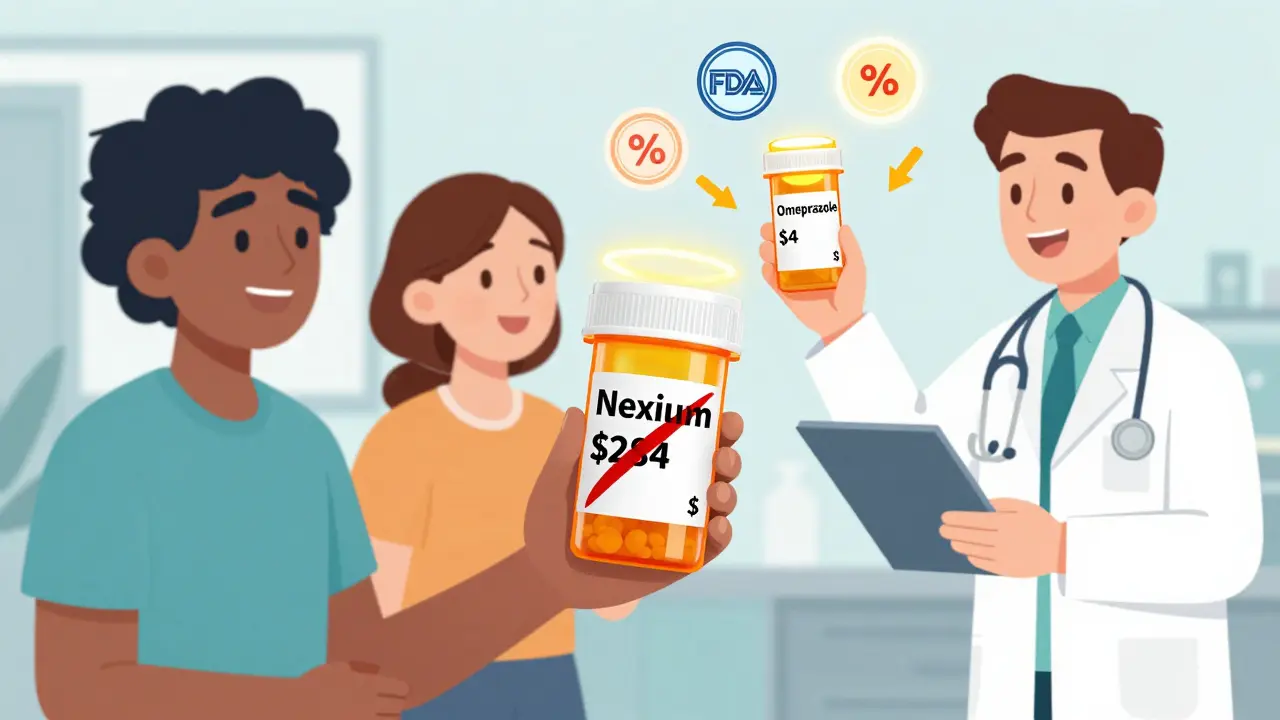
Here’s the real difference: price. When a brand-name drug’s patent expires, other manufacturers can step in. The first generic usually costs about 6% less. Once five or six companies start making it, prices drop by 50% to 95%. For example, the brand-name heartburn drug Nexium costs around $284 for a 30-day supply. The generic, omeprazole, costs $4. That’s not a typo.
Studies show that 95% of generic drugs perform identically to their brand-name counterparts in real-world use. The American Medical Association, the FDA, and the Mayo Clinic all agree: for most people, generics are just as good. Even patients on antidepressants like sertraline or blood pressure meds like lisinopril report no difference in effectiveness after switching.
When You Should Stick With Brand-Name
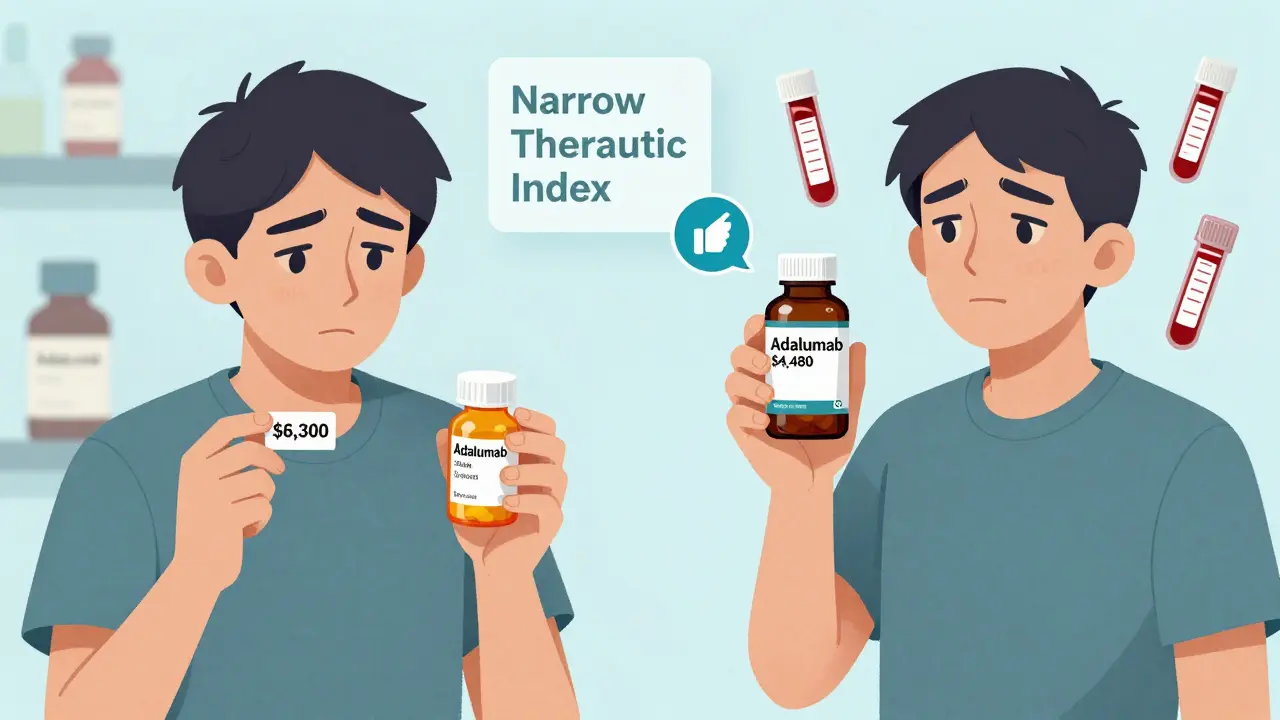
There are exceptions. About 5% of medications have what’s called a narrow therapeutic index. That means even tiny changes in how much of the drug gets into your bloodstream can cause big problems. These include:
- Warfarin (blood thinner)
- Levothyroxine (thyroid medication)
- Some seizure medications like phenytoin
- Certain immunosuppressants after organ transplants
For these, your doctor might recommend staying on one brand or one generic manufacturer. Why? Because switching between different generic versions-even though they’re all FDA-approved-can cause small fluctuations in blood levels. One patient at Johns Hopkins had thyroid levels swing out of range after switching between two different generic levothyroxine brands. That’s why consistency matters here.
If your doctor says, “This one needs to be brand-name,” ask: “Is this because of the narrow therapeutic index?” If they say yes, that’s a valid reason. If they say, “It’s just better,” ask for evidence. Most of the time, there isn’t any.
How to Bring It Up at Your Appointment
Don’t wait until you’re at the pharmacy and see the price tag. That’s too late. Bring it up during your appointment.
Here’s how to say it without sounding confrontational:
- “Is there a generic version of this medication?”
- “Would it be safe and effective for me to use the generic?”
- “Are there any reasons you’d recommend staying on the brand-name version?”
- “If a generic isn’t available now, when might one become available?”
Use this line: “I want the most effective drug at the best price, and I want prescriptions for generic drugs when possible.” It shifts the focus from cost to shared goals-getting you the right treatment without unnecessary expense.
Bring a printed list of your current meds. Highlight the ones you’re paying the most for. If you can, look up the cash price of the generic ahead of time. Blue Cross Blue Shield of Texas has examples showing brand-name drugs costing $200+ versus generics at $5-$15. Seeing it in black and white makes the case stronger.
What If Your Doctor Says No?
Some doctors don’t know when a new generic hits the market. Others assume you want the brand because it’s what they’ve always prescribed. Don’t take a “no” as final.
Ask: “Can we try the generic for one refill and see how I do?” Many doctors will agree to a trial. If you feel fine after a month, you’ve got your answer.
If they still refuse, ask if they can write “Dispense as Written” or “Do Not Substitute” on the prescription. If they don’t write that, your pharmacist can legally switch you to the generic anyway. In 48 states, pharmacists are allowed to substitute generics unless the doctor specifically blocks it.
And here’s something most people don’t know: your pharmacist can call your doctor to suggest a generic alternative. If your doctor doesn’t know a generic is available, your pharmacist might be the one to tell them.
Insurance and Cost Differences Matter
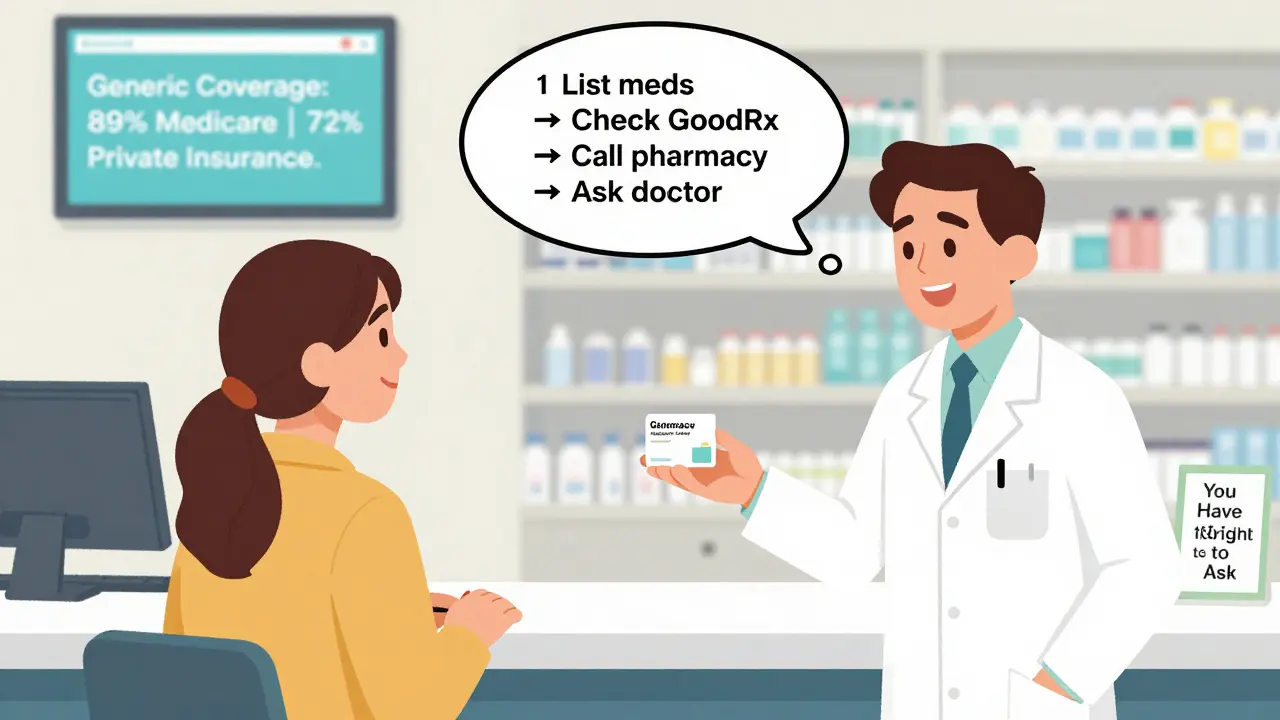
Medicare Part D patients get generics 89% of the time. Commercial insurance? Around 72%. That means if you’re on a private plan, you might be missing out on bigger savings.
Check your plan’s formulary. Look up your drug on your insurer’s website. If the generic is listed as Tier 1 (lowest cost), you’re saving money just by switching. If it’s not listed at all, ask your insurer why. Sometimes, they haven’t updated their list yet.
Even if you don’t have insurance, cash prices for generics are often lower than your co-pay. A 30-day supply of metformin (for diabetes) can cost $4 at Walmart or Target. The brand-name version? Over $100.
Real Savings, Real Stories
A patient with rheumatoid arthritis in Ohio switched from Humira (brand-name) to generic adalimumab. The brand cost $6,300 a month. The generic? $4,480. That’s $1,820 saved every month. And their blood tests showed no change in inflammation levels.
An AARP survey of 12,500 seniors found that 68% who asked their doctor about generics successfully switched-and saved an average of $427 a year. That’s not pocket change. That’s groceries, gas, or a new pair of shoes.
One woman in Boston switched from brand-name Zoloft to sertraline. She was paying $120 a month. The generic cost $7. She used the savings to pay for her daughter’s piano lessons.
What You Can Do Today
You don’t need to wait for your next appointment. Here’s your action plan:
- Make a list of all your prescriptions. Circle the ones you pay the most for.
- Go to GoodRx.com or your pharmacy’s website. Search each drug. Note the cash price of the generic.
- Call your pharmacy. Ask: “Is there a generic for this? Can you check if it’s covered?”
- Write down your questions before your next doctor visit.
- Ask. Just ask. Most doctors are happy to help you save money if it doesn’t hurt your health.
Generics aren’t a compromise. They’re smart medicine. The science is clear. The savings are real. And you have the right to ask for them.
Are generic drugs really as good as brand-name drugs?
Yes, for the vast majority of medications. The FDA requires generics to have the same active ingredient, strength, dosage form, and bioequivalence as the brand-name version. That means your body absorbs them the same way. Studies show 95% of generics work just as well. The only differences are in color, shape, or inactive ingredients-which don’t affect how the drug works.
Can I switch from a brand-name drug to a generic anytime?
Usually, yes-but check with your doctor first. For most drugs, switching is safe and common. But for medications with a narrow therapeutic index-like warfarin, levothyroxine, or some seizure drugs-your doctor may recommend sticking with one version (brand or generic) to avoid small fluctuations in blood levels. Never switch without talking to your provider.
Why does my doctor keep prescribing the brand-name drug?
Often, it’s just habit. Many doctors don’t track when generics become available. Some assume patients prefer brands. Others get information from pharmaceutical reps who focus on new brand-name drugs. It’s not usually because the brand is better-it’s because they weren’t told otherwise. Ask directly: “Is there a generic? Can we try it?”
Will my insurance cover the generic?
Almost always. Insurance plans encourage generics because they’re cheaper. Medicare Part D fills generics 89% of the time. Commercial plans are around 72%. Even if your plan doesn’t list the generic yet, it’s likely covered. Ask your pharmacist or log into your insurer’s website to check your formulary.
What if the generic makes me feel different?
Some people report minor differences in side effects-like stomach upset or headaches-after switching. This is usually due to different inactive ingredients (fillers, dyes, coatings), not the active drug. If you notice changes, tell your doctor. You might need to try a different generic manufacturer. Most generics are interchangeable, but sometimes one brand’s version works better for you personally. That’s okay. You’re not broken-you just need to find the right fit.
Can my pharmacist switch my prescription to a generic without asking me?
In 48 states, yes-unless your doctor wrote “Do Not Substitute” on the prescription. Pharmacists are trained to substitute generics when it’s legal and safe. They’re also required to tell you if they made the switch. If you’re not told, ask: “Was this switched to a generic?” You have the right to know.
How do I know when a generic will be available for my drug?
Most brand-name drugs get generic versions 10-12 years after launch, once patents expire. You can check the FDA’s Orange Book online or ask your pharmacist. Some drugs take longer if there are legal delays or complex manufacturing. If your drug doesn’t have a generic yet, ask your doctor: “When might one become available?” They may be able to help you monitor it.
Christina Widodo
January 14, 2026 AT 07:41I switched my blood pressure med to generic lisinopril last year and saved $150 a month. My doctor was like, 'Oh, you didn't know you could do that?' Yeah, neither did I. Now I ask about every script. Why pay more when the science says it's the same?
Also, my pharmacist told me the generic for my antidepressant was $3 at Walmart. I cried. Not because I'm sad-because I could finally afford my mental health care.
Prachi Chauhan
January 15, 2026 AT 10:36generics are not just cheaper they are the truth of medicine. brand names are marketing dressed as science. the body doesn't care what label is on the pill. it only cares if the molecule works. why do we worship brands like they're gods? we don't do that with bread or soap. why medicine?
capitalism turned healing into a product. and we are all paying the price.
Katherine Carlock
January 17, 2026 AT 06:20This is such a needed conversation. I used to feel guilty asking for generics like I was being cheap. But then I realized-my doctor wants me to be healthy, not broke. When I started asking, they were actually impressed. One even said, 'You're the first patient who came in with the generic price already checked.'
Now I bring a printout of GoodRx prices to every visit. It makes the whole thing way easier. And honestly? It feels empowering. Like I'm finally taking charge of my own care.
Jennifer Phelps
January 17, 2026 AT 18:37I took the generic for my thyroid med and my heart started racing and I felt like I was gonna pass out
so I switched back and now I'm fine
but my doctor said it was probably the filler not the drug
so I tried a different generic brand and it worked fine
so it's not the generic it's the manufacturer
just know that
and always tell your doc if something feels off
even if it's small
your body knows
beth cordell
January 19, 2026 AT 00:17Just switched my Zoloft to sertraline and saved $113 a month 😭
Used the money to buy my cat a new scratching post 🐱💖
Generics are the real MVPs of healthcare
Also my pharmacist gave me a free lollipop when I asked about it 🍭
Healthcare with kindness? Yes please.
Craig Wright
January 20, 2026 AT 23:09It is a disgrace that American citizens must beg for affordable medicine. In the UK, generics are the default. No discussion. No negotiation. No branding nonsense. The NHS ensures access, not profit. This post is a symptom of a broken system. You should not have to be a detective to get the same medicine at a fair price. Shame on the pharmaceutical industry and the politicians who protect them.
Lelia Battle
January 21, 2026 AT 01:09I've been prescribing generics for over 20 years, but I still get surprised when patients come in with the price comparison already printed out. It's not that I don't want to help-it's that the system doesn't always make it easy to know when a new generic hits the market. I appreciate when patients come prepared. It makes the conversation smoother and more productive.
And yes, for most drugs, the science is clear: generics are identical in efficacy. The only exceptions are those narrow therapeutic index drugs-and even then, consistency matters more than brand.
Rinky Tandon
January 21, 2026 AT 17:54Oh please. You think generics are safe? I know someone who took a generic version of her seizure med and had a full-blown episode because the filler was different. The FDA doesn't test for every single inactive ingredient. And some manufacturers use cheap fillers that cause inflammation. You think your body doesn't notice? It does. You're just ignoring the signs until you're in the ER.
And don't get me started on how big pharma owns the generics too. It's all the same game. Just different packaging.
Ben Kono
January 23, 2026 AT 00:04My dad took generic metformin and his blood sugar went wild
he thought it was the same
but his doctor said the generic was delayed release and his was immediate
so he got the wrong one
so now he only takes the brand
you gotta check the release type
not just the name
pharmacies mess this up all the time
Amanda Eichstaedt
January 24, 2026 AT 00:38I used to think asking for generics was being cheap. Then I realized I was choosing between paying for meds or paying rent. My doctor didn't even know the generic for my cholesterol drug was $5. I printed the GoodRx page and handed it to her. She said, 'Why didn't you tell me sooner?'
Turns out, she's been prescribing the brand because she never got the memo. That's the real problem-not patients, not generics-but the system that lets doctors stay in the dark.
We're not asking for charity. We're asking for transparency.