
When you submit a generic drug application today, regulators aren't just checking the final bottle; they are auditing how you built the product. This shift marks a fundamental change in the pharmaceutical landscape. You can no longer rely solely on testing quality at the end of the line. Instead, you must build quality into the process from day one. This is Quality by Design, commonly known as QbD, defined by the International Council for Harmonisation as a systematic approach emphasizing product and process understanding. As we move through 2026, this is not just a recommendation for complex drugs anymore; it is the baseline expectation for almost every Abbreviated New Drug Application (ANDA) hitting the pipeline.
The pressure to adopt these principles comes directly from the U.S. Food and Drug Administration. In 2011, the agency formalized QbD as a regulatory requirement. By October 1, 2017, all new generic submissions were expected to include QbD elements. Why does this matter to you right now? Because applications using this framework see approval cycles drop significantly. Recent performance data shows approval timelines averaging 9.2 months for QbD-based submissions compared to 13.9 months for traditional methods. That difference alone can mean millions in revenue acceleration for manufacturers.
Understanding the Core Architecture of QbD
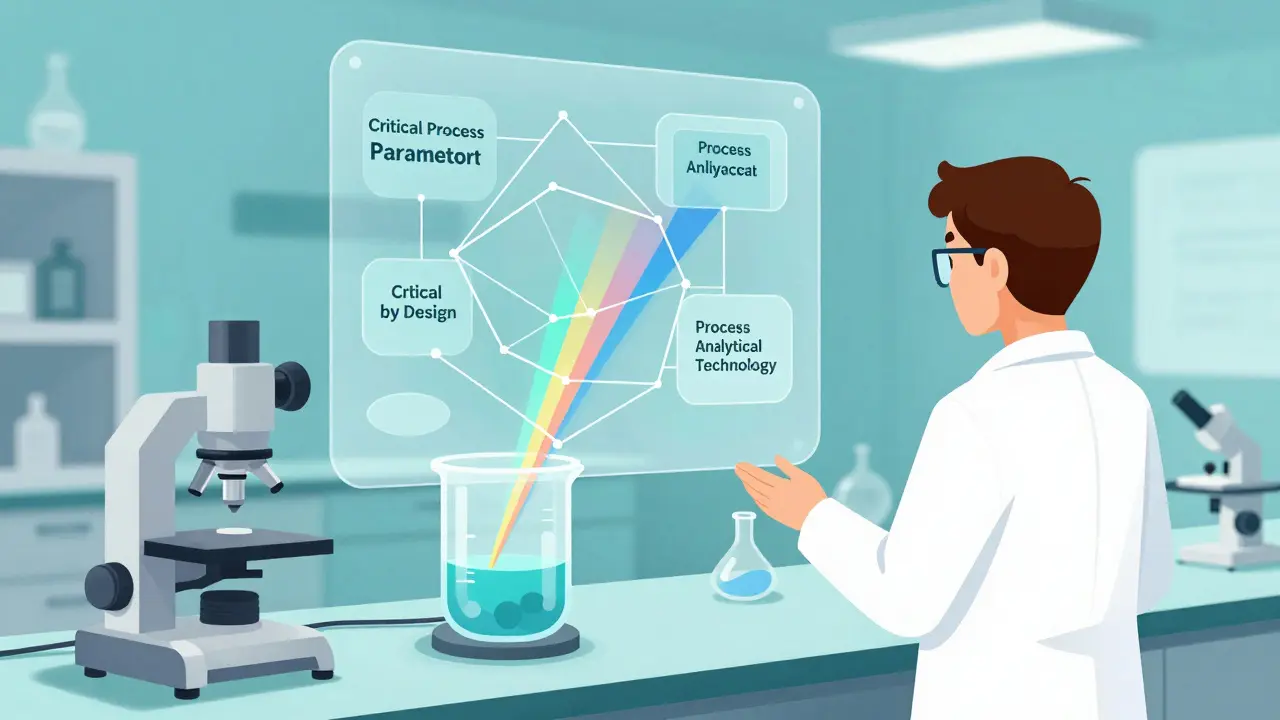
To implement QbD effectively, you need to understand its five interconnected components. These aren't abstract concepts; they are specific documents and datasets you will present during your chemistry, manufacturing, and controls (CMC) review.
- Quality Target Product Profile (QTPP): This is your roadmap. It defines exactly what the finished product must look like, including identity, assay, and dissolution profiles. For generics, the goal is achieving at least 95% similarity to the Reference Listed Drug (RLD).
- Critical Quality Attributes (CQAs): These are the specific properties-like impurity levels or dissolution rate-that must stay within strict limits. Most generic developers document between 5 and 12 CQAs per product. For instance, a standard tablet might require a dissolution rate similarity factor (f2) greater than 50.
- Critical Process Parameters (CPPs): These are the levers you control during manufacturing, such as compression force or drying temperature. You typically identify 3 to 8 CPPs through Design of Experiments studies.
- Design Space: Think of this as a safety zone. It represents the multidimensional combination of input variables proven to deliver quality. If you operate inside this space, you do not need prior approval for changes.
- Control Strategy: This integrates real-time monitoring systems. With 87% of manufacturers adopting Process Analytical Technology (PAT), you can reduce end-product testing requirements by up to 60%.
The power of the Design Space is particularly important for operational flexibility. Imagine you are running a batch, and the humidity shifts. Under a traditional 'recipe-based' model, you have a fixed setting like 'mix for 15 minutes.' If conditions change, you risk failure. With QbD, you have a scientifically justified operating range. A 2023 study showed this provides 28-42% greater process robustness during scale-up.
Regulatory Expectations and Market Trends
The regulatory landscape for QbD continues to tighten while rewarding early adopters. The FDA's Center for Drug Evaluation and Research has reported that QbD implementation increased generic drug application approval rates by 23%. This isn't just anecdotal evidence; it is backed by submission data analyzed in their 2022 Regulatory Report. Furthermore, the agency processes QbD submissions with a 92% first-cycle approval rate under the GDUFA III Pilot Program, compared to 78% for traditional submissions.
Global alignment is also strengthening. While the FDA led the charge, the European Medicines Agency and Japan's PMDA have joined forces. In 2023, the International Pharmaceutical Federation reported that 89% of regulatory authorities consider QbD elements essential for complex generic approvals. This means if you develop a formulation in Boston today, it needs to comply with standards relevant to London or Tokyo as well.
| Feature | Traditional Approach | Quality by Design (QbD) |
|---|---|---|
| Development Time | 18-24 Months | 22-32 Months (Includes initial setup) |
| Review Timeline | Avg. 13.9 Months | Avg. 9.2 Months |
| First Cycle Approval Rate | 78% | 92% |
| Process Robustness | Fixed Parameters | 28-42% Higher |
| Change Management | Requires Prior Approval | Faster Implementation (73%) |
Financial Implications of Implementation
One of the biggest objections to QbD remains the upfront cost. Implementing these protocols requires significant investment before you see the return. Initial development costs can be 25% to 40% higher than traditional methods. You are looking at approximately 4 to 8 additional months added to your development cycle, plus specialized training for your scientists.
However, the long-term economics tell a different story. Manufacturers report saving between $1.2 million and $2.8 million annually per product. How does this happen? It comes down to regulatory flexibility. When you have an approved design space, you can adjust process parameters without filing a Supplemental Drug Master File. Dr. Sarah Kim of Mylan noted that their QbD strategy for simvastatin allowed 11 manufacturing adjustments without prior approval. During supply chain disruptions, this capability maintained 99.8% on-time delivery.
Training is another major line item. Every scientist involved needs roughly 80 to 120 hours of specialized training in Quality Risk Management and Design of Experiments. Additionally, hardware investments are substantial. Setting up a lab for Process Analytical Technology tools like near-infrared spectroscopy requires a minimum investment of $500,000. Software for multivariate analysis, such as MODDE Pro, averages $15,000 per user per year. Despite these figures, companies implementing QbD for generic esomeprazole reported reducing post-approval deviations from 14 per year to just 2, saving roughly $850,000 annually in quality investigations alone.
Challenges in Complex Generic Products
QbD shines brightest when dealing with difficult formulations. If you are working on immediate-release tablets with established design spaces, some experts caution against over-engineering. Dr. James Polli from the University of Maryland notes that spending $450,000 on excessive studies for simple generics creates unnecessary burden. However, for complex products like modified-release tablets, inhalers, or transdermal patches, QbD is often mandatory.
The European Medicines Agency highlighted that 63% of QbD implementation failures stem from inadequate mechanistic understanding. This is especially true for modified-release products where 22% of applicants struggle to establish meaningful in vitro-in vivo correlations. If you cannot predict how the drug behaves in the body based on lab tests, your design space will likely be rejected. Successful applicants leverage RLD characterization data using advanced analytical techniques to reduce development time by 30%.
Risk management is critical here. Common hurdles include establishing meaningful design spaces for multi-component formulations, cited by 41% of survey respondents. Justifying boundaries for complex products is another frequent pain point during Type B meetings with regulators. To mitigate this, many firms now use bracketing approaches for multi-strength products, which cuts necessary studies by 45%.

Modern Technologies Driving Future Adoption
We are seeing a convergence between QbD principles and emerging manufacturing technologies. Continuous manufacturing is no longer a niche trend; it is becoming the preferred method for solid oral dosage forms. The FDA's Emerging Technology Program has processed 27 QbD-based continuous manufacturing applications with a 100% approval rate in 2023. This synergy increases batch consistency by 28%, as seen in Teva's case study on levothyroxine.
Digitalization is also playing a larger role. The updated ICH Q2(R2) guideline on Validation of Analytical Procedures emphasizes a lifecycle approach. This requires 30-50% more method robustness data but offers 40% faster validation for QbD-aligned submissions. Looking forward, the FDA's 2024-2026 Strategic Plan identifies expanding QbD to complex product platforms as a priority. Draft guidance is already expected for 3D-printed generics and complex biologics follow-ons.
McKinsey analysts predict that by 2027, 95% of new generic approvals will incorporate QbD elements. This suggests that delaying adoption is a risky strategy. Even in emerging markets, adoption is accelerating. Indian generic manufacturers currently sit at 68% adoption rates, driven partly by top-tier firms investing heavily in capabilities to meet international export standards.
Implementing QbD in Your Organization
If you are ready to transition, the FDA outlines a six-phase implementation roadmap. For immediate-release products, expect the process to take 6-9 months. Complex generics may require 12-18 months. Essential capabilities include personnel trained in Quality Risk Management and the software infrastructure to handle the data load.
The process starts with defining the QTPP clearly. Many submissions fail because the profile is too vague. You must document specific metrics. Once that is set, you perform risk assessment to identify CQAs. Then you run Design of Experiments to map out the Design Space. Finally, you lock in the Control Strategy.
The FDA Office of Pharmaceutical Quality provides free QbD training modules, which 1,247 professionals completed in 2022 alone. The Parenteral Drug Association also offers certified practitioner courses. Investing in human capital is as vital as buying the hardware. Disruption is inevitable during the first two ANDA submissions, but the long-term operational stability outweighs the short-term friction.
Is QbD mandatory for all generic drug submissions?
The FDA formally expects QbD elements in all Abbreviated New Drug Applications submitted after October 1, 2017. While it is technically not always 'mandatory' in a legal sense for every single product type, failing to demonstrate a science-based rationale often results in a Complete Response Letter. Therefore, practically speaking, it is required for successful approval.
How much does QbD implementation cost compared to traditional development?
Initial development costs are typically 25-40% higher due to extended timelines and specialized equipment like PAT tools. However, this investment can save manufacturers $1.2-2.8 million annually per product through reduced regulatory submissions and faster post-approval change management.
What is the impact of QbD on approval timelines?
Data from the FDA's Office of Generic Drugs indicates that QbD-based applications experience 31% fewer Complete Response Letters. Approval timelines average 9.2 months versus 13.9 months for non-QbD applications.
Can QbD be applied to simple immediate-release tablets?
Yes, but experts warn against over-engineering. For simple generics with well-established design spaces, extensive DoE studies might add unnecessary cost. The value proposition is highest for complex generics where traditional bioequivalence approaches face limitations.
What tools are needed for QbD compliance?
Essential tools include Process Analytical Technology (PAT) like near-infrared spectroscopy, multivariate analysis software (e.g., MODDE Pro), and staff trained in Design of Experiments and Quality Risk Management protocols.
Tommy Nguyen
March 27, 2026 AT 17:39finally the industry is catching up to modern science it feels great to see the numbers backing this up and the timeline improvements are obvious
walker texaxsranger
March 28, 2026 AT 10:36regulations always creep higher but they claim efficiency while adding layers of red tape that slow down the actual workflow significantly
Jordan Marx
March 29, 2026 AT 09:25i think you are missing the point regarding operational flexibility once the design space is approved changes become seamless and that saves money in the long run because you skip the filing fees
kendra 0712
March 30, 2026 AT 18:49The data really speaks volumes!! It is amazing how much faster approvals are when you play by these rules!!! Who would have thought the timeline drops by nearly four months???
Sarah Klingenberg
April 1, 2026 AT 10:36Global standards aligning is huge for us here in Australia :) It makes exporting products so much smoother
Monique Louise Hill
April 3, 2026 AT 03:14Safety must come first though 🙄 We cant cut corners on patient well being for profit margins 😤
Eva Maes
April 3, 2026 AT 14:06People overlook the grim reality beneath these polished graphs and statistics regarding quality metrics. Manufacturers often hide the true waste generated during the iterative failure cycles of design space definition. Regulatory bodies paint rosy pictures of timelines while ignoring the graveyard of failed submissions. You see the flashy savings numbers without witnessing the drained budgets in R&D departments trying to justify massive tooling costs. Every dollar spent on near-infrared spectroscopy is a dollar diverted from actual formulation innovation. The buzzwords create a false sense of security among middle management who lack deep process chemistry knowledge. Deviations might drop on paper while actual contamination risks slip through complex analytical validation gaps. Companies prioritize compliance theater over genuine product robustness in many observed cases. The promised flexibility of parameter adjustments often gets bottlenecked by internal QA bureaucracy. Training requirements demand cognitive load from staff already stretched thin by legacy protocols. Real world supply chains ignore the theoretical elegance of a multidimensional control strategy during actual disruption events. Patents expire anyway meaning all this heavy investment yields diminishing returns before recoupment happens. The industry churns through consultants selling the same generic QbD templates every single year. True quality stems from cultural integrity rather than software suites claiming predictive capabilities. This trend reflects a desperate attempt to bureaucratize engineering problems that require intuition.
Paul Vanderheiden
April 5, 2026 AT 07:51small shops can really benefit if they jump on this early dont worry too much about the learning curve cause the community helps each other out
Rachael Hammond
April 5, 2026 AT 20:56i kinda get where u coming from but honestly risk is still real even with fancy software sometimes things break unexpectedly and you need solid plans
Kameron Hacker
April 7, 2026 AT 18:19The statistical significance of these claims is undeniable regardless of corporate sentiment
Richard Kubíček
April 8, 2026 AT 11:46We must look past the friction and embrace the future direction of our shared practice
Devon Riley
April 9, 2026 AT 13:24Training is key people need support to learn these new tools 🌟 Its important we invest in our teams properly
Philip Wynkoop
April 10, 2026 AT 01:10ROI is there eventually :)
Sophie Hallam
April 10, 2026 AT 18:05That is a fair assessment of the timeline involved.
Shawn Sauve
April 11, 2026 AT 16:10Understood completely.