
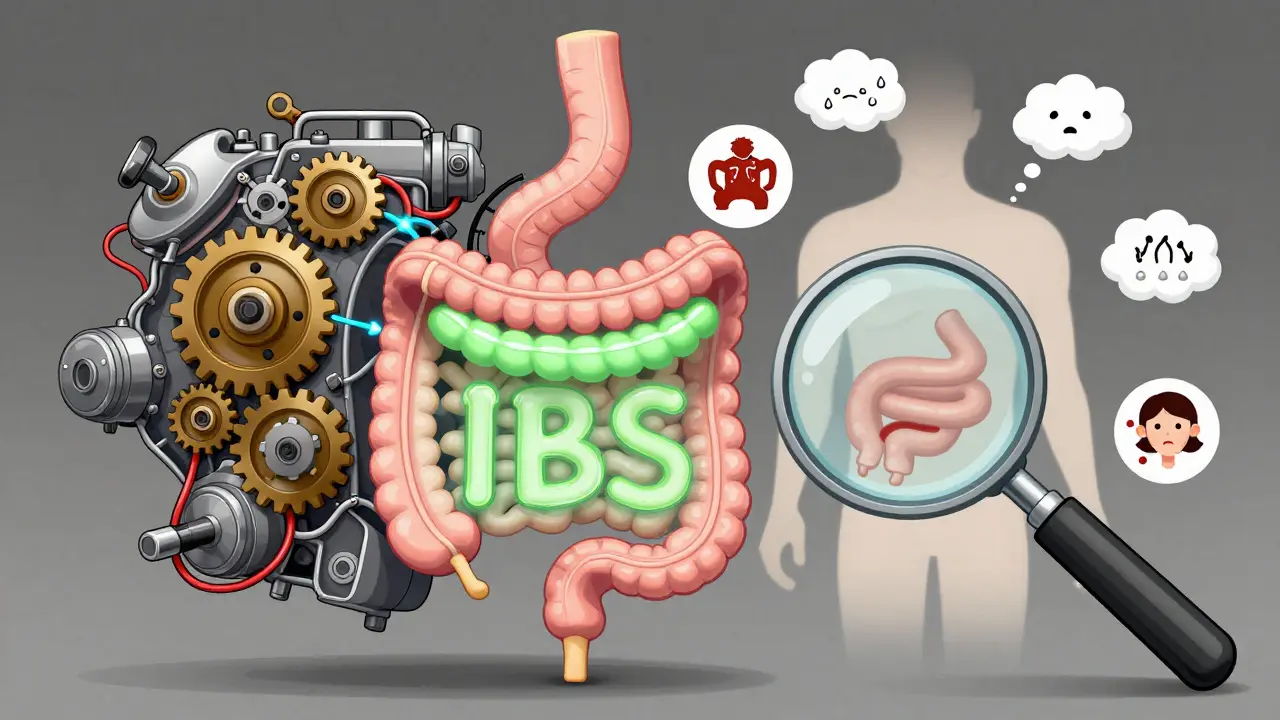
When your stomach is in knots, you’re rushing to the bathroom, or you’re constantly bloated, it’s easy to assume you have "bowel issues." But not all gut problems are the same. Two conditions-IBS and IBD-sound similar and share symptoms like diarrhea, cramps, and bloating. Yet they’re fundamentally different in cause, diagnosis, and long-term impact. Confusing them can lead to wrong treatments, unnecessary stress, or even dangerous delays in care.
What Is IBS? A Functional Disorder Without Damage
Irritable Bowel Syndrome, or IBS, isn’t caused by inflammation, infection, or structural damage. It’s a functional disorder. That means your gut looks normal on scans and biopsies, but it doesn’t work right. Think of it like a misfiring engine: everything’s in place, but the signals are off. According to the Rome IV criteria (updated in 2016), IBS is diagnosed when you have abdominal pain at least one day a week for three months, along with changes in bowel habits. You might have diarrhea more often (IBS-D), constipation (IBS-C), or both (IBS-M). Around 76% of people with IBS report bloating. Nearly half notice mucus in their stool. Symptoms often flare after meals, during stress, or after certain foods. Crucially, IBS doesn’t cause bleeding, weight loss, or fever. If you’re losing weight without trying, or seeing blood in your stool, that’s not IBS. Those are red flags for something else. Doctors diagnose IBS by ruling out other conditions. There’s no single test. You’ll likely have blood work, stool tests, and maybe a colonoscopy-but all of them will come back normal. That’s not a failure of testing. It’s confirmation of IBS.What Is IBD? Inflammation That Damages Your Gut
Inflammatory Bowel Disease is not one condition. It’s two: Crohn’s disease and ulcerative colitis. Both involve chronic inflammation that physically damages the lining of your digestive tract. In Crohn’s disease, inflammation can hit anywhere from mouth to anus. It doesn’t just affect the surface-it digs deep into the gut wall. This can lead to ulcers, strictures (narrowing of the intestine), and fistulas (abnormal tunnels between organs). About 33% of people with Crohn’s develop strictures within 10 years. Around 17% get fistulas. Ulcerative colitis sticks to the colon and rectum. It causes continuous inflammation and ulcers on the innermost layer. Blood in the stool? That’s common-seen in 92% of ulcerative colitis patients at diagnosis. Black, tarry stools? That can mean bleeding higher up, seen in 15% of Crohn’s cases. IBD doesn’t just mess with your gut. It can trigger problems elsewhere: joint pain, eye inflammation (uveitis), skin rashes like erythema nodosum, and even liver issues. These are called extraintestinal manifestations. They’re rare in IBS.The Big Difference: Inflammation and Damage
This is where IBS and IBD split apart completely. IBS: No inflammation. No ulcers. No tissue damage. Your colon looks perfect under a scope. IBD: Inflammation is everywhere. Biopsies show immune cells attacking the gut lining. Blood tests show high C-reactive protein (CRP)-a marker of inflammation. Stool tests show elevated calprotectin, which signals active gut inflammation. A 2022 study in the American Journal of Gastroenterology found that 95% of IBD patients had fecal calprotectin levels above 250 µg/g. IBS patients? Their levels stayed below 50 µg/g-the same as healthy people. The CDC and Mayo Clinic both say it plainly: IBD causes structural damage. IBS does not. That’s why IBD can lead to cancer risk. After 10 years of pancolitis (ulcerative colitis affecting the whole colon), the risk of colorectal cancer jumps by 2% per year. IBS carries zero cancer risk.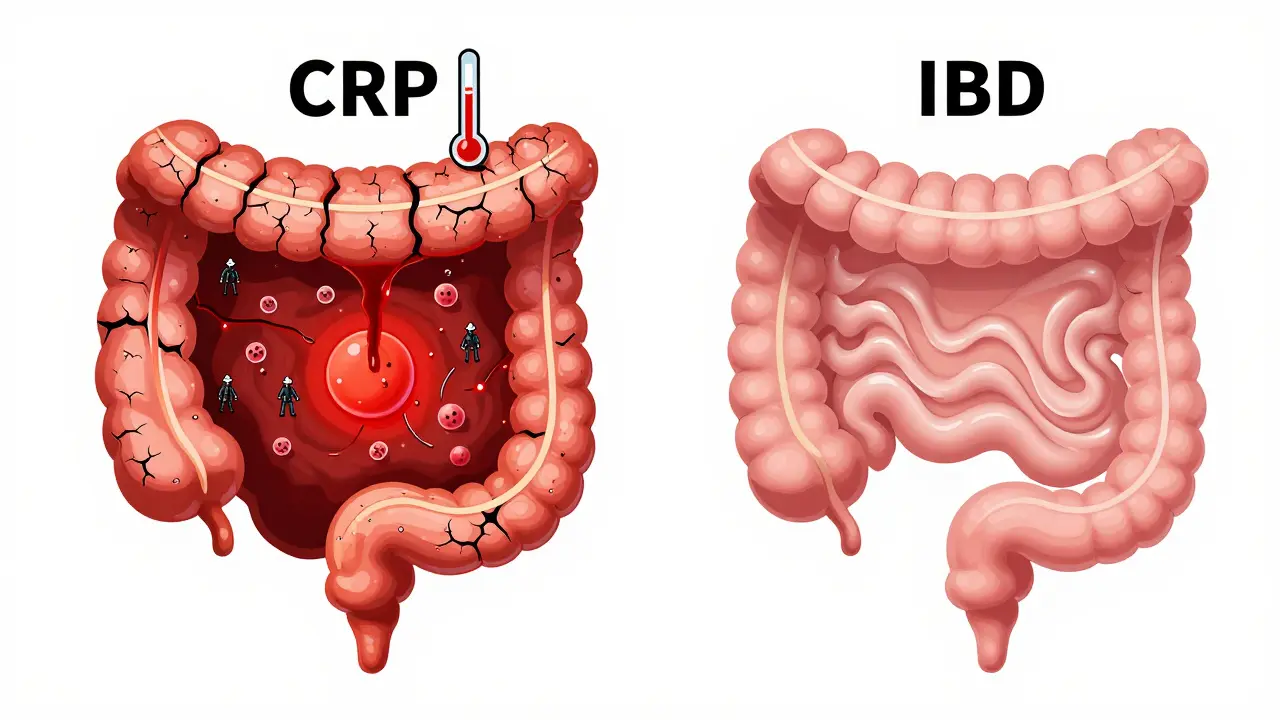
How Are They Diagnosed?
IBS diagnosis is like a detective game. You eliminate everything else. If you’re under 50, have no family history of colon cancer, no weight loss, no bleeding, and no fever-your symptoms fit IBS if they match the Rome IV criteria. IBD diagnosis is more aggressive. Doctors don’t wait to rule things out. They look for proof of damage. That means:- Colonoscopy with biopsies-showing inflamed, ulcerated tissue
- MRI enterography-detecting thickened bowel walls or fistulas in Crohn’s
- Blood tests-high CRP, low hemoglobin (anemia), elevated white blood cells
- Fecal calprotectin-over 250 µg/g confirms active inflammation
Treatment: Different Goals, Different Tools
IBS treatment is about managing symptoms, not curing disease. You can’t fix what isn’t broken. So doctors focus on what triggers your gut:- Low-FODMAP diet: Studies show it reduces symptoms in 76% of IBS patients. It cuts out fermentable carbs found in onions, garlic, dairy, and certain fruits.
- Low-dose antidepressants: Not because you’re depressed. These drugs (like amitriptyline) calm overactive nerves in the gut. They cut pain by 50% in 60% of users.
- Gut-targeted meds: Drugs like eluxadoline help with IBS-D. Linaclotide helps IBS-C.
- Anti-TNF drugs: Infliximab puts 50-60% of Crohn’s patients into remission within 14 weeks.
- Biologics: Vedolizumab targets gut-specific immune cells. It induces remission in nearly half of ulcerative colitis patients after a year.
- Corticosteroids: Effective for flares, but not for long-term use. Side effects include bone loss, diabetes, and mood swings.

Logan Hawker
February 18, 2026 AT 03:56Let’s be real-IBS is just the medical establishment’s way of saying, "We don’t know what’s wrong, so here’s a diet you’ll hate." Meanwhile, IBD? Now that’s a real disease. The fact that calprotectin levels are *literally* diagnostic is poetic. I mean, we’ve got biomarkers, not just vibes. And yet, somehow, TikTok influencers are telling people to "heal their gut with turmeric and breathwork." It’s 2024. We have colonoscopies. Use them.
Digital Raju Yadav
February 18, 2026 AT 08:19IBS is a Western luxury. In India, if you have chronic diarrhea, you don’t get a low-FODMAP diet-you get antibiotics and a stern lecture about hygiene. This whole "functional disorder" nonsense is just Big Pharma’s way of selling expensive drugs to rich Americans who eat avocado toast for breakfast. Real medicine doesn’t need five different gut-targeted meds. It needs clean water and discipline.
Carrie Schluckbier
February 19, 2026 AT 19:12Wait-so you’re telling me that if I have bloating and cramps but no blood? It’s "just IBS"? But what if the government is using 5G to manipulate our gut microbiomes? What if the calprotectin tests are falsified to hide the truth? I know someone who went to a "functional medicine" doctor and found out her IBS was actually caused by mold in her office building. They don’t want you to know this. They profit from the confusion.
guy greenfeld
February 19, 2026 AT 20:25It’s funny how we reduce the body to binary categories-functional vs. inflammatory-as if the soul doesn’t have a role in digestion. The gut is not a machine. It’s a conversation between your nervous system, your emotions, your environment, and your ancestral trauma. IBS isn’t a malfunction. It’s a message. And IBD? It’s the scream that follows when you ignore the message long enough. We treat symptoms because we’re terrified of the meaning behind them.
Steph Carr
February 20, 2026 AT 09:46Wow. This post was basically a textbook chapter with footnotes. I’m impressed. But let’s be honest-most people don’t care about calprotectin levels. They care about not dying on the toilet at work. The real tragedy? The system forces people to suffer for years before they get diagnosed. I know a woman who had IBD for 8 years before someone finally listened. She was told she was "anxious." Meanwhile, her colon was turning into Swiss cheese. This isn’t just medical knowledge-it’s a social justice issue.
Kancharla Pavan
February 22, 2026 AT 00:04Let me tell you something. In India, we don’t have the luxury of overdiagnosing IBS. We have millions who don’t even have access to basic healthcare. You talk about low-FODMAP diets? Have you ever seen someone trying to afford organic garlic in a rural village? This whole discussion is a first-world problem wrapped in medical jargon. The real solution? Invest in public health infrastructure, not boutique gut clinics in Palo Alto. And stop romanticizing IBS as some mystical "functional" condition-it’s just poor nutrition and stress, plain and simple.
PRITAM BIJAPUR
February 22, 2026 AT 19:24✅ IBS = No inflammation. No damage. Just nerves. 🌿
✅ IBD = Inflammation. Ulcers. Scarring. Cancer risk. 💥
✅ Blood in stool? Fever? Weight loss? 🚨 NOT IBS. GO TO DOCTOR.
✅ Low-FODMAP works for 76%? That’s science, not luck. 📊
✅ Biologics? They’re miracles. Not magic. 💉
✅ You can have both? Yes. And it’s okay. ❤️
Thank you for this clarity. My gut (and my soul) thank you.
Dennis Santarinala
February 23, 2026 AT 08:13I’ve had IBS for 12 years. I’ve done the low-FODMAP diet, the probiotics, the peppermint oil, the antidepressants. And you know what? I’m okay. I don’t need a label to be valid. IBD people? You’re fighting a war. IBS people? We’re just trying to get through Tuesday without a bathroom emergency. Neither is easy. But neither is less real. I’m glad someone finally explained the difference without making me feel like I’m making it up.
Tony Shuman
February 25, 2026 AT 07:57So you’re saying if I have bloating and diarrhea but no inflammation, it’s "just IBS"? What if I’m secretly developing Crohn’s and they’re just not seeing it yet? What if the whole medical system is covering up early-stage IBD because biologics are too expensive? I’ve read studies where 30% of IBS patients later turned out to have IBD-missed because they didn’t test calprotectin early enough. This isn’t science. It’s complacency.