
Low back pain is one of the most common reasons people visit a doctor. About 80% of adults will deal with it at some point in their life. Most of the time, it’s not serious-it’s just your muscles or ligaments reacting to stress, poor posture, or a bad lift. But sometimes, it’s a warning sign of something much more serious. Knowing the difference can save you from unnecessary tests, wasted time, and even permanent damage.
Most Back Pain Isn’t Dangerous-But You Need to Know When It Is
Ninety-seven percent of low back pain cases are mechanical. That means no tumor, no fracture, no infection. Just strained tissues. These cases usually get better on their own within a few weeks. The problem? Many people panic when the pain sticks around, and doctors, under pressure, often order imaging too early. That’s where red flags come in.
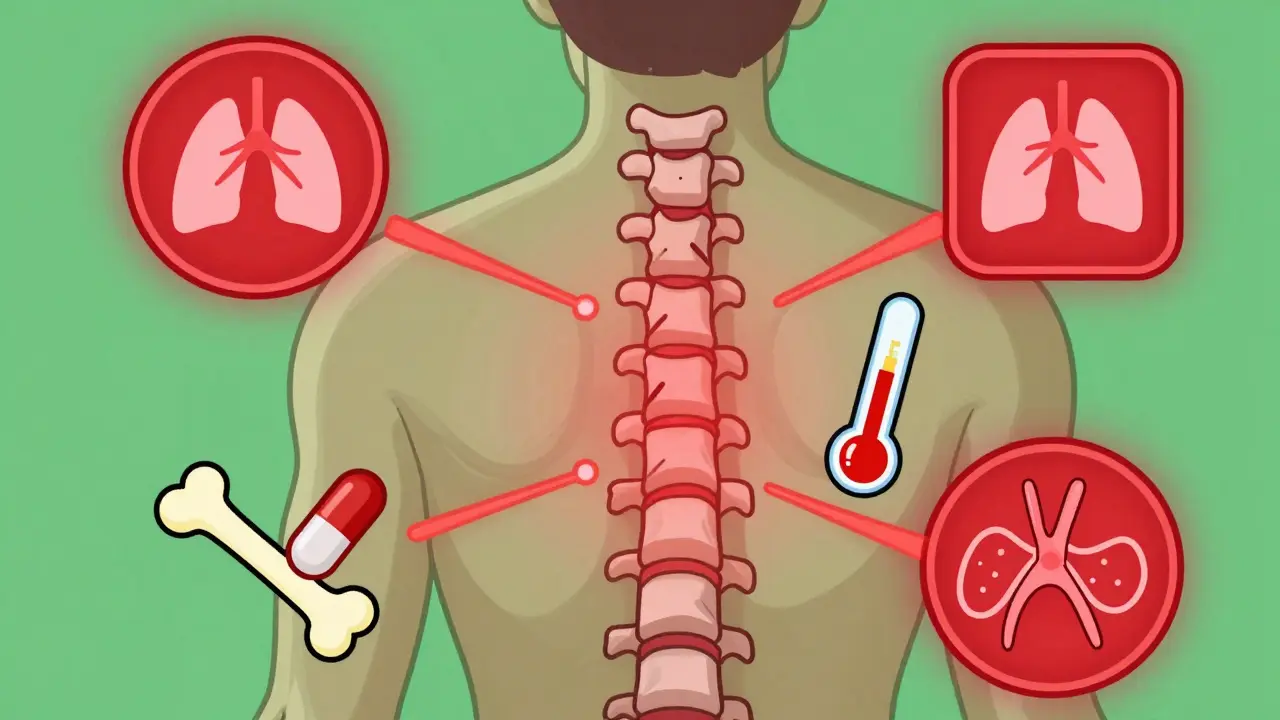
Red flags aren’t symptoms you should ignore-they’re signals that something serious might be going on. The four main conditions they point to are: cancer, spinal fracture, infection, and cauda equina syndrome. Each has its own set of warning signs, and not all of them are obvious.
For cancer, the strongest red flags are a history of cancer (especially breast, lung, or prostate) and unexplained weight loss. If you’ve had cancer before and now your back hurts, that’s not something to wait out. Same with losing 10 pounds or more without trying. Fever alone isn’t enough, but fever plus back pain? That’s a red flag for infection. Intravenous drug use is another major clue. And if your back hurts worse at night or when you’re resting, especially if it wakes you up, that’s another signal to get checked.
What About Fractures? It’s Not Just About Falls
Most people think fractures only happen after a fall or car crash. But that’s not the whole story. People on long-term steroids-like for asthma, lupus, or after an organ transplant-are at higher risk. Even a minor bump can cause a break in their spine. Same with older adults with osteoporosis. If you’re over 65 and you’ve had a fall, even a small one, you should get evaluated.
The most reliable red flags for fracture are major trauma (like a fall from height or a car accident) and steroid use. Age alone? Not enough. A 2022 survey found that nearly 70% of doctors still think being over 50 is a red flag. But studies show age by itself doesn’t increase the chance of serious spine problems. It’s the combination of age plus trauma or medication that matters.
Cauda Equina Syndrome: The Emergency You Can’t Afford to Miss
This is the one condition where minutes matter. Cauda equina syndrome happens when the bundle of nerves at the bottom of your spinal cord gets compressed. If it’s not treated within 48 hours, you could lose bladder and bowel control permanently.
The key signs are:
- Loss of bladder or bowel control
- Difficulty starting urination or feeling like your bladder won’t empty
- Numbness in your inner thighs, buttocks, or around the anus (saddle anesthesia)
- Weakness in both legs
- Loss of anal sphincter tone (a doctor can test this)
If you have urinary retention with more than 200cc of urine left after peeing, plus saddle numbness, the chance you have this condition jumps to 92%. This isn’t a "wait and see" situation. Go to the ER immediately. Surgery within two days can mean the difference between full recovery and lifelong disability.
Imaging: When It Helps, When It Doesn’t
Let’s clear this up: X-rays and MRIs don’t help most people with low back pain. In fact, they often make things worse.
If you’ve had pain for less than four weeks and no red flags, imaging is not recommended. Not because doctors are being cheap, but because it doesn’t change treatment-and it can lead to unnecessary surgery. Studies show that people who get early MRIs for non-specific back pain are more likely to have surgery, even when the scan shows nothing serious.
Here’s what the guidelines say:
- No imaging for acute pain (<4 weeks) without red flags
- For red flags like cauda equina or neurological loss: MRI without contrast
- For suspected infection: Bone scan with SPECT/CT or CT with contrast
- For suspected cancer: MRI without contrast
- For chronic pain (>12 weeks) without red flags: X-rays aren’t useful. MRI isn’t needed unless symptoms change or red flags appear
The American College of Radiology rates imaging appropriateness on a 9-point scale. No imaging for acute pain? That’s a 1-the lowest possible score for unnecessary tests. Yet, a 2022 survey found that over 40% of primary care doctors still order X-rays for first-time back pain. That’s not just wasteful-it’s misleading. Many people see a bulging disc on their MRI and assume that’s the cause. But 30% of healthy 30-year-olds have bulging discs with no pain at all.
Exercise Therapy: The Most Proven Treatment
If you’ve been told to rest, stop. Movement is the best medicine for most low back pain.
A 2020 Cochrane Review looked at 97 studies with nearly 20,000 people. The result? Exercise reduced pain by an average of 6.6 points on a 100-point scale and improved function by 6.7 points. That’s not a tiny change-it’s meaningful. People who stuck with exercise for 8 to 12 weeks had better results than those who took painkillers or did nothing.
Not all exercises are equal. The best evidence supports:
- Motor control exercises (focusing on deep core muscles)
- Graded activity (gradually increasing movement and load)
- Combined programs (strength + aerobic + flexibility)
You don’t need a gym membership. Start with walking 20 minutes a day. Add bodyweight squats, bridges, and bird-dogs. Progress slowly. The goal isn’t to lift heavy-it’s to move consistently. The American Physical Therapy Association recommends 2-3 supervised sessions per week at first, then a home routine. Intensity should build over time: start at 40-60% of your max strength, and work up to 70-85% over 8-12 weeks.
And here’s the kicker: if you do less than half the prescribed exercises, you get almost no benefit. Consistency beats intensity every time.
Why Do So Many People Get Unnecessary Scans?
Doctors aren’t trying to overtest. They’re under pressure. A typical back pain visit lasts 12.7 minutes. The recommended time? 18-22 minutes. That’s not enough to properly screen for red flags, explain why imaging isn’t needed, or teach someone how to move safely.
Patients want answers. Scans feel like progress. But a scan without a clear reason often leads to more scans, more specialists, more anxiety, and sometimes unnecessary surgery.
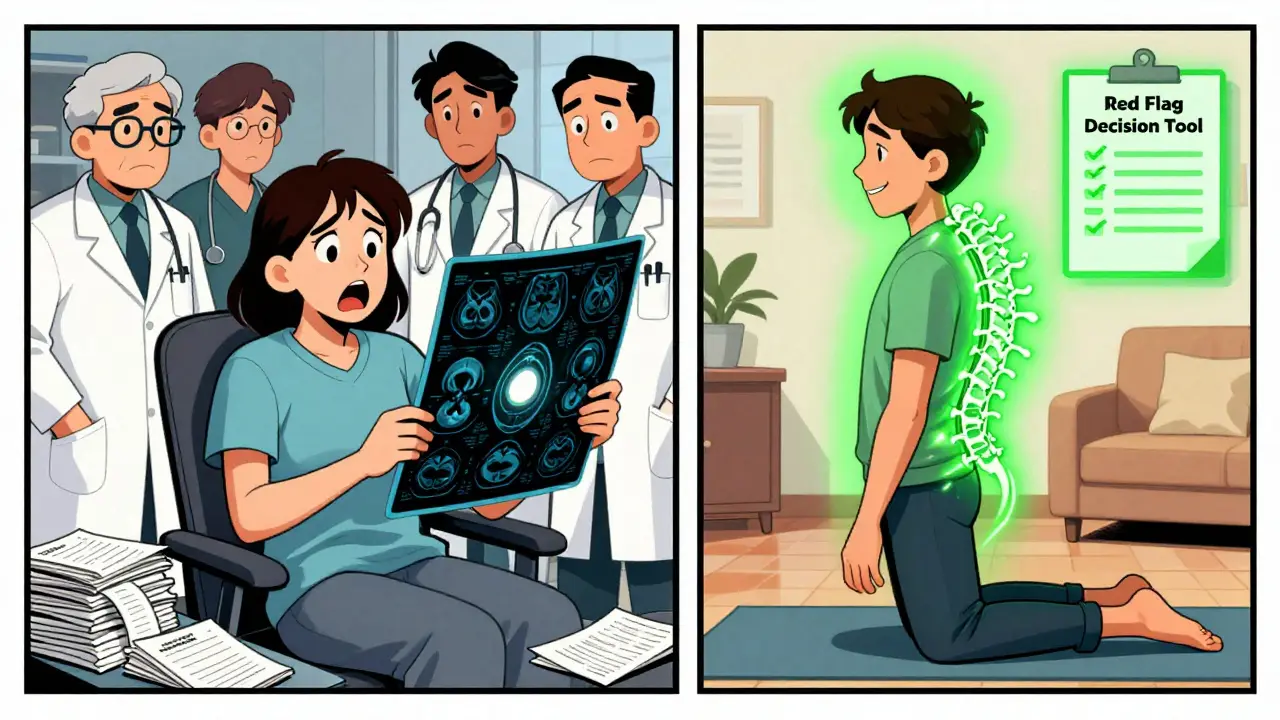
Tools like the Red Flag Decision Tool help. It’s a simple 3-step checklist that asks: Is there trauma? Is there cancer history? Are there neurological symptoms? If yes to any, refer. If no, start movement therapy. A trial in 2021 showed this tool cut unnecessary imaging by 28%.
The Bigger Picture: Less Is More
The Choosing Wisely campaign has cut inappropriate imaging for back pain by over 15% since 2014. New guidelines are dropping age-based red flags because they don’t work. AI tools are being tested to improve accuracy-some now catch serious cases 89% of the time, up from 73% with old checklists.
But the real win? When patients understand that pain doesn’t equal damage. That movement isn’t dangerous. That recovery takes time-and that their body is built to heal.
Most back pain gets better with time, movement, and patience. The goal isn’t to eliminate pain overnight. It’s to get you back to your life-without surgery, without scans, without fear.
Is back pain always a sign of something serious?
No. About 97% of low back pain cases are mechanical-caused by muscle strain, poor posture, or overuse. These aren’t dangerous and usually improve within a few weeks with movement and time. Only 1-2% of cases involve serious conditions like cancer, infection, or nerve damage.
Should I get an MRI if my back pain lasts more than a few weeks?
Not unless you have red flags. For pain lasting 4-12 weeks without warning signs like unexplained weight loss, fever, or leg weakness, imaging won’t change your treatment. Studies show that people who get early MRIs are more likely to have surgery-even when the scan shows nothing serious. Stick with exercise and activity unless red flags appear.
What’s the best type of exercise for low back pain?
The strongest evidence supports motor control exercises, graded activity, and combined programs that include strength, aerobic movement, and flexibility. Start with walking, bridges, and bird-dogs. Aim for 2-3 sessions per week, then move to a home routine. Progress slowly: increase intensity over 8-12 weeks. Consistency matters more than intensity.
Can age alone be a red flag for serious back pain?
No. Being over 50 or 55 doesn’t mean you have a serious condition. Older guidelines listed age as a red flag, but newer evidence shows it has almost no predictive value. What matters is trauma, steroid use, cancer history, or neurological symptoms-not age.
How quickly do I need to act if I suspect cauda equina syndrome?
Within 48 hours. If you have bladder or bowel control loss, saddle numbness, or urinary retention with more than 200cc left after peeing, go to the emergency room immediately. Surgery within two days leads to much better outcomes-up to 35 points improvement on disability scales. After 48 hours, recovery is often incomplete.
Why do doctors sometimes order X-rays for back pain even when guidelines say not to?
Time pressure and patient expectations play a big role. Most visits last under 13 minutes-too short to properly explain why imaging isn’t needed. Some doctors order scans to reassure patients or avoid missing something rare. But studies show this leads to more surgeries, higher costs, and no better outcomes. Tools like the Red Flag Decision Tool help reduce unnecessary imaging by 28%.
Linda Foster
March 24, 2026 AT 08:27While I appreciate the thorough breakdown of red flags, I'm concerned about how often patients are left to self-diagnose. The line between "mechanical" and "serious" is incredibly thin for someone without medical training. I've seen too many people dismiss genuine symptoms because they read online that "it's probably just strain." A little more emphasis on professional evaluation-even if imaging isn't immediately needed-would go a long way.
Also, the 48-hour window for cauda equina is critical, but most people don't know what "saddle anesthesia" even means. Maybe simplify that part for laypeople.
Still, this is one of the clearest summaries I've seen.
Kevin Siewe
March 25, 2026 AT 17:40Great post. I'm a physical therapist and this aligns perfectly with what we teach. The biggest barrier isn't lack of knowledge-it's fear. Patients are terrified of movement because they've been told "rest is healing." But movement is medicine. Start slow. Walk. Breathe. Move. Your body isn't broken-it's just confused.
And yes, 30% of healthy 30-year-olds have bulging discs. That MRI you got? It's probably just a map of your age, not your pain.
Keep moving. You've got this.
Chris Farley
March 25, 2026 AT 18:30Oh great. Another article from the "Don't Trust Your Body, Trust the Algorithm" cult.
So let me get this straight-you're telling me that if I've had back pain for 3 weeks, I shouldn't get an MRI because "studies show"? Who funded those studies? Big Pharma? The insurance companies? The same ones who make billions off spine surgeries?
And exercise? Sure, go ahead and do bird-dogs while your nerve is slowly dying. Maybe if you're a 25-year-old gym bro, but what about my 68-year-old mom with osteoporosis? You think she's gonna "gradually increase load" after a sneeze breaks her spine?
This isn't medicine. It's corporate propaganda wrapped in Cochrane reviews.
Darlene Gomez
March 27, 2026 AT 18:08I love how this post challenges the idea that pain equals damage. That’s such a crucial shift.
I used to think my chronic back pain meant I was broken. I avoided everything-lifting, bending, even twisting to reach the top shelf. Then I started walking. Just 10 minutes a day. Then 20. Then adding bridges and bird-dogs. It wasn’t magic. It was slow. And it worked.
What helped me most was realizing my spine isn’t fragile. It’s strong. It’s adaptable. It just needs consistent, gentle input.
And yeah-my MRI showed "degenerative changes." So did my husband’s. He’s 42, has zero pain. I used to think mine was a death sentence. Now I see it as a history book-not a warning label.
Don’t fear movement. Fear stillness.
Also-thank you for mentioning that age alone isn’t a red flag. That myth has caused so much unnecessary panic.
Katie Putbrese
March 27, 2026 AT 20:34So we're supposed to just "move through it" when people are getting surgery because they got an MRI and saw a herniated disc? Are you kidding me?
My cousin had a 5mm herniation. No symptoms. No pain. Just a scan. Then the doctor said "you need to be careful." Now he can't lift groceries. He's terrified of his own body.
This isn't helping. It's gaslighting. People need scans when they're scared. You can't fix fear with a Cochrane review.
And who the hell decided that "motor control exercises" are better than a good chiropractor? I'm not some lab rat in a study. I need answers, not a lecture on "progressive loading."
Jacob Hessler
March 28, 2026 AT 18:41man i had back pain last year and i just did squats and it went away. no doctor no scan. why do people make this so hard? just move. your body knows what to do. stop overthinking. i dont even know what cauda equina is but i know i dont wanna be paralyzed. so if my butt goes numb i stop. simple.
also why do doctors charge 500 bucks for an xray when the machine cost 20k? scam.
Amber Gray
March 30, 2026 AT 03:33YOOOOO this is fire 🔥
Just did bird-dogs this morning and now my back feels like a yoga guru’s dream 🙌
Also-no scans. No way. My dog has more MRI results than I do and she’s a beagle. 😂
Move. Breathe. Live. 💪❤️
Danielle Arnold
March 31, 2026 AT 21:18Wow. A 12,000-word essay on "just walk more."
And yet somehow, in the entire thing, not a single mention of how insurance companies refuse to cover physical therapy unless you’ve had three failed rounds of opioids.
Thanks for the advice. I’ll just… go for a walk. Right after I pay my $2,000 deductible for the MRI they forced me to get.
Real helpful.
Kevin Y.
April 1, 2026 AT 17:28Thank you for this exceptionally well-researched and compassionate overview. The emphasis on the psychological dimension of pain-how fear of movement often exacerbates physical symptoms-is both clinically sound and deeply human.
I’ve worked with patients who delayed recovery for months because they believed their MRI findings were catastrophic. Once they understood that degenerative changes are common, even asymptomatic, and that movement is protective rather than perilous, their outcomes improved dramatically.
Also, the Red Flag Decision Tool deserves wider adoption. It’s simple, evidence-based, and reduces both patient anxiety and healthcare waste.
Let’s normalize the idea that healing is not about eliminating pain overnight-but about rebuilding trust in our bodies.
Korn Deno
April 3, 2026 AT 08:24There’s a deeper truth here that nobody talks about: pain is not data. It’s a signal. A warning. Not a diagnosis.
We treat pain like a math problem-solve for X and you’re cured. But the body doesn’t work like that. It’s a system. A conversation. Your back isn’t broken because it hurts. It’s asking for attention.
Exercise isn’t a cure-it’s a dialogue. Movement tells your nervous system: "I’m safe. I’m capable. I’m not under attack."
And scans? They’re snapshots. Not stories. You can’t read a novel from one page.
Stop chasing answers. Start listening.
Aaron Sims
April 5, 2026 AT 06:53Oh, so now we’re supposed to trust "studies" from "researchers" who get funded by Big Physio™?
Let me guess-the same people who told us smoking was safe, vaccines cause autism, and low-fat diets were the answer?
And now you want me to believe that 30% of 30-year-olds have bulging discs? So why am I in pain if my disc is "normal"? Did my pain get kidnapped?
Also, if you think a 20-minute walk fixes nerve compression, you’ve never had a real injury. I had sciatica for 18 months. Walked 10 miles a day. Didn’t help. Got an MRI. Found the herniation. Got surgery. Back to normal in 6 weeks.
Don’t preach to people who’ve suffered. You don’t know what pain really is.
And don’t tell me "don’t get an MRI." I’ll get one when I want. And I’ll sue anyone who tells me I shouldn’t.
Also-why is there no mention of epidurals? Why is no one talking about the real treatments?
This article is dangerous. And naive.