
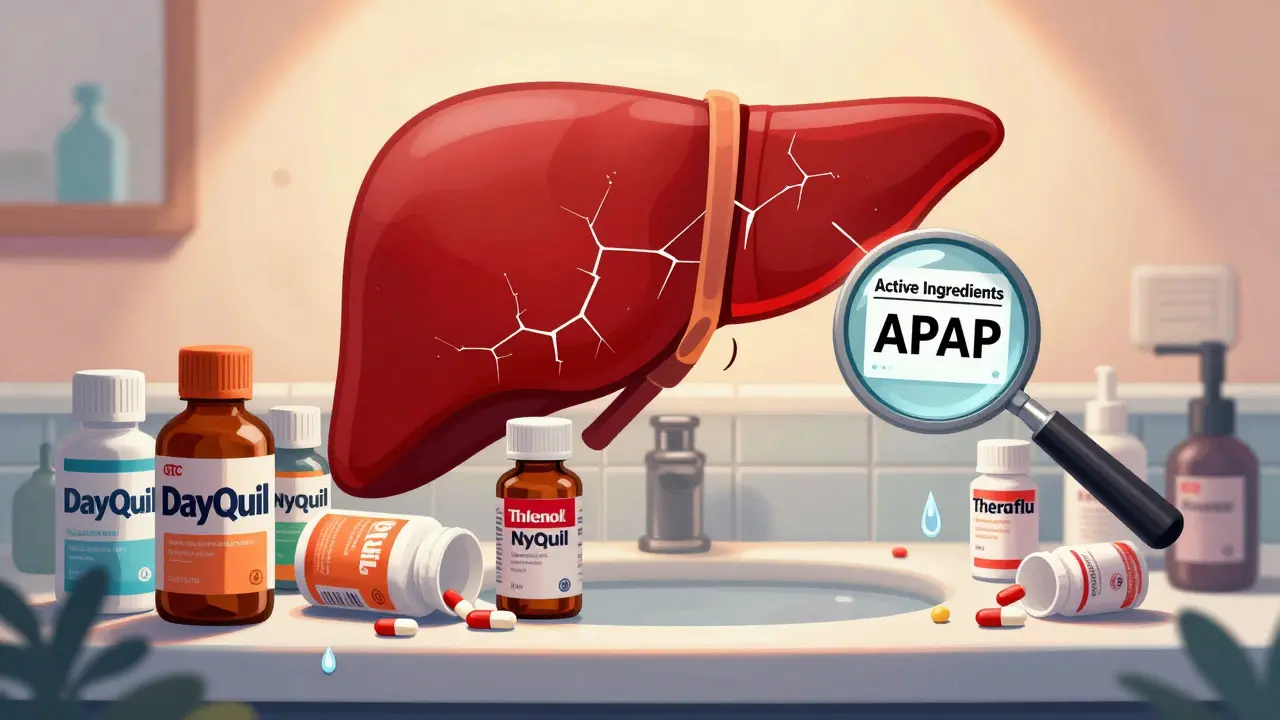
Every winter, millions of people grab a bottle of OTC cold and flu medicine thinking they’re doing the smart thing-grabbing one product to fix everything. Fever? Check. Congestion? Check. Cough? Check. But here’s the problem: acetaminophen is hiding in almost every one of them. And if you’re also taking Tylenol for a headache, or a sleep aid with the same ingredient, you could be on track for liver damage without even realizing it.
What’s Actually in Those Combination Pills?
OTC cold and flu meds are designed like Swiss Army knives: one bottle, multiple tools. But unlike a real Swiss Army knife, you can’t see what’s inside. The active ingredients are listed in tiny print on the Drug Facts label, and most people skip reading them. That’s dangerous.Most combination products contain at least three active ingredients:
- Acetaminophen (also called APAP or paracetamol) - for fever and pain. Found in 73% of all combo cold meds.
- Dextromethorphan (often labeled as DM) - for cough suppression.
- Phenylephrine - for nasal congestion. (Though the FDA recently proposed removing it because studies show it doesn’t work at OTC doses.)
Nighttime versions add a fourth: doxylamine or chlorpheniramine, antihistamines that make you drowsy. That’s fine if you’re trying to sleep-but not if you’re driving the next morning or taking other sedatives.
Here’s the real issue: these ingredients show up in multiple brands. Take Tylenol Cold & Flu Nighttime. It has 325mg of acetaminophen per caplet. So does Vicks DayQuil Cold & Flu. So does Theraflu ExpressMax. If you take one of each-thinking you’re treating different symptoms-you’ve just hit 650mg of acetaminophen in one dose. Do that three times a day? You’re at 1,950mg. Add a regular Tylenol tablet (500mg) for your back pain? Now you’re over 2,400mg. The safe daily limit is 4,000mg, but many people hit that limit without knowing it because they don’t realize how many products contain acetaminophen.
Why Double Dosing Happens (And Why It’s So Common)
People don’t double dose on purpose. They do it because:- They don’t know acetaminophen is in cold medicine.
- They think “flu medicine” and “pain reliever” are separate things.
- They see “non-drowsy” on the front label and assume it’s safe to take with other meds.
- They’ve taken the same product before and don’t check the label again.
A 2023 survey by Consumer Reports found that 41% of adults have accidentally taken too much of an OTC cold medicine ingredient. Of those, 68% overdosed on acetaminophen. That’s not a small number. That’s nearly half the population.
Pharmacists see it every day. In a 2022 survey by the American Pharmacists Association, 87% said they regularly counsel patients on avoiding double dosing during cold season. One common case: a patient takes NyQuil for a cough and fever, then takes Advil PM for trouble sleeping. Advil PM has acetaminophen. NyQuil has acetaminophen. Two doses. One liver stress.
What You Should Do Instead
Stop grabbing the combo pack. Here’s a better plan:- List your symptoms. Do you have a fever? Just a runny nose? A dry cough? Don’t treat symptoms you don’t have.
- Choose one active ingredient per symptom. For fever or pain: use plain acetaminophen or ibuprofen. For cough: use plain dextromethorphan. For congestion: use a standalone decongestant like pseudoephedrine (behind the counter) or a saline nasal spray.
- Check every bottle. Look for the “Active Ingredients” section on the Drug Facts label. Even if you’ve used the brand before, formulations change. Always check.
- Know the abbreviations. APAP = acetaminophen. DM = dextromethorphan. PE = phenylephrine. Doxylamine = nighttime sedative.
- Don’t mix with other meds. If you’re taking a prescription sleep aid, antidepressant, or painkiller, talk to your pharmacist before using any OTC cold product. Many interact dangerously.
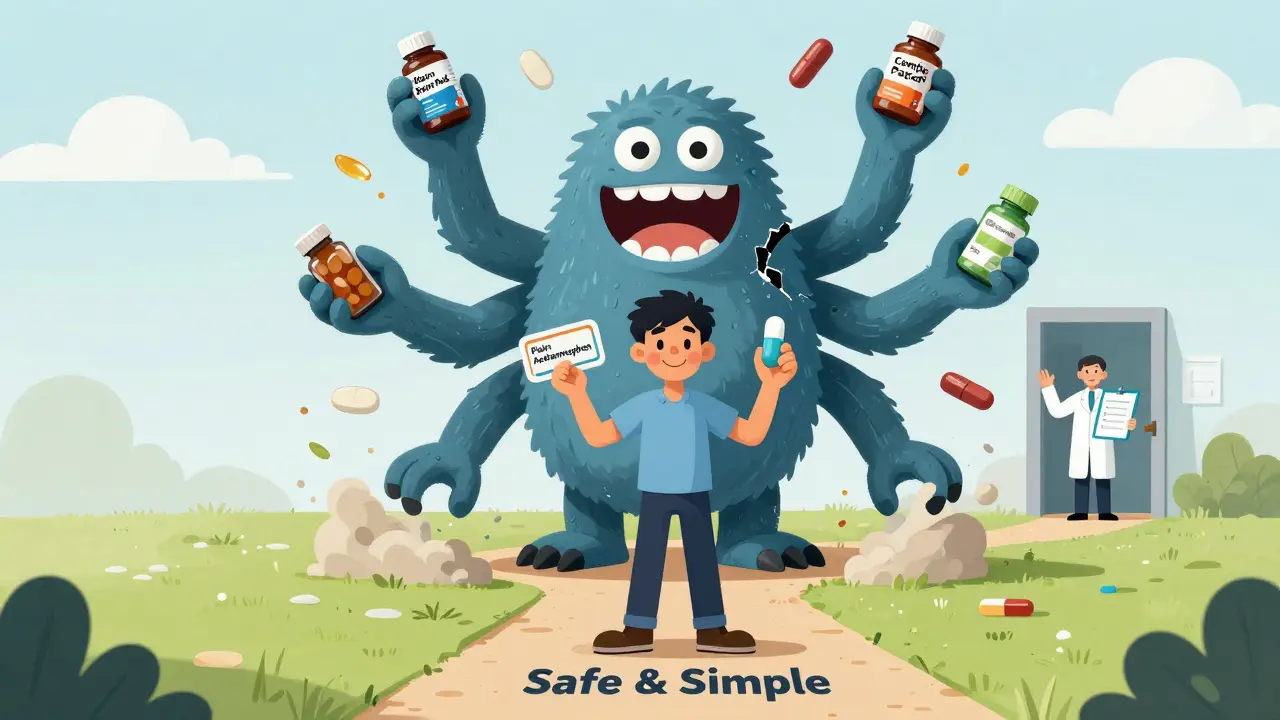
For example: if you have a fever and a cough, buy plain acetaminophen and plain dextromethorphan. That’s two pills. Not one fancy bottle. You’ll spend less, avoid side effects, and know exactly what you’re taking.
The Big Red Flag: Phenylephrine Isn’t Working
You’ve probably seen it on the label: phenylephrine. It’s the decongestant in most DayQuil, Sudafed PE, and Theraflu products. It’s cheap. It’s easy to put in a pill. But here’s the truth: it doesn’t work at the doses sold over the counter.In November 2024, the FDA proposed removing phenylephrine from the list of approved OTC decongestants. Why? Because multiple studies-including one published in the Journal of Allergy and Clinical Immunology in 2022-showed it’s no better than a placebo at 10mg doses. That’s the amount in every bottle you’re buying.
That means you’re taking a useless ingredient that adds no benefit, but still contributes to the risk of side effects like high blood pressure or jitteriness. And you’re paying for it. Meanwhile, pseudoephedrine (found in Sudafed) works-but it’s kept behind the pharmacy counter because of its link to illegal meth production. If you need real congestion relief, ask your pharmacist for pseudoephedrine. It’s more effective, and you’ll know exactly what you’re getting.
What to Do If You Think You’ve Overdosed
If you’ve taken more than one cold medicine in a day and you’re worried about acetaminophen, here’s what to do:- Stop taking all OTC cold meds immediately.
- Call Poison Control at 1-800-222-1222. They’re free, available 24/7, and trained to handle exactly this situation.
- Don’t wait for symptoms. Liver damage from acetaminophen can take hours to show up. By the time you feel sick, it might be too late.
- Bring all your bottles to the ER. Doctors need to know exactly what you took, including doses and times.
Don’t be embarrassed. This happens to smart people all the time. The CDC reports that 15,000-20,000 cases of acetaminophen-related liver injury happen every year in the U.S.-and most are from OTC meds, not prescriptions.

How to Stay Safe This Season
Here’s a simple checklist you can print or save on your phone:- ✅ Only take meds for symptoms you have.
- ✅ Read the Drug Facts label every time-even if it’s the same brand.
- ✅ Look for “acetaminophen,” “APAP,” or “paracetamol” on every bottle.
- ✅ Don’t take two products with the same ingredient.
- ✅ Use plain acetaminophen or ibuprofen for fever/pain instead of combo packs.
- ✅ Ask your pharmacist: “Is this safe with what else I’m taking?”
- ✅ Keep a list of all your meds (including supplements) in your phone.
The FDA’s Safe Use of Acetaminophen guide has been downloaded over 247,000 times since 2021. That’s not because people are careless-it’s because the system is confusing. You’re not alone. But you can be smarter.
What’s Changing in 2025?
The market is shifting. Sales of combo cold meds grew just 2.3% in 2023, while single-ingredient acetaminophen sales jumped 12.7%. More people are realizing that convenience isn’t worth the risk.Manufacturers are already adjusting. Johnson & Johnson is testing new formulas without phenylephrine. Some brands are starting to offer “two-in-one” packs-one tablet for daytime, one for nighttime-instead of one pill with four ingredients. That’s a step forward.
But until labels get clearer and consumers get better at reading them, the safest choice is still the simplest: treat your symptoms one at a time. You’ll save money. You’ll avoid side effects. And you won’t risk your liver.
Can I take OTC cold medicine with my prescription meds?
Sometimes, but never assume it’s safe. Many OTC cold medicines interact with blood pressure drugs, antidepressants, and sleep aids. Acetaminophen can increase liver damage risk if you’re on certain antibiotics or seizure meds. Always check with your pharmacist before combining any OTC product with a prescription.
Is it safe to take DayQuil and NyQuil on the same day?
No. Both contain acetaminophen and dextromethorphan. Taking them together can easily push you over the 4,000mg daily limit for acetaminophen. You’ll also get too much dextromethorphan, which can cause dizziness, nausea, or even hallucinations in high doses. Pick one-DayQuil for daytime, NyQuil for nighttime-and stick to the label’s dosing schedule.
Why do some cold meds have acetaminophen and others have ibuprofen?
It’s about brand strategy and target symptoms. Acetaminophen is cheaper and works well for fever and pain, but doesn’t reduce inflammation. Ibuprofen reduces inflammation and is better for sore throats or sinus pressure, but can upset your stomach. If you have stomach issues, choose acetaminophen. If you have swelling or inflammation, ibuprofen may be better. But never take both together unless your doctor says so.
What’s the difference between doxylamine and diphenhydramine?
Both are antihistamines that cause drowsiness. Doxylamine (in NyQuil) lasts longer-up to 8 hours-and is more sedating. Diphenhydramine (in Benadryl or some sleep aids) wears off faster but can still leave you groggy the next day. Mixing them increases sedation risk. Don’t take both. Pick one nighttime product and stick to it.
Are there any OTC cold meds without acetaminophen?
Yes. Look for products labeled “ibuprofen-based” or “non-acetaminophen.” Advil Multi-Symptom Cold & Flu uses ibuprofen instead. Some store brands also offer acetaminophen-free options. Always check the Active Ingredients list. If you’re unsure, ask your pharmacist to help you find one.
Jarrod Flesch
January 20, 2026 AT 03:18michelle Brownsea
January 20, 2026 AT 17:27Melanie Pearson
January 22, 2026 AT 00:37Kelly McRainey Moore
January 22, 2026 AT 05:51Stephen Rock
January 23, 2026 AT 23:16lokesh prasanth
January 25, 2026 AT 13:31Gerard Jordan
January 25, 2026 AT 22:11Uju Megafu
January 27, 2026 AT 14:57Andrew Rinaldi
January 29, 2026 AT 03:15Roisin Kelly
January 30, 2026 AT 04:11Ashok Sakra
February 1, 2026 AT 01:28