
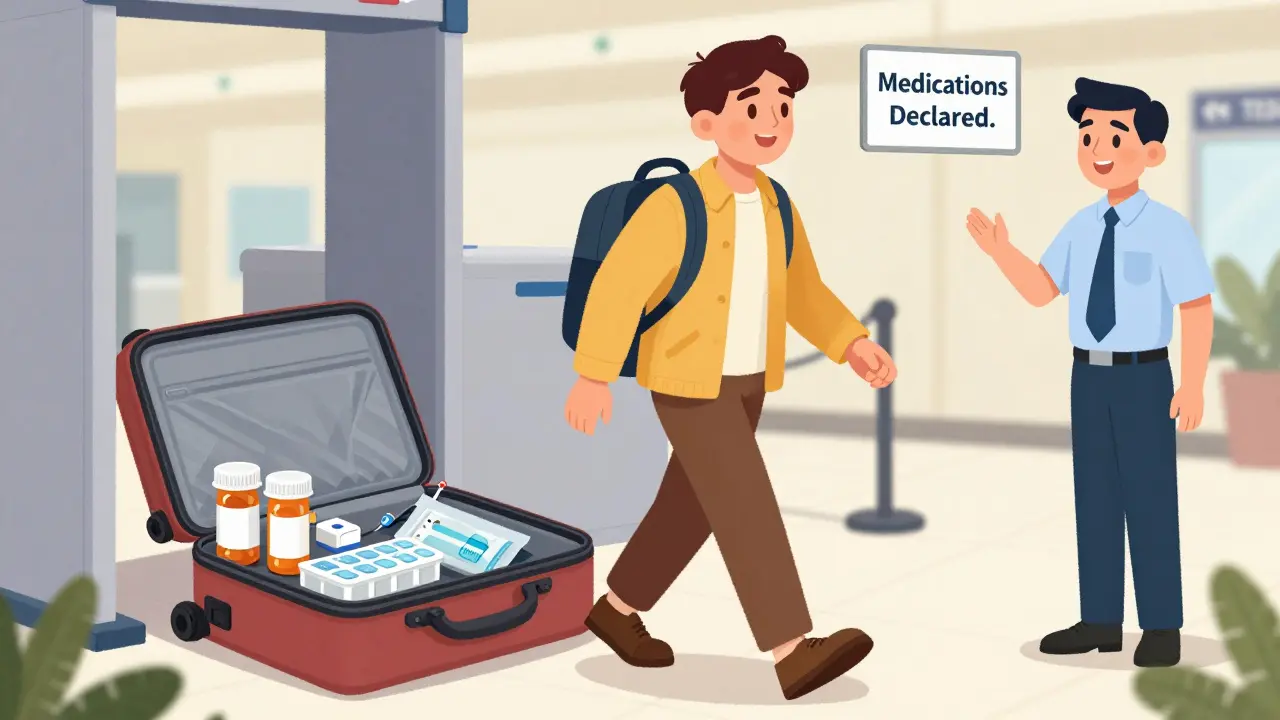
Planning a trip and worried about bringing your prescription meds through airport security? You’re not alone. Every day, thousands of travelers face confusion, delays, or even confiscation of their medications because they don’t know the real rules. The good news? The TSA lets you bring almost any prescription medication on a plane-no limits on quantity, no need to pack it in your checked bag. But there are important details that can save you from a stressful scene at the checkpoint.
You Can Bring Any Prescription Medication on a Plane
The TSA doesn’t restrict how much prescription medicine you can carry. That means your full 30-day supply of blood pressure pills, your 90-day stash of antidepressants, or your entire insulin pump setup-all perfectly legal in your carry-on. Even liquid medications like cough syrup, eye drops, or injectables like insulin are exempt from the standard 3-1-1 rule (3.4 oz per container, in a quart-sized bag). You don’t have to fit them into a small plastic bag. You can bring them in their original bottles, in pill organizers, or even in travel-sized containers-no problem.
But here’s the catch: you must declare them to the TSA officer. Don’t wait for them to ask. When you walk up to the security checkpoint, say something simple like, “I have medication I need to declare.” That small step cuts down on delays and helps officers know what to look for. Most of the time, they’ll just give it a quick visual check. But if they need to inspect it further, you’re already ahead of the game.
Keep Meds in Your Carry-On-Never in Checked Luggage
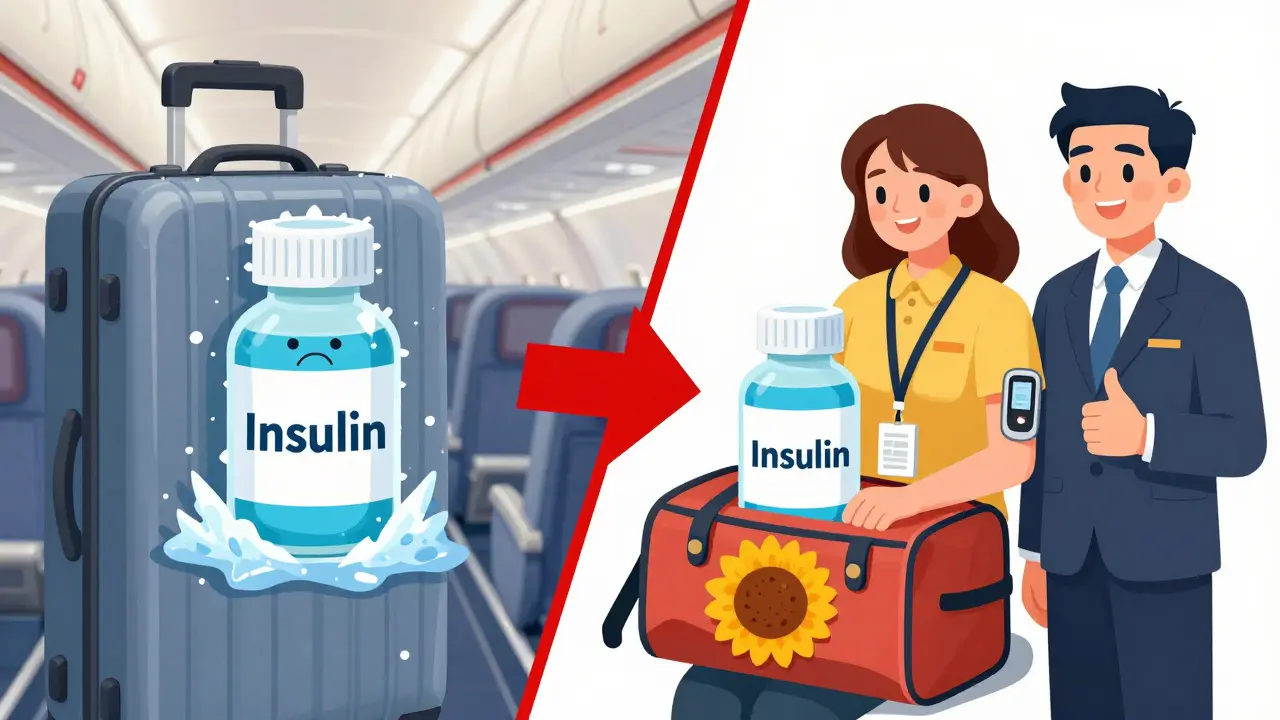
United Airlines, Delta, American, and every major U.S. carrier now strongly recommend-and in many cases require-that you keep all medications in your carry-on bag. Why? Because checked bags get lost, delayed, or exposed to extreme temperatures. Imagine your insulin freezing in the cargo hold or your heart medication disappearing for 48 hours. That’s not just inconvenient-it’s dangerous.
There’s a real story behind this rule. In 2022, a passenger’s life-saving medication was destroyed in checked baggage after a flight delay. The airline changed its policy immediately. Now, all major airlines follow the same standard: carry-on only. If you’re traveling with injectables, inhalers, or temperature-sensitive drugs like epinephrine pens, this isn’t optional. It’s essential.
Original Packaging? Not Required, But Highly Recommended
TSA doesn’t legally require your meds to be in their original bottles. But if you’re flying internationally-or even just want to avoid extra questions-keep them labeled. A 2023 United Airlines internal report found that 78% of medication delays at security happened because the name on the bottle didn’t match the passenger’s ID. Even a missing middle initial or a typo like “J. Smith” instead of “John Smith” can trigger a full search.
Here’s what works best: If you’re taking multiple pills, use a pill organizer-but keep the original bottles in your carry-on. When you get to security, show the officer the bottle with the prescription label and your ID. If you’ve transferred meds to a small container, have a copy of the prescription or a note from your doctor ready. It’s not mandatory, but it removes doubt. And in a world where TSA officers handle hundreds of bags a day, clarity saves time.
CBD Oil and Medical Marijuana Are Still Banned
This is where things get tricky. Just because your state allows medical marijuana or CBD oil doesn’t mean you can bring it on a plane. Federal law still bans all marijuana products, including CBD, if they contain more than 0.3% THC. TSA agents aren’t trained to test THC levels-they’re trained to report anything that looks like marijuana. If they find a bottle labeled “CBD oil” and aren’t sure about the THC content, they’ll confiscate it. And they’re not required to give it back.
According to a 2024 Government Accountability Office report, over 14,000 CBD products were confiscated in 2023-even though they met federal THC limits. Why? Because officers don’t have handheld THC testers. They err on the side of caution. If you’re relying on CBD for pain or anxiety, leave it at home. Or better yet, buy it at your destination if it’s legal there. Don’t risk a delay or worse.
International Travel? Check the Rules Before You Go
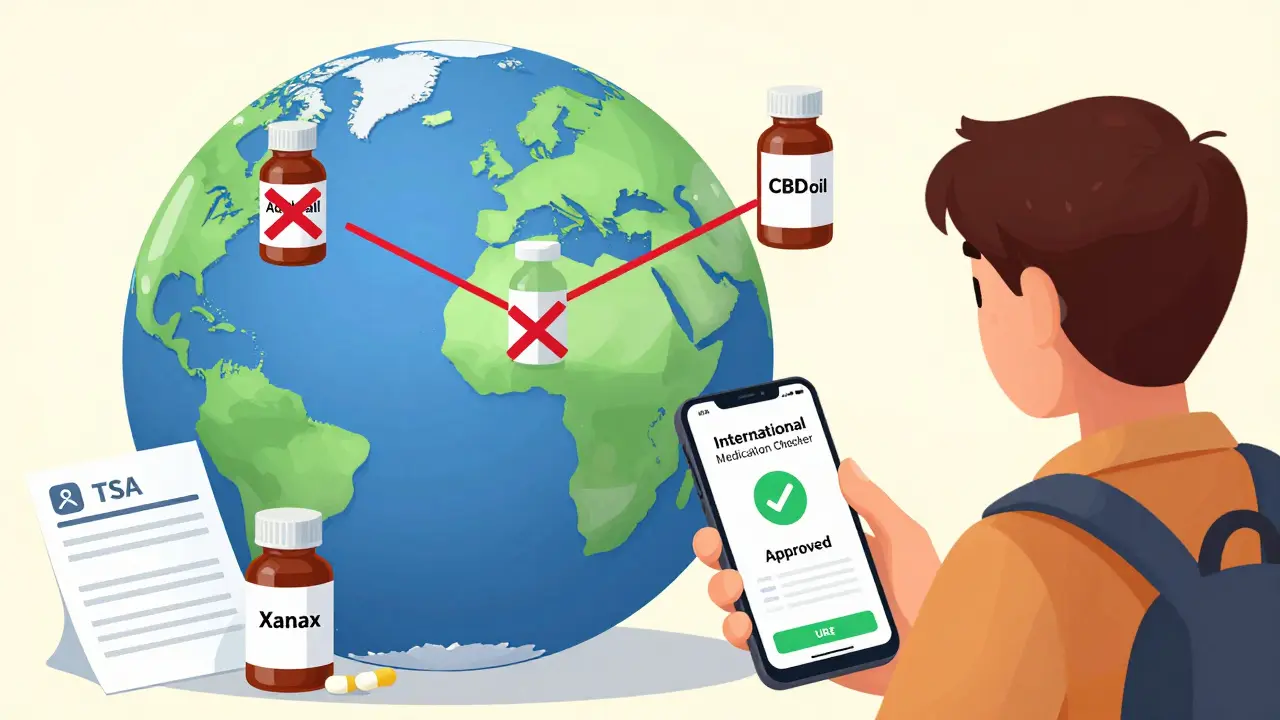
Domestic flights are one thing. International trips are another. A medication that’s perfectly legal in the U.S. might be completely banned in Japan, South Korea, the UAE, or even parts of Europe. Adderall? Illegal in Japan. Xanax? Restricted in Singapore. Tramadol? Banned in Saudi Arabia. The CDC warns that travelers caught with these drugs can face detention, fines, or even jail.
Before you book your flight, check the rules for your destination. The U.S. State Department’s website has a list of restricted drugs by country. You can also use the TSA app’s new International Medication Checker, launched in May 2024. It pulls data from the International Association for Medical Assistance to Travellers (IAMAT) and tells you if your meds are allowed in over 200 countries. Don’t skip this step. One wrong pill can ruin your entire trip.
Insulin Pumps, CGMs, and Other Medical Devices
If you use an insulin pump, continuous glucose monitor (CGM), or other medical device, you’re allowed to bring it through security. But you need to tell the officer. Don’t assume they’ll know what it is. Say, “I have a medical device that I need to keep with me.” You can request a pat-down instead of an X-ray scan for the device. TSA officers are trained to handle these requests.
For travelers with hidden disabilities, TSA offers the Sunflower Lanyard program. You can pick one up at any major U.S. airport (45 airports as of September 2024). Wearing it signals to staff that you may need extra time or assistance. You don’t need a doctor’s note. Just ask at the checkpoint.
Also, if you’re carrying frozen gel packs to keep your insulin cool, they’re allowed-as long as they’re completely frozen when you arrive at security. Once they start melting, they’ll be treated like liquids. So pack them with ice or dry ice if you’re on a long flight.
What About Over-the-Counter Meds?
Don’t forget about the stuff you buy at the drugstore. DayQuil, Tylenol, Advil, allergy pills, antacids-all of these are fine in any quantity. Even liquid cough syrups, nasal sprays, and eye drops are exempt from the 3-1-1 rule. You don’t need to declare them unless they’re part of a larger medical regimen. But if you’re carrying a lot, it’s still smart to keep them in their original packaging. It makes things easier if you’re questioned.
TSA PreCheck Makes It Easier
If you’re a TSA PreCheck member (and you’re not, you should be), you get a big advantage: you don’t have to take your liquids or medications out of your bag. Your meds stay in your carry-on, your shoes stay on, your laptop stays in your bag. In 2024, over 28 million travelers used PreCheck. It’s fast, and it cuts down on medication-related delays by about 70%.
Apply for PreCheck through the DHS Trusted Traveler Program. It costs $78 for five years. The interview takes 10 minutes. And if you fly often, it pays for itself in saved time and stress.
What to Pack: A Simple Checklist
- Keep all medications in your carry-on bag
- Bring original prescription labels or a doctor’s note (especially for controlled substances)
- Declare all medications at the checkpoint
- Don’t bring marijuana or CBD oil with more than 0.3% THC
- Check your destination country’s drug laws before you fly
- Use the TSA app’s International Medication Checker
- Consider TSA PreCheck to skip the liquid removal step
- Keep frozen gel packs completely frozen for temperature-sensitive meds
- Never transfer meds to unlabeled containers unless absolutely necessary
What If TSA Confiscates My Medication?
If your medication is taken, ask for a receipt. You have the right to one. Then contact TSA’s Customer Service line at 1-855-787-2227. Most confiscations of compliant medications are mistakes-and they can be reversed. In 2023, over 9,000 confiscated items were returned after review. But you have to act fast. Don’t wait until you land.
If you’re traveling with controlled substances like opioids, ADHD meds, or anxiety drugs, carry a letter from your doctor. It doesn’t need to be fancy-just a note on letterhead saying you’re prescribed this medication, the dosage, and the reason. It’s not required by TSA, but it’s your best defense if questions arise.
Can I bring my prescription pills in a pill organizer?
Yes. TSA allows you to transfer prescription pills into pill organizers, travel containers, or even ziplock bags. But you should still carry the original prescription bottle in your carry-on. If asked, you’ll need to show the label with your name and the prescribing doctor’s info. This helps avoid delays and confirms the medication is legitimate.
Do I need a doctor’s note to fly with prescription meds?
No, TSA doesn’t require a doctor’s note for most medications. But if you’re carrying controlled substances like Adderall, Xanax, or opioids, or if you’re flying internationally, a note from your doctor can save you hours of questioning. It should include your name, the medication name, dosage, and reason for use. Keep it simple and on official letterhead.
Can I bring liquid insulin on a plane?
Yes. Insulin, whether in vials, pens, or pumps, is completely exempt from the 3-1-1 liquid rule. You can bring as much as you need. Declare it at the checkpoint. You don’t need to put it in a plastic bag. TSA officers are trained to recognize insulin and will usually just visually inspect it.
Is CBD oil allowed on planes in 2026?
Only if it contains 0.3% THC or less and is derived from hemp. But even then, TSA agents may confiscate it because they can’t test THC levels on the spot. Many travelers report being denied CBD oil despite compliant labeling. To avoid risk, leave it at home or buy it at your destination if legal there.
What happens if my medication is confiscated at the airport?
Ask for a receipt and contact TSA Customer Service at 1-855-787-2227. Many confiscations are errors, especially with CBD products or medications with name mismatches. You can file a claim, and TSA will review it. If your medication was compliant, you may get it back. But don’t wait-act within 72 hours.
Final Tip: Be Prepared, Not Paranoid
The TSA isn’t out to take your meds. They’re trained to help travelers with medical needs. But they’re also under pressure to keep airports safe. The best way to make your experience smooth is to be clear, calm, and ready with your documents. Know the rules. Pack smart. Declare your meds. And if you’re unsure about something-ask. Most TSA officers will go out of their way to help if you’re respectful and prepared.
Traveling with medication doesn’t have to be stressful. With the right info, you can fly with confidence-no matter where you’re going.
Josh McEvoy
January 22, 2026 AT 19:04Tommy Sandri
January 24, 2026 AT 03:05Sawyer Vitela
January 24, 2026 AT 09:00Amelia Williams
January 24, 2026 AT 23:59Shanta Blank
January 26, 2026 AT 22:00Himanshu Singh
January 27, 2026 AT 15:47Tiffany Wagner
January 29, 2026 AT 06:59Jamie Hooper
January 29, 2026 AT 18:16Sushrita Chakraborty
January 30, 2026 AT 07:09Phil Maxwell
January 30, 2026 AT 17:47Shelby Marcel
February 1, 2026 AT 02:44Luke Davidson
February 2, 2026 AT 00:29Izzy Hadala
February 3, 2026 AT 13:26