
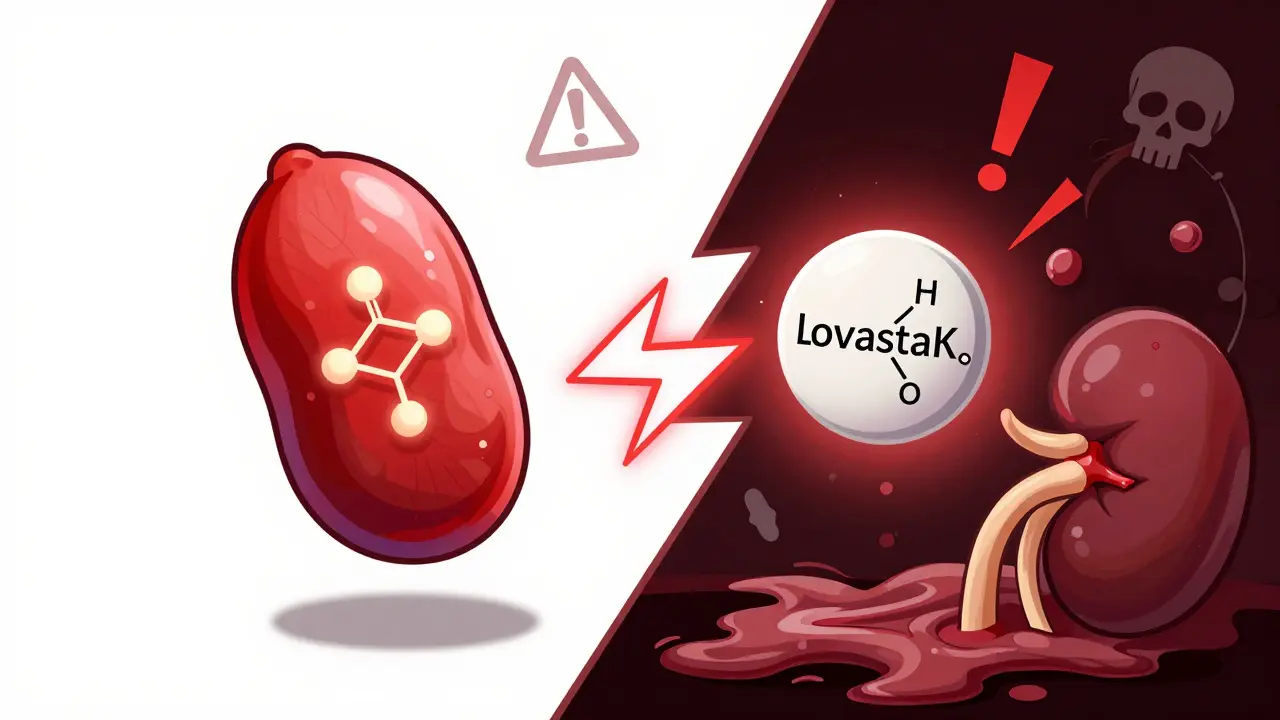
Many people turn to red yeast rice as a "natural" way to lower cholesterol, especially if they’ve had bad reactions to statins. It sounds safe - it’s made from fermented rice, used in Chinese medicine for centuries, and sold over the counter. But here’s the hard truth: red yeast rice isn’t just a supplement. It’s essentially a hidden statin. And when you take it with a real statin pill, you’re doubling down on a powerful drug - with serious risks.
What Exactly Is Red Yeast Rice?
Red yeast rice is rice fermented with a mold called Monascus purpureus. For centuries, it was used in Asia for digestion and circulation. But in 1979, scientists discovered something startling: one of its active compounds, monacolin K, is chemically identical to lovastatin - the first statin drug ever made. That means red yeast rice doesn’t just mimic statins. It is a statin, just not labeled as one.
Here’s the problem: unlike prescription statins, which are made in controlled labs with exact doses, red yeast rice supplements vary wildly. One capsule might have 3 mg of monacolin K. Another might have 15 mg. A 2022 analysis by ConsumerLab.com found only 30% of products matched their label claims. Some had no monacolin K at all. Others had enough to be as potent as a 40 mg dose of lovastatin. You simply can’t know what you’re getting.
Why Statins Are Prescribed - And How Red Yeast Rice Compares
Statins like atorvastatin, rosuvastatin, and simvastatin work by blocking HMG-CoA reductase, an enzyme your liver uses to make cholesterol. They’re proven to cut LDL (bad cholesterol) by 30-60%, depending on the dose. They’re also backed by decades of clinical trials showing they reduce heart attacks and strokes.
Red yeast rice works the same way. Studies show it lowers LDL by about 20-30% - similar to low-dose statins. A 2019 review in the Journal of the American College of Cardiology found it as effective as 10-20 mg of lovastatin. That’s why some people with statin side effects - like muscle pain - try it as a replacement.
But here’s the catch: statins are dosed precisely. A 10 mg tablet is always 10 mg. Red yeast rice? One brand’s 1,200 mg capsule could be equivalent to 5 mg of lovastatin. Another’s same dose might be 12 mg. There’s no standard. And if you’re already on a statin, adding red yeast rice is like taking a second statin pill - without knowing how much.
The Real Danger: Duplicate Therapy
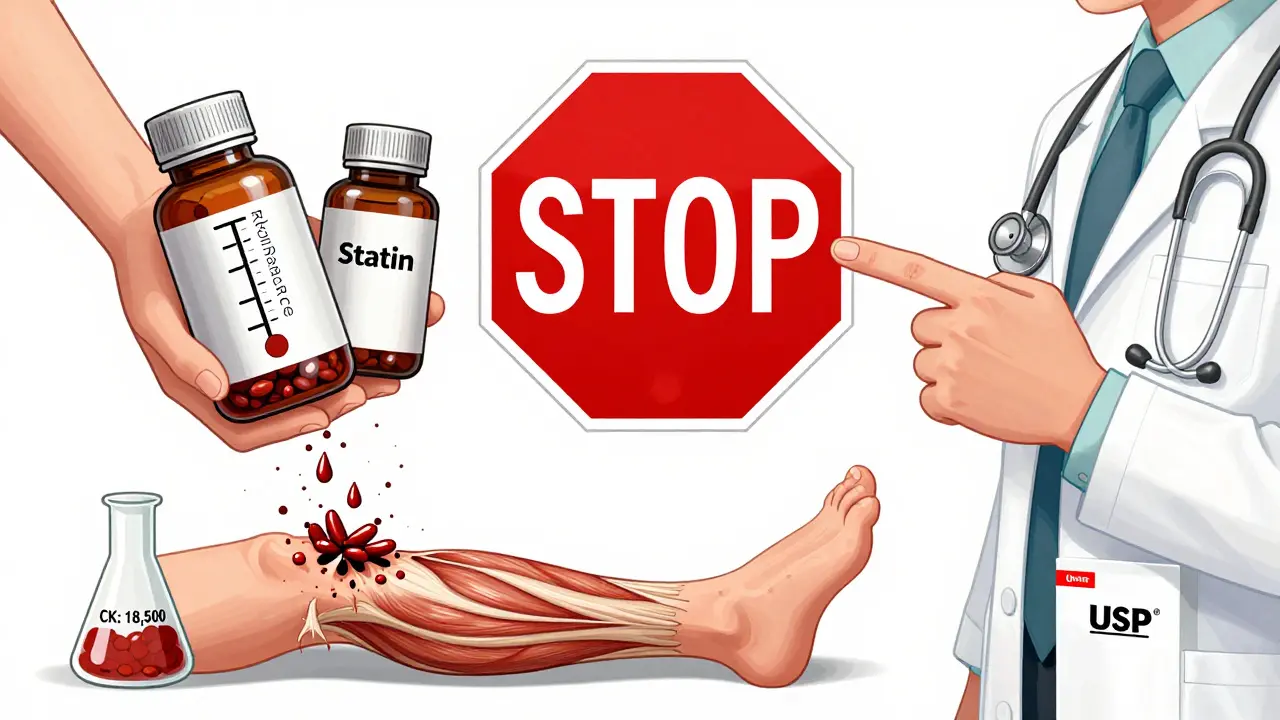
Combining red yeast rice and statins is called duplicate therapy. It’s not just risky - it’s dangerous. Both work on the same enzyme. Together, they can over-suppress cholesterol production, leading to muscle breakdown. This is called rhabdomyolysis - a condition where muscle cells leak into the bloodstream, damaging kidneys and sometimes causing death.
Case reports are chilling. One Reddit user, "CardioWarrior99," shared how he ended up in the hospital after taking 1,200 mg of red yeast rice daily while on 20 mg of atorvastatin. His creatine kinase (CK) levels hit 18,500 U/L - normal is under 200. His doctor said he was lucky to avoid kidney failure. The FDA’s adverse event database recorded 127 cases of severe muscle damage between 2018 and 2022 from this exact combo.
The Mayo Clinic rates this interaction as "Major - Use Alternative." Why? Because the risk isn’t theoretical. A 2021 study showed people who took both had a 3.7-fold higher chance of muscle injury. Liver damage is also common. WebMD’s forum has 27 documented cases of elevated liver enzymes (ALT levels up to 450 U/L) from the combo. Normal is under 40.
Who Might Benefit - And Who Should Avoid It
Red yeast rice isn’t all bad. For people who truly can’t tolerate statins - about 7-29% of users - it can be a lifeline. A 2017 study found 60% of statin-intolerant patients could handle 1,800 mg of red yeast rice daily, with LDL dropping 25-30%. Many users on Amazon and Healthline report success after switching from statins.
But this only works if you use it alone. Not with a statin. Not with other cholesterol meds. Not with grapefruit juice (which slows metabolism of both). And not without medical oversight.
Here’s who should avoid it entirely:
- Anyone taking a prescription statin
- People with liver disease
- Those on drugs that interact with CYP3A4 (like certain antibiotics, antifungals, or blood pressure meds)
- Pregnant or breastfeeding women
Even if you’re not on a statin, red yeast rice isn’t risk-free. Up to 30% of products contain citrinin - a toxic mold byproduct linked to kidney damage. The FDA has issued 12 warning letters since 2008 for this reason.
What You Should Do Instead
If you’re struggling with statin side effects, don’t self-treat with red yeast rice. Talk to your doctor. There are safer, better-tested options:
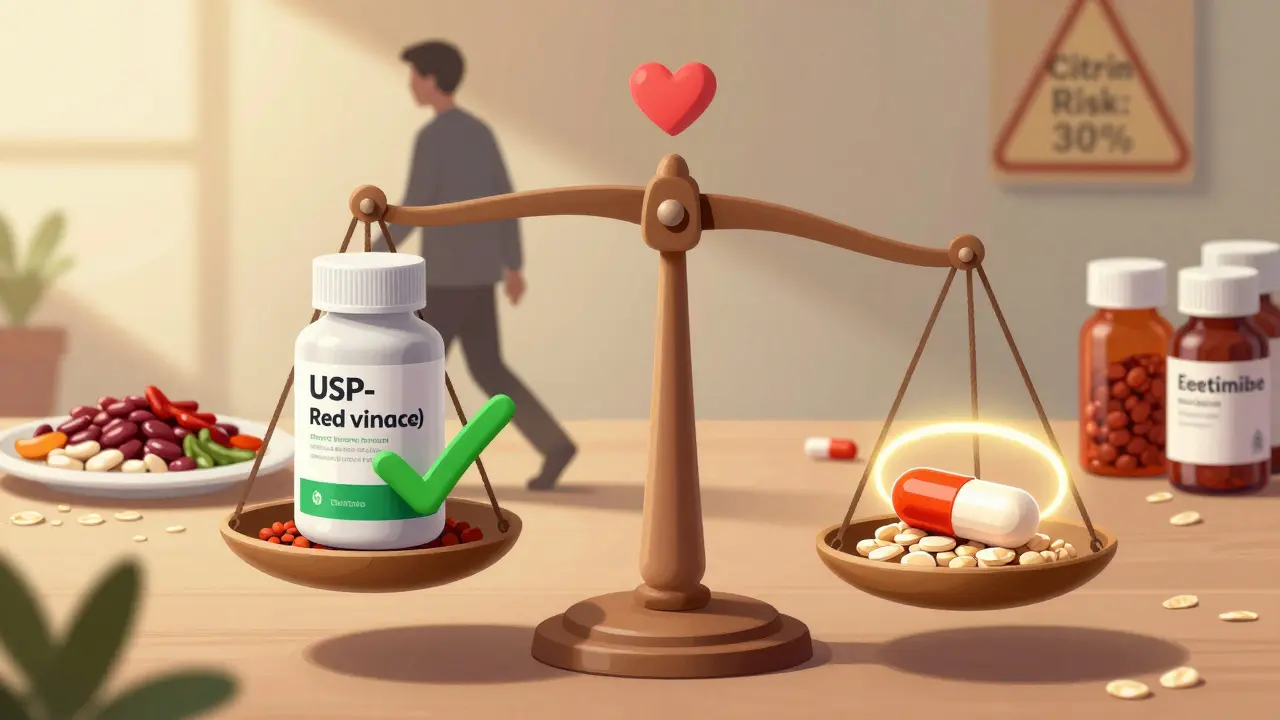
- Ezetimibe: A pill that blocks cholesterol absorption in the gut. Often used with low-dose statins or alone. Fewer side effects.
- PCSK9 inhibitors: Injected medications that lower LDL by 50-60%. Used for high-risk patients. Costly, but effective.
- Lifestyle changes: Soluble fiber (oats, beans), plant sterols, regular exercise, and weight loss can lower LDL by 10-20%.
Some doctors now recommend switching from a high-dose statin to ezetimibe, then adding a low-dose statin if needed. This avoids the "double hit" of uncontrolled supplements.
How to Stay Safe
If you’re already using red yeast rice - or thinking about it - here’s what to do:
- Stop combining it with statins. Period. No exceptions.
- Only use USP-verified products. The USP label means it’s been tested for content and purity. Only 15% of products carry this now - up from 5% in 2020.
- Get blood tests. Before starting, check your liver enzymes (ALT, AST) and muscle enzyme (CK). Repeat at 3 months and yearly.
- Tell your doctor. Nearly half of patients don’t mention supplements. That’s how dangerous interactions slip through.
- Avoid grapefruit. It interferes with how your body breaks down both statins and monacolins.
And if you’re switching from a statin to red yeast rice? Don’t do it cold turkey. Work with your provider. Ease off the statin slowly while monitoring your cholesterol and symptoms.
The Bottom Line
Red yeast rice isn’t a magic cure. It’s a powerful, unregulated drug with variable strength, contamination risks, and dangerous interactions. It can help people who can’t take statins - but only if used alone, under supervision, and with verified products.
For everyone else - especially those already on statins - it’s not an alternative. It’s a hazard. The FDA, the American Heart Association, and major medical centers all agree: don’t mix them. Your muscles, your liver, and your kidneys will thank you.
Is red yeast rice the same as a statin?
Yes, in one key way: its main active ingredient, monacolin K, is chemically identical to lovastatin - a prescription statin. That means it works the same way in your body, blocking the same enzyme to lower cholesterol. The difference is that statins are precisely dosed and regulated; red yeast rice is not. So while it’s the same drug, it’s far less predictable and more dangerous.
Can I take red yeast rice if I had muscle pain from statins?
Some people can. Studies show about 60% of statin-intolerant patients tolerate red yeast rice without muscle pain - especially at low doses (1,200-1,800 mg daily, delivering 3-5 mg monacolin K). But you must stop the statin first. Never take both together. Also, get your liver enzymes and CK levels checked before starting, and use only USP-verified products to reduce contamination risks.
How much monacolin K is in a typical red yeast rice supplement?
It varies wildly. Most supplements contain 3-10 mg per daily dose, but some have as little as 0.5 mg or as much as 34 mg per gram. A 2022 ConsumerLab.com test found only 30% of products matched their label claims. That’s why it’s so risky - you can’t trust the dose. Prescription lovastatin comes in fixed doses (10-80 mg), so you always know what you’re getting.
Are there safer alternatives to red yeast rice for lowering cholesterol?
Yes. Ezetimibe is a well-studied pill that blocks cholesterol absorption with fewer side effects than statins. PCSK9 inhibitors (injections) are highly effective for high-risk patients. Lifestyle changes like eating more soluble fiber (oats, lentils), exercising daily, and losing weight can lower LDL by 10-20%. These options are safer, more predictable, and backed by clinical evidence - unlike red yeast rice.
Why isn’t red yeast rice banned if it’s so risky?
Because of the Dietary Supplement Health and Education Act of 1994. Under this law, the FDA can’t stop a supplement from being sold unless it proves it’s unsafe - not the other way around. So even though the FDA has issued 12 warning letters since 2008 for red yeast rice products containing active drug ingredients, it can’t remove them unless they’re proven to cause harm. That’s why it’s still on shelves, even though it’s essentially an unapproved drug.
Suzette Smith
February 11, 2026 AT 03:10I know this sounds crazy, but I’ve been taking red yeast rice for two years now with my atorvastatin, and I feel better than ever. No muscle pain, my energy’s up, and my last blood work was perfect. Maybe the docs are just scared of natural stuff? I’m not a lab rat.
Autumn Frankart
February 12, 2026 AT 11:45THEY’RE HIDING THE TRUTH. Big Pharma bought off the FDA decades ago. Red yeast rice has been used for 1,000 years in China-why is it suddenly dangerous? Because they want you buying pills that cost $300 a month. They can’t patent rice. That’s why they scare you with ‘rhabdomyolysis.’ It’s all about control. Check the FDA warning letters-they admit it’s lovastatin. So why isn’t it regulated like a drug? Because they don’t want you to know you can buy it for $12 at Walmart.
Pat Mun
February 14, 2026 AT 09:15I really appreciate how thorough this post is. I used to take red yeast rice because I thought ‘natural’ meant safe. Then I got a weird muscle twitch and went to my doctor-turns out my CK was 800. Scared the hell out of me. I stopped it cold, switched to ezetimibe, and now I feel 100% better. Honestly? I wish someone had told me this before I started. The variability in supplements is insane. One bottle I bought had no monacolin K at all. Another had enough to make me feel like I was on a statin. I don’t trust anything unlabeled anymore. USP-verified is the only way to go if you’re going to try it. And please, please, talk to your doctor. Don’t just Google it and hope for the best.
Sophia Nelson
February 15, 2026 AT 22:30Wow. So you’re saying if I’m on a statin and I take this ‘natural’ stuff, I’m basically overdosing? And nobody told me this? I’ve been doing this for three years. Guess I’m lucky I didn’t lose a kidney.
Skilken Awe
February 17, 2026 AT 18:59Let me get this straight: you’re telling me that a fermented rice product, which is essentially an unregulated pharmaceutical, is being sold as a ‘dietary supplement’? That’s not a loophole-that’s a failure of regulatory capture. The FDA can’t regulate it because of DSHEA, which was pushed by supplement companies with lobbying budgets bigger than some small countries. Meanwhile, people are dying from citrinin contamination and rhabdo because they didn’t know they were taking 15mg of lovastatin in a capsule labeled ‘1200mg red yeast rice.’ This isn’t natural health. This is pharmaceutical anarchy. And yes, I’m a pharmacist. And yes, I’m furious.
andres az
February 19, 2026 AT 16:18Monacolin K = lovastatin. So why isn't this classified as a drug? Because if it was, you'd have to have a prescription. And if you had a prescription, you'd have to pay for it. And if you had to pay for it, Big Pharma wouldn't make as much off the $500 statin you're on. This isn't about safety. It's about profit. The FDA doesn't ban it because they're not supposed to. DSHEA says they can't. So they issue warning letters and do nothing. Meanwhile, your liver is slowly turning to soup. I've seen it. I work in ER. We get these cases every month. They always say 'I thought it was safe.' It's not.
Steve DESTIVELLE
February 20, 2026 AT 07:15What is health? Is it the absence of disease or the presence of harmony? The body is not a machine to be fixed with pills. Red yeast rice is a bridge between ancient wisdom and modern pharmacology. To fear it is to fear nature itself. The pharmaceutical industry seeks to control life through reductionism. But life is not reducible. The same enzyme blocked by statins is the same one that allows life to flow. To suppress it too much is to deny the dance of metabolism. Perhaps the real danger is not the supplement, but the fear of trusting the body. We have forgotten how to listen. We have outsourced our healing to laboratories and profit margins. The rice remembers what the pill forgets.
Stephon Devereux
February 22, 2026 AT 05:10Just to clarify something real quick: red yeast rice isn’t evil. It’s just poorly regulated. Think of it like homemade wine vs. store-bought wine. One has consistent alcohol content, the other varies wildly and might have mold. That’s the difference. I’ve helped patients switch from statins to red yeast rice successfully-BUT only after stopping the statin completely, using a USP-certified product, checking liver enzymes, and monitoring for 3 months. It’s not a magic bullet, but for some, it’s a viable path. The real villain here is misinformation. People think ‘natural’ = safe. It doesn’t. And people think ‘over the counter’ = harmless. It isn’t. If you’re going to use it, treat it like a drug. Because it is. Also, ezetimibe is underrated. It’s like a quiet hero in cholesterol management-no muscle pain, no liver stress, just solid, predictable results. Talk to your doc. Seriously.
steve sunio
February 23, 2026 AT 16:33