

Most people with diabetes assume that if their insulin shot stings or leaves a red bump, it’s just normal irritation. But sometimes, that bump isn’t just irritation-it’s your body sounding the alarm. Insulin allergies, while rare, are real. And if you ignore them, they can turn dangerous fast. About 2.1% of insulin users experience some kind of immune reaction to insulin or its additives, according to the Independent Diabetes Trust. That’s not common, but it’s common enough that anyone on insulin should know the signs-and what to do next.
What an Insulin Allergy Actually Looks Like
An insulin allergy isn’t one thing. It shows up in different ways, at different times, and in different parts of the body. The most common reaction-making up about 97% of cases-is localized. That means it stays right where you injected the insulin. You’ll notice swelling, redness, and itching. Sometimes, it feels like a hard lump under the skin. These lumps, called subcutaneous nodules, can appear anywhere from 30 minutes to six hours after your shot. They’re tender to the touch and can last a couple of days. In 85% of cases, they go away on their own without treatment. But then there are the rarer, more serious reactions. Less than 0.1% of insulin users have systemic reactions. These aren’t just skin deep. They can make your whole body react: hives spread across your chest or arms, your lips or tongue swell up, you feel dizzy, your throat tightens, or you can’t breathe. These are signs of anaphylaxis-a medical emergency. If you’ve ever had a peanut allergy and felt your throat close, this is the same kind of reaction, just triggered by insulin instead. And here’s something most people don’t know: you can develop an allergy even after years of using insulin without issue. A delayed reaction can show up as joint pain, muscle aches, or bruising that takes weeks to fade. This isn’t an IgE-mediated allergy like hives or swelling. It’s a T-cell response, meaning your immune system is slowly building up a grudge against the insulin. These reactions can appear even in people who’ve been on human insulin for over a decade.Is It an Allergy-or Just a Side Effect?
It’s easy to confuse a real allergy with normal insulin side effects. Shaking, sweating, anxiety-those are signs of low blood sugar, not an allergy. If you feel shaky after a shot and your glucose meter reads 65 mg/dL, you’ve got hypoglycemia. Treat it with juice or glucose tabs. No need to panic about an allergic reaction. But if you get a rash that spreads beyond the injection site, or if your face puffs up, or you feel like you’re suffocating-that’s different. The NHS and the American Academy of Allergy, Asthma & Immunology both stress this: true insulin allergies affect fewer than 1 in 100 users. Most reactions are mild and local. But if you’re unsure, don’t guess. Call your diabetes team. They’ve seen this before. Another twist: sometimes, it’s not the insulin itself causing the problem-it’s the additives. Insulin formulations contain preservatives like metacresol and zinc. Humalog, for example, has more metacresol than other insulins. If you’re reacting to the same brand every time, switching to a different one might solve the problem. One study showed that switching insulin types helped 70% of allergic patients.What to Do When You React
If you notice a small red bump or itching at the injection site, don’t stop your insulin. That’s the worst thing you can do. Skipping insulin-even for a day-can send your blood sugar soaring and lead to diabetic ketoacidosis, a life-threatening condition. Instead, take these steps:- Apply a topical calcineurin inhibitor like tacrolimus or pimecrolimus right after your shot. Repeat it 4-6 hours later. This helps calm down delayed T-cell reactions.
- For stubborn redness or swelling, use a mid- to high-potency corticosteroid cream like flunisolide 0.05%. Apply it immediately after injection and again a few hours later.
- Take an over-the-counter antihistamine like cetirizine or loratadine daily. It won’t fix everything, but it reduces itching and redness in many cases.
- Rotate your injection sites. Don’t keep injecting into the same spot. Use your abdomen, thighs, arms, and buttocks in rotation to avoid overloading one area.

How Doctors Diagnose It
Your endocrinologist can’t diagnose this with a blood test alone. You’ll need to see an allergist. The gold standard is skin prick testing or intradermal testing. A tiny amount of your insulin (or the specific brand you’re using) is placed under your skin. If a hive forms within 15-20 minutes, it’s likely an IgE-mediated allergy. For delayed reactions, doctors may use patch testing or blood tests to check for T-cell activity. They’ll also ask you to log every injection: what type of insulin, when you took it, where you injected, and what symptoms followed. Patterns matter. If every time you use Lantus you get bruising on your thigh three days later, that’s a clue.What Treatments Actually Work
Most mild cases improve with simple changes: switching insulin brands, using antihistamines, applying topical creams. But for persistent cases, there’s a powerful tool called immunotherapy-or desensitization. It sounds scary, but it’s straightforward: you get tiny, gradually increasing doses of insulin under close medical supervision. The goal? Train your immune system to stop seeing insulin as a threat. A 2008 study followed four patients with severe insulin allergies. After undergoing immunotherapy, 67% had their symptoms completely eliminated. The other 33% saw major improvement. That’s not a fluke. It’s repeatable. This approach is now recommended by leading diabetes centers like Joslin. In rare cases where immunotherapy doesn’t work, doctors may consider switching to oral diabetes medications-like metformin or GLP-1 agonists. But that’s only possible for people with type 2 diabetes. Type 1 patients can’t survive without insulin. For them, desensitization is often the only path forward.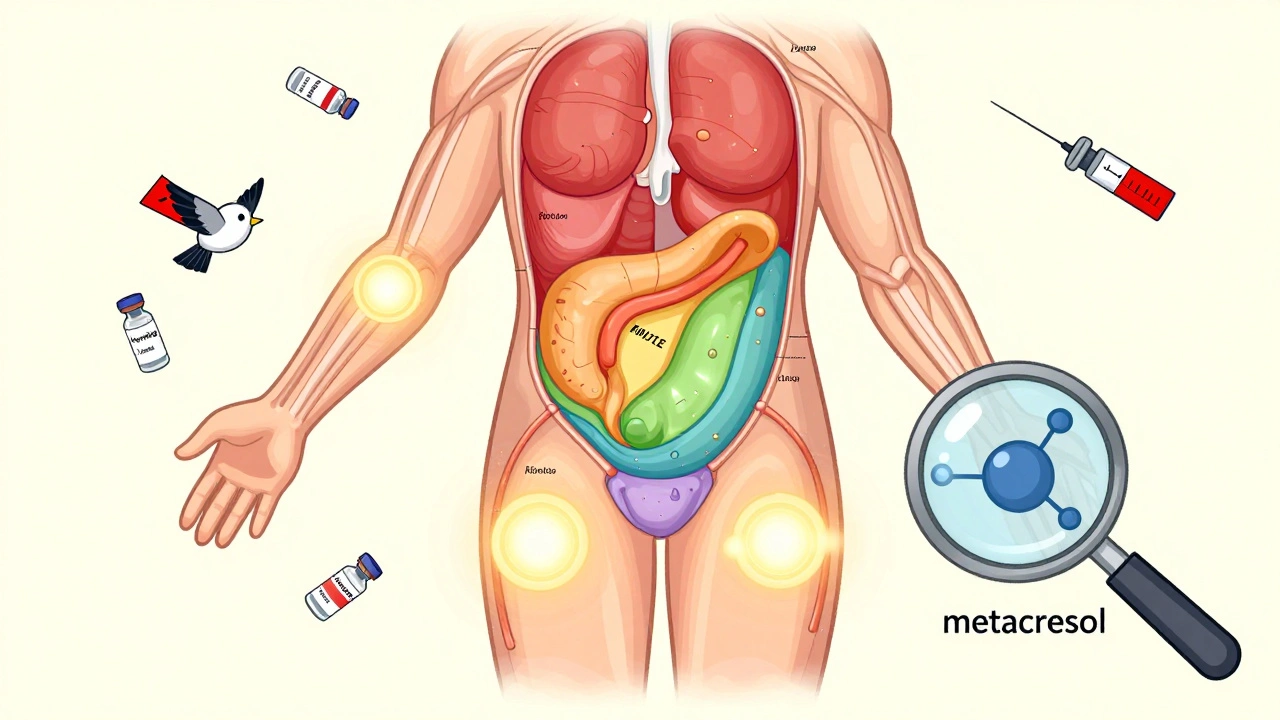
When to Call Your Doctor
You don’t need to wait for a full-blown emergency to get help. Contact your diabetes team if:- Reactions keep happening in the same spot, even after rotating injection sites
- The redness or swelling lasts longer than 48 hours
- You develop new symptoms like joint pain, fever, or unexplained bruising
- You’ve had a reaction to a new insulin brand
- You’re unsure whether what you’re feeling is an allergy or low blood sugar
What’s Changing in Insulin Allergy Care
Newer insulin analogs are being designed with fewer additives. Some now use different preservatives or none at all. That’s good news for people who react to metacresol. Continuous glucose monitors (CGMs) are also helping. They let doctors monitor your blood sugar in real time during desensitization, so they can adjust doses safely without risking dangerous lows. Research is also looking into biomarkers-measurable signals in the blood-that could predict who’s at risk for insulin allergies before they even happen. That’s still experimental, but it points to a future where allergies are caught early, not treated in crisis. For now, the message is simple: if you’re reacting to insulin, you’re not alone. You’re not broken. And you don’t have to stop treatment. With the right diagnosis and care, you can keep using insulin safely-no matter how your body responds.Can you outgrow an insulin allergy?
Unlike some childhood allergies, insulin allergies don’t typically go away on their own. Once your immune system has reacted to insulin or its additives, it remembers. But with proper management-like immunotherapy or switching insulin types-symptoms can be controlled or eliminated entirely. You won’t outgrow it, but you can manage it.
Can I use an EpiPen if I have an insulin allergy?
Yes-if you’ve had a systemic reaction before, your allergist may prescribe an epinephrine auto-injector (EpiPen) as a precaution. Use it immediately if you experience throat swelling, trouble breathing, dizziness, or a sudden drop in blood pressure after an insulin injection. Then call 911 or your local emergency number. EpiPen doesn’t replace medical care-it buys you time until help arrives.
Are all insulins the same when it comes to allergies?
No. Different insulins have different formulations, preservatives, and additives. For example, Humalog contains more metacresol than NovoLog or Lantus. Some people react to one brand but not another. Switching from animal-derived to human insulin reduced allergies dramatically in the past. Today, switching to a newer analog with fewer additives often resolves the issue.
Can insulin allergies cause long-term damage?
The allergy itself doesn’t damage organs, but ignoring it can. Repeated injections into inflamed skin can lead to lipohypertrophy-fatty lumps under the skin that absorb insulin poorly. That makes blood sugar control harder. Worse, if you stop insulin out of fear, you risk diabetic ketoacidosis, which can cause kidney failure, coma, or death. Proper treatment prevents both the allergy and its consequences.
Is insulin allergy more common in type 1 or type 2 diabetes?
It’s equally rare in both, but type 1 patients are more likely to be affected because they rely on insulin daily from an early age. Type 2 patients may use insulin less frequently or only later in life, so exposure is lower. But the risk of reaction is the same per dose. The key difference? Type 2 patients may have more treatment options if an allergy develops. Type 1 patients don’t.
Can stress or illness trigger an insulin allergy?
Stress and illness don’t cause insulin allergies, but they can make existing ones worse. When your immune system is already activated-like during an infection or after surgery-it may overreact to insulin more easily. That’s why some people notice new reactions during periods of high stress or after hospitalization. It’s not the stress causing the allergy, but it can lower your threshold for reacting.
Jean Claude de La Ronde
December 11, 2025 AT 08:38so like... insulin is just the new gluten? everyone's allergic to it now but no one can actually prove it? i mean i got a red dot after my shot and now i'm convinced i'm allergic to capitalism too. brb, going to cry into my metformin.
Jim Irish
December 13, 2025 AT 01:26Thank you for sharing this important information. Many individuals may dismiss minor reactions as routine, but awareness can prevent serious outcomes. Proper identification and medical guidance are essential.
Mia Kingsley
December 14, 2025 AT 19:52OMG I KNEW IT. I’ve been using Lantus for 8 years and every time I inject my thigh turns purple like a bruised grape and I swear my left toe tingles. I told my doctor it was ‘insulin witchcraft’ and she laughed. Turns out I’m one of the 2.1% and now I’m basically a superhero. #InsulinWarrior
Kristi Pope
December 15, 2025 AT 13:24Reading this made me feel so seen. I used to think I was just ‘bad at injections’ until I started tracking my reactions and realized it wasn’t me-it was the preservatives. Switching to a newer analog changed everything. You’re not broken. You’re just using the wrong tool. Keep going, you’ve got this.
Jimmy Kärnfeldt
December 16, 2025 AT 21:04Man, I’ve been on insulin for 15 years and never thought twice about a little red bump. Now I’m sitting here checking my injection sites like they’re crime scenes. Thanks for the heads-up-this stuff matters. Also, the immunotherapy thing? That’s wild. Feels like sci-fi but actually real. Cool.
Katherine Liu-Bevan
December 18, 2025 AT 13:08It is critical to distinguish between localized irritation and systemic allergic responses. Misinterpretation can lead to dangerous outcomes, including discontinuation of insulin therapy. Skin testing and detailed symptom logs are the gold standard for diagnosis. Always consult a board-certified allergist if symptoms persist beyond 48 hours.
Courtney Blake
December 18, 2025 AT 21:55Wow. Another ‘rare’ medical condition that somehow affects everyone on Reddit. 2.1%? That’s not rare, that’s a marketing ploy to sell more test strips. Also, why are we trusting a blog that says ‘your immune system is building a grudge’? Sounds like someone watched too much Dr. Oz.
Lisa Stringfellow
December 20, 2025 AT 07:43Ugh. Another ‘you’re not broken’ pep talk. But what if I am broken? What if I’ve been injecting into the same spot for months because I’m too tired to rotate? What if I can’t afford new insulin? This post is just guilt wrapped in glitter.
Eddie Bennett
December 20, 2025 AT 23:15My cousin had this. Went from Lantus to Humalog and boom-no more lumps. Took her six months to figure it out because everyone told her it was ‘just stress’. Glad this got written. Real talk: if your skin looks like a crime scene after a shot, don’t ignore it.
Vivian Amadi
December 22, 2025 AT 15:03Wait so you’re telling me I’ve been injecting into my belly for 10 years and now I’m supposed to rotate? That’s just extra work. I have a job. I have kids. I don’t have time to become a human injection map.
Ariel Nichole
December 24, 2025 AT 05:24Just wanted to say thanks for the detailed breakdown. I’ve been too scared to ask my doctor about my red bumps. Now I’m going to bring this in next week. You made me feel like it’s okay to care about my body.