
When standard antihistamines stop working for chronic spontaneous urticaria (CSU), the frustration is real. You’ve tried the pills. You’ve stuck to the schedule. You’ve avoided triggers. Yet the hives keep coming-itching, burning, swelling-sometimes for years. That’s not just inconvenient. It’s exhausting. And it’s more common than you think. About 60-80% of all chronic urticaria cases are CSU, and nearly 60% of those patients don’t get enough relief from first-line antihistamines. So what’s next? This isn’t about guessing. It’s about knowing which second-line treatments actually move the needle-and which ones might be better for you.
Why First-Line Treatments Often Fail
Second-generation H1 antihistamines like cetirizine, loratadine, and fexofenadine are the starting point for almost everyone with CSU. They’re safe, widely available, and work for about 40% of patients. But for the rest? The hives don’t go away. Not because they’re not trying hard enough. Not because they’re not following instructions. It’s because CSU isn’t just an allergic reaction. In up to 50% of cases, it’s driven by autoimmunity-your own immune system mistakenly attacks your skin cells, triggering mast cells to release histamine and other inflammatory chemicals. Antihistamines block histamine, but they don’t stop the root cause. That’s why escalating the dose to two or even four times the standard amount helps only a small fraction more. It’s like putting a bandage on a leaking pipe. The water keeps coming.Omalizumab: The Established Second-Line Option
For over a decade, omalizumab has been the go-to second-line treatment. It’s a monoclonal antibody that binds to free IgE in your bloodstream, preventing it from activating mast cells. That’s a direct hit to one of the main drivers of CSU. Given as a monthly subcutaneous injection, it’s administered in a doctor’s office. Clinical trials show it helps 30-70% of patients who didn’t respond to antihistamines. But here’s the catch: about 70% of those patients still don’t achieve complete control. And for people with IgG-mediated autoimmune urticaria-a subgroup that makes up at least 30% of CSU cases-omalizumab often doesn’t work at all. That’s not a failure of the drug. It’s a failure of one-size-fits-all treatment. If your body is making autoantibodies that directly activate mast cells, blocking IgE won’t fix it.Emerging Alternatives: What’s on the Horizon
The treatment landscape is changing fast. Three new options are stepping into the spotlight, each with a different mechanism and delivery method.Remibrutinib is a Bruton tyrosine kinase inhibitor (BTKi). Unlike omalizumab, it’s taken orally as a daily pill. It doesn’t just target IgE-it shuts down both mast cells and basophils, and it also reduces the production of those harmful autoantibodies. In two large phase 3 trials (REMIX-1 and REMIX-2), 28-32% of patients achieved complete symptom control after 24 weeks. That’s comparable to omalizumab, but without needles. For patients who dread monthly injections or struggle with adherence, this could be a game-changer.
Dupilumab, already approved for eczema and asthma, targets IL-4 and IL-13-key cytokines involved in type 2 inflammation. In CSU trials, it delivered a 30-31% complete response rate at week 24. It’s not yet approved for CSU, but the data is strong. It may work especially well for patients whose urticaria overlaps with other allergic conditions. If you’ve tried omalizumab and still have asthma or eczema, dupilumab could be a two-for-one solution.
Barzolvolimab is another promising candidate. In phase 2 trials, it achieved 38-51% complete response rates in just 12 weeks. That’s faster and higher than most current options. But it’s still early. Phase 3 trials are needed before it reaches patients.
Why Cyclosporine Still Has a Role
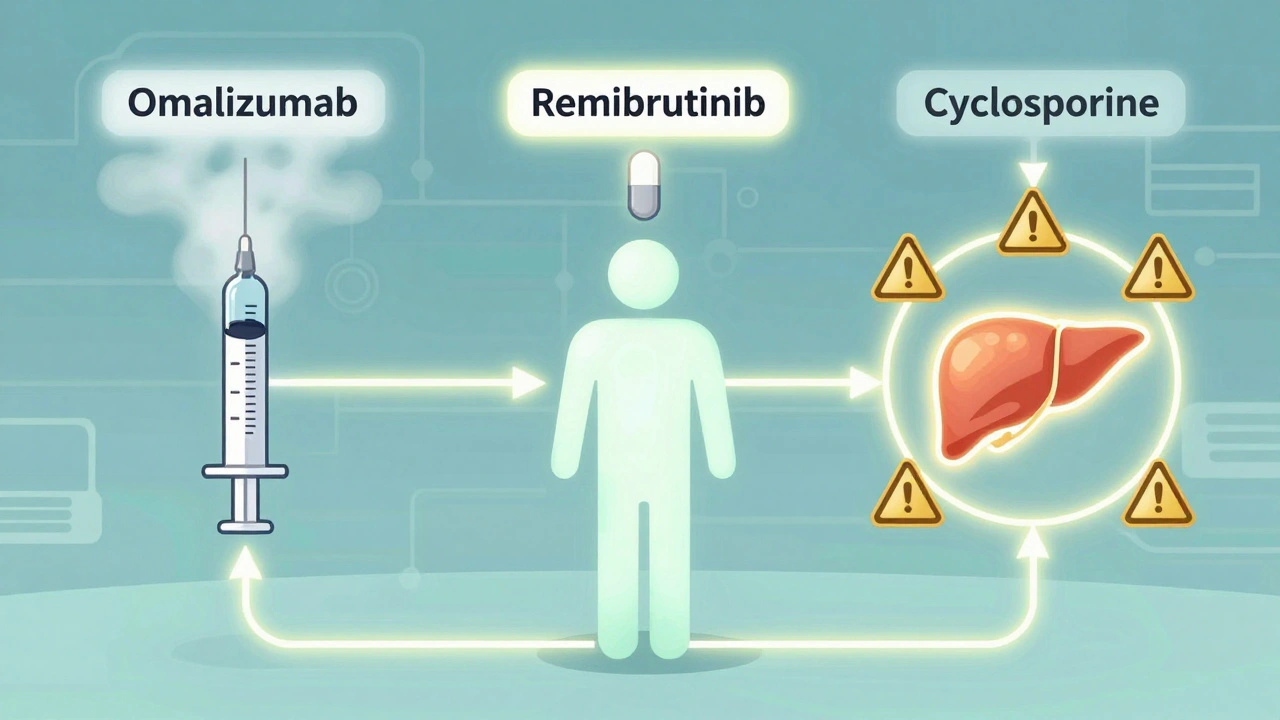
Cyclosporine isn’t new. It’s been used off-label for decades. But it’s still one of the most effective options for autoimmune CSU. In patients who don’t respond to omalizumab, cyclosporine improves symptoms in 54-73% of cases. That’s higher than most biologics. But it comes with serious trade-offs: kidney damage, high blood pressure, and increased infection risk. It’s not a long-term solution. It’s a bridge. Used for 3-6 months to get symptoms under control, then tapered off. If you’re young, otherwise healthy, and have clear signs of autoimmunity, cyclosporine might be the fastest way to get your life back. But if you’re over 50 or have existing kidney or liver issues, it’s usually off the table.What Doesn’t Work (And Why)
Not every new drug makes it to market. Fenebrutinib, another BTK inhibitor, was dropped in 2023 after some patients developed elevated liver enzymes. It wasn’t just ineffective-it was unsafe for a subset of users. That’s why the field is moving toward precision medicine. We’re learning that CSU isn’t one disease. It’s a collection of subtypes. Some are IgE-driven. Others are IgG-driven. Some involve mast cell hyperactivity. Others involve B-cell overproduction. The right treatment depends on the subtype. Right now, we can’t test for these reliably in routine practice. But we can make educated guesses. If you’ve tried omalizumab and it didn’t work, especially if you have other autoimmune conditions like thyroid disease or lupus, you’re likely in the IgG subgroup. That’s where remibrutinib or cyclosporine may be better bets.
How Doctors Decide What’s Next
There’s no single algorithm. But most specialists follow a rough path:- Start with standard-dose antihistamines for 2-4 weeks.
- If no improvement, increase dose to 2-4x standard (still under 40% effective).
- If still no relief, consider omalizumab-especially if you have no autoimmune history.
- If omalizumab fails and you have signs of autoimmunity (positive autologous serum skin test, thyroid antibodies), try cyclosporine short-term.
- If you’re looking for an oral option and want to avoid injections, ask about remibrutinib when it’s approved.
- If you have eczema or asthma too, dupilumab might be worth discussing.
It’s not about trying everything. It’s about matching the mechanism to your body’s biology. That’s why tracking your symptoms matters. Keep a log: when hives appear, how long they last, what you were doing before they started. That data helps your doctor spot patterns you might not even notice.
What’s Next for CSU Treatment
The future isn’t just better drugs-it’s smarter prescribing. Within the next 3-5 years, doctors may routinely test for autoantibodies or use blood markers to classify CSU subtypes. Imagine walking into a clinic and getting a simple blood test that tells you: “Your CSU is IgG-driven. You’ll likely respond best to a BTK inhibitor.” That’s not science fiction. It’s already happening in research centers. The goal is to stop guessing and start matching. For now, the best thing you can do is stay informed. Ask your doctor about emerging options. Don’t settle for partial relief. If you’ve been living with hives for more than six weeks, you deserve better than just masking symptoms. The tools are getting better. And you’re not alone.How long does it take for second-line treatments to work?
Most second-line treatments take weeks to show results. Omalizumab usually starts working in 4-8 weeks, with full effects seen by 12-16 weeks. Remibrutinib and dupilumab show measurable improvement around week 4, with peak results at week 12-24. Cyclosporine can work faster-sometimes within 2-4 weeks-but it’s used short-term. Don’t expect overnight results. Patience and consistency matter.
Can I switch from omalizumab to an oral drug like remibrutinib?
Yes, if omalizumab didn’t work well enough for you. Many patients who respond poorly to omalizumab-especially those with autoimmune features-do better on oral BTK inhibitors like remibrutinib. Your doctor will likely monitor you closely during the transition, especially if you’re switching from a biologic to a small molecule drug. There’s no washout period needed, but timing depends on your individual response and safety profile.
Are these treatments covered by insurance?
Omalizumab is FDA-approved for CSU and is usually covered, though prior authorization is often required. Cyclosporine is generic and affordable, but insurance may limit dose or duration. Remibrutinib and dupilumab aren’t yet approved for CSU as of 2025, so coverage is unlikely unless part of a clinical trial. Check with your insurer and ask your doctor about patient assistance programs.
Do I need to stop antihistamines before starting a second-line treatment?
No. Most patients continue taking antihistamines while starting omalizumab, remibrutinib, or dupilumab. In fact, guidelines suggest keeping them on board-they can help manage breakthrough symptoms. Stopping them abruptly can make symptoms worse. Your doctor will decide if and when to taper them based on your response.
What if nothing works?
You’re not out of options. Clinical trials for new drugs like barzolvolimab and other BTK inhibitors are ongoing. Many academic centers offer access to these before they’re widely available. Also, some patients benefit from combination therapies-like low-dose cyclosporine with an antihistamine-or non-drug approaches like stress management and dietary tracking. Work with a specialist in autoimmune skin conditions. You’re not alone, and new treatments are coming faster than ever.
Ruth Witte
December 8, 2025 AT 06:21OMG I’ve been living this for 3 years 😭 Just got on remibrutinib last month and my hives are GONE. No more midnight scratching sessions. I’m crying happy tears. Someone please tell my dermatologist I told you so. 🙌
Katherine Rodgers
December 8, 2025 AT 20:46so omalizumab is just a fancy bandaid for people who dont wanna take the pill? lmao. they charge 20k a year for that? i could buy a whole year supply of cyclosporine and a nice massage chair with that money. 🤡
Lauren Dare
December 9, 2025 AT 05:30Let’s be clear: the term ‘second-line’ is a euphemism for ‘we gave up on you.’ The fact that we’re still using cyclosporine as a bridge-despite its nephrotoxicity-is a systemic failure of pharmaceutical innovation. The biologics are expensive, yes, but the real cost is the 5-year delay in targeted therapy development. We’re treating symptoms, not mechanisms. And until we classify subtypes via biomarkers, we’re just guessing in the dark. With receipts.
Gilbert Lacasandile
December 9, 2025 AT 20:04I really appreciate how thorough this is. I’ve been on omalizumab for a year and it helped a little, but not enough. I’m going to ask my doc about remibrutinib next visit. I’ve been avoiding injections since I got a phobia after my last flu shot. 😅
Michael Robinson
December 11, 2025 AT 08:47It’s funny. We spend billions on drugs that block histamine, but no one asks why the body is screaming in the first place. Maybe the skin isn’t the problem. Maybe it’s the gut. Or the stress. Or the air. We treat the symptom like it’s the enemy. But what if the body’s just trying to tell us something?
Suzanne Johnston
December 12, 2025 AT 03:11For anyone reading this and feeling hopeless: you’re not broken. Your immune system isn’t defective-it’s confused. And we’re finally learning how to unconfuse it. The science here is real. Remibrutinib, dupilumab, even cyclosporine-it’s not magic. It’s medicine catching up to biology. Keep pushing. Keep asking. Your life matters more than a 6-week wait for relief.
Graham Abbas
December 13, 2025 AT 19:05I swear to god, if I see one more ‘clinical trial shows X% improvement’ headline, I’m going to scream. I’ve been on 7 different meds. 7. I’ve cried in dermatology waiting rooms. I’ve missed weddings. I’ve worn long sleeves in July. And now you’re telling me remibrutinib might work? I’m not hopeful. I’m just… tired. But I’ll try it. Because what else is there?
Haley P Law
December 14, 2025 AT 08:49Okay so I tried omalizumab and it made me feel like a zombie and my hives got worse?? like what?? I switched to cyclosporine and now I’m basically a human kidney machine?? I just want to wear a tank top again. #CSUwarrior #hivesdontcareaboutyourfashion
Steve Sullivan
December 15, 2025 AT 13:13you know what’s wild? nobody talks about how much this messes with your mental health. i stopped dating. i stopped going out. i started wearing black turtlenecks in july. and when i finally got on omalizumab, my therapist said ‘you’re not the same person.’ she was right. we don’t talk about the trauma of chronic itching. we just hand out pills. and now we’re gonna hand out more pills? maybe we need therapy too. not just btk inhibitors.
Chris Marel
December 16, 2025 AT 03:01This is so helpful. I’m from Nigeria and we don’t have access to most of these drugs. My doctor just told me to take antihistamines and avoid stress. But stress is my job. And the hives come every Monday. I wish I could try remibrutinib. Maybe one day.
Evelyn Pastrana
December 17, 2025 AT 17:36lol i tried dupilumab because i had eczema and thought ‘eh why not’ and boom-my hives vanished. like, i didn’t even tell my derm i had urticaria. she was like ‘what? oh wow.’ so if you got eczema or asthma AND hives? ask for dupilumab. it’s basically a two birds, one stone situation. 🤷♀️
Elliot Barrett
December 19, 2025 AT 16:01Why are we even talking about this? Just take Benadryl. Done. Problem solved. Why do you need a PhD to manage a rash?
Shubham Mathur
December 21, 2025 AT 06:52remibrutinib is the future but dont forget cyclosporine is still the most effective if you can handle the side effects i was on it for 4 months and my hives vanished like magic but my bp went through the roof and i had to stop but i would do it again if i had to
Rich Paul
December 22, 2025 AT 20:32so remibrutinib is just a btk inhibitor? like the one they use for leukemia? so we’re basically chemo-ing our skin now? cool. and dupilumab is for asthma? so my hives are just allergic asthma on my skin? mind blown. also omalizumab is just xolair right? why do they make it sound like a spaceship?
Kathy Haverly
December 23, 2025 AT 20:05Wow. Another feel-good article about how ‘the future is bright’ while real people are still scratching their skin off. You know what doesn’t work? Hope. And you know what’s worse? People who think telling you ‘you’re not alone’ fixes anything. I’ve been told that 12 times. I’m not alone. I’m just tired. And you’re still selling me hope instead of a cure.